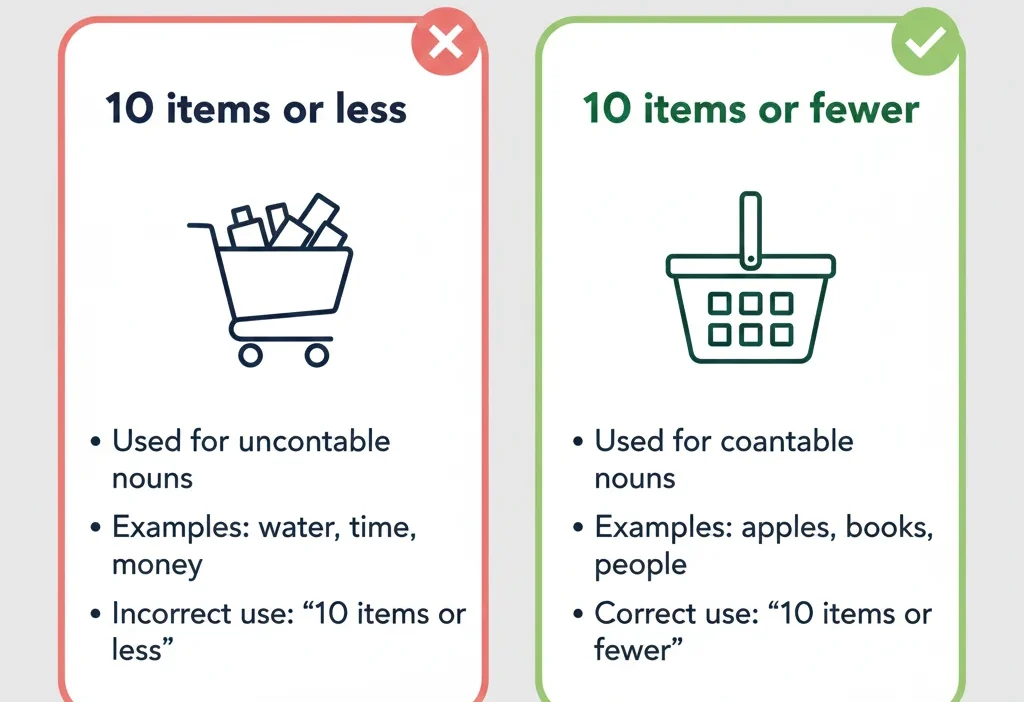
👉 “10 items or fewer” is grammatically correct.
👉 “10 items or less” is very common in everyday speech, but it is not correct by traditional grammar rules.
This guide will explain why, in the simplest way possible, with clear examples anyone can understand — even a class 4 student.
Have you ever stood in a grocery store line and seen a sign that says “10 items or less”?
If yes, you are not alone. Millions of people see and use this phrase every day. But here’s the surprise: it is technically wrong according to English grammar rules.
The correct phrase is “10 items or fewer.”
So why do people still say “10 items or less”? Why does it sound right? And when should you use less or fewer?
In this easy guide, you will learn:
- The meaning of 10 items or less and 10 items or fewer
- The key difference between less and fewer
- Simple rules with real-life examples
- Common mistakes and how to avoid them
- Memory tricks to never get confused again
By the end, you’ll know exactly which phrase to use and why.
What Does Each Phrase Mean?
Let’s break both phrases down very simply.
What Does “10 Items or Less” Mean?
- Less is usually used for things you cannot count.
- It talks about amount, not number.
Examples of things you cannot count:
- Water
- Sugar
- Time
- Money (as a total amount)
Examples:
- I have less water today.
- She needs less time to finish.
- Add less sugar to the tea.
👉 Problem: Items CAN be counted, so “less” does not fit here grammatically.
What Does “10 Items or Fewer” Mean?
- Fewer is used for things you can count.
- It talks about number, not amount.
Examples of countable things:
- Apples
- Books
- Pens
- Items
Examples:
- I have fewer books than you.
- She made fewer mistakes.
- Choose 10 items or fewer.
👉 Since items are countable, fewer is the correct word.
The Key Difference Between 10 Items or Less and 10 Items or Fewer
Simple Rule (Very Important ⭐)
- Count it? → Use FEWER
- Can’t count it? → Use LESS
Comparison Table
| Feature | 10 Items or Less | 10 Items or Fewer |
|---|---|---|
| Grammar correctness | ❌ Informal | ✅ Correct |
| Used for | Uncountable things | Countable things |
| Grammar rule | Breaks the rule | Follows the rule |
| Common usage | Very common in stores | Correct in writing |
| Example | ❌ 10 items or less | ✅ 10 items or fewer |
Quick Tip to Remember
👉 If you can count it using numbers (1, 2, 3…), use FEWER.
Common Mistakes and How to Avoid Them
Let’s look at mistakes people make every day.
❌ Mistake 1
“I have less books than you.”
✅ Correct: “I have fewer books than you.”
Why it’s wrong: Books can be counted.
❌ Mistake 2
“10 items or less” (on signs)
✅ Correct: “10 items or fewer”
Why it happens: The wrong phrase sounds normal because people hear it often.
❌ Mistake 3
“She made less mistakes.”
✅ Correct: “She made fewer mistakes.”
Fix: Ask yourself, Can I count it?
When to Use LESS
Use less when talking about uncountable things.
Situations Where LESS Is Correct
- Liquids
- Time
- Money (as a whole)
- Air, sand, sugar, rice
Easy Examples
- I need less water today.
- We have less time left.
- He spends less money now.
- Add less salt to the food.
- There is less noise outside.
🧠 Memory Hack:
If you can’t count it one by one, LESS is best.
When to Use FEWER
Use fewer when talking about things you can count.
Situations Where FEWER Is Correct
- Items
- People
- Books
- Cars
- Mistakes
Easy Examples
- I bought fewer apples today.
- She has fewer toys now.
- There are fewer students in class.
- Choose 10 items or fewer.
- He made fewer errors in the test.
🧠 Visual Trick:
Imagine counting on your fingers → FEWER.
Why Do Stores Still Say “10 Items or Less”?
Good question!
- “10 items or less” sounds shorter and smoother
- People are used to hearing it
- Spoken English often ignores strict grammar rules
👉 In casual conversation, people accept it.
👉 In writing, exams, or professional English, “10 items or fewer” is correct.
Quick Recap: 10 Items or Less vs 10 Items or Fewer
- Items are countable → use fewer
- 10 items or fewer = ✅ correct
- 10 items or less = ❌ informal
- Less = uncountable
- Fewer = countable
Advanced Tips (For Curious Learners)
Word History (Simple Version)
- Less comes from Old English and meant “not as much”
- Fewer was created to show number difference
In Exams & Formal Writing
- Always use fewer with countable nouns
- Teachers and examiners expect this rule
Texting & Social Media
- People often break rules online
- Meaning stays clear, but grammar suffers
Mini Quiz: Test Yourself 🎯
Fill in the blanks:
- I have ______ time today.
- She bought ______ books this week.
- Choose 10 items or ______.
- There is ______ milk in the fridge.
- He made ______ mistakes this time.
Answers:
- less
- fewer
- fewer
- less
- fewer
FAQs
1. Is “10 items or less” wrong?
Grammatically, yes. The correct phrase is 10 items or fewer.
2. Why does “10 items or less” sound right?
Because it is commonly used in daily speech.
3. Can I use “less” for people?
No. People are countable, so use fewer.
4. Which phrase should I use in exams?
Always use 10 items or fewer.
5. Does this rule really matter?
Yes, especially in writing, tests, and professional English.
Conclusion
Now you know the truth behind 10 items or less vs 10 items or fewer.
The rule is simple: if you can count it, use fewer. Items can be counted, so “10 items or fewer” is the correct choice.
While “10 items or less” is common in speech, correct grammar helps you write better, score higher in exams, and sound more confident in English.

Francis Sufford crafts thoughtful, insightful explanations on language, meaning, and usage, blending clarity with storytelling to guide readers effectively.