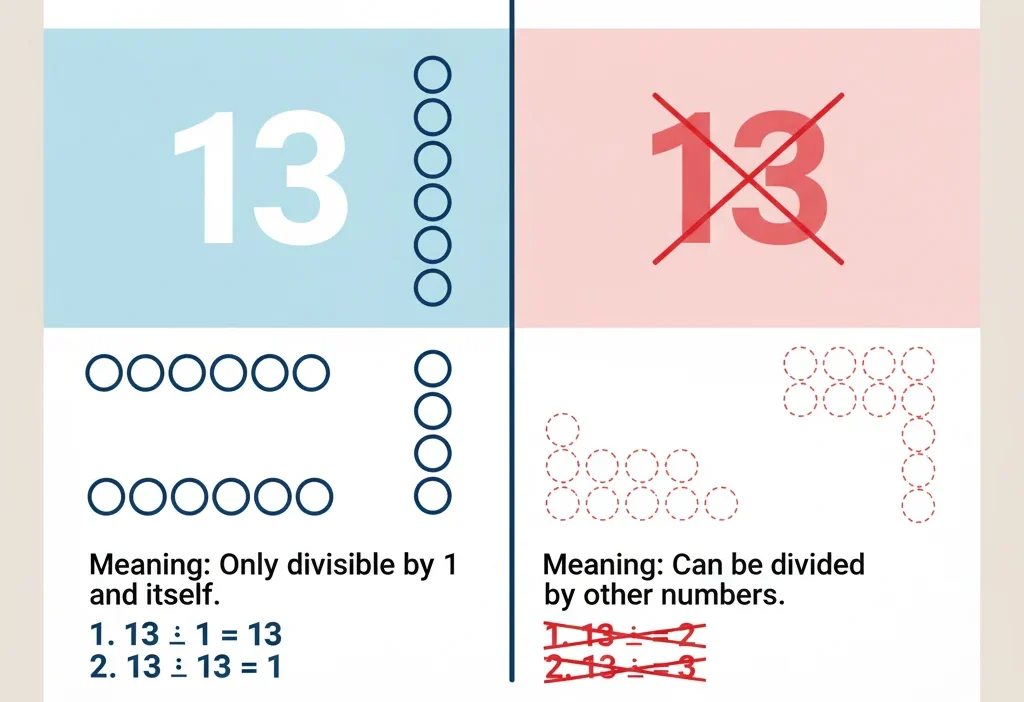
It can only be divided evenly by 1 and 13, which means it has exactly two factors — the rule that makes any number prime.
Have you ever looked at a number and wondered, “Is this prime or composite?” You’re not alone! Many students and even adults get confused when trying to understand whether a number like 13 is prime or composite. Numbers may look simple, but the logic behind them can feel tricky — until it’s explained clearly.
In this friendly guide, you’ll learn the meaning of prime, meaning of composite, the difference between prime and composite, and exactly why 13 is prime. We’ll also break everything down using simple examples, easy tables, real-life stories, and memory hacks.
By the end, even a 4th-grade student will confidently understand the topic.
Let’s make prime and composite numbers super easy!
What Does “Prime” Mean? (Simple Definition + Examples)
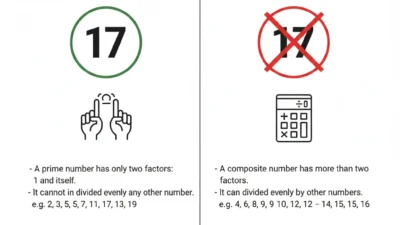
A prime number is any whole number greater than 1 that has exactly two factors:
- 1
- Itself
That’s it — no other number divides it evenly.
Easy Examples of Prime Numbers
- 2 → factors: 1 and 2
- 5 → factors: 1 and 5
- 13 → factors: 1 and 13
You can think of prime numbers like “VIP numbers” — they don’t like sharing and don’t let many numbers divide them.
What Does “Composite” Mean? (Simple Definition + Examples)
A composite number is any whole number greater than 1 that has more than two factors.
It lets many numbers divide it.
Easy Examples of Composite Numbers
- 4 → factors: 1, 2, 4
- 6 → factors: 1, 2, 3, 6
- 15 → factors: 1, 3, 5, 15
Think of composite numbers like “friendly numbers” — they allow many numbers to divide them.
The Key Difference Between Prime and Composite (Especially for 13)
Here is the simple reason why 13 is a prime number:
✔ 13 has only two factors: 1 and 13
✖ 13 cannot be divided evenly by any number like 2, 3, 4, 5, 6…
Below is a super-easy comparison table:
Comparison Table: 13 Prime or Composite
| Feature | Prime Number | Composite Number |
|---|---|---|
| Meaning | Has exactly 2 factors | Has more than 2 factors |
| Divisible by | Only 1 and itself | Many numbers |
| Example | 13 → 1, 13 | 12 → 1, 2, 3, 4, 6, 12 |
| Can 13 be here? | YES | NO |
| Quick Tip | “Prime = Private” | “Composite = Company” |
Quick Memory Tip
👉 If a number cannot be divided evenly by any number between 2 and itself (minus 1), then it is prime.
Common Mistakes and How to Avoid Them
❌ Mistake 1: Thinking 13 is composite because it is odd
Correct: Being odd does not make a number composite or prime.
Example: 9 is odd but composite; 13 is odd but prime.
❌ Mistake 2: Assuming all big numbers are composite
Correct: Size doesn’t matter.
Even large numbers can be prime (like 101).
❌ Mistake 3: Confusing “factors” with “multiples”
Correct:
- Factors go into a number.
- Multiples go out of a number.
Understanding this helps you correctly identify 13 as prime.
When to Call a Number “Prime” (Easy Rules + Examples)
A number is prime when:
✔ It has exactly two factors
✔ It cannot be divided by 2, 3, 4, 5… without leaving a remainder
✔ It is greater than 1
Easy Example Sentences
- 13 is a prime number because it has only two factors.
- 7 is a prime number that cannot be divided by 2 or 3.
- Students learn that prime numbers are important in math.
- A prime number cannot be broken into smaller factor pairs.
Real-Life Use
When cracking computer codes or encrypting data, prime numbers (like 13) are often used.
When to Call a Number “Composite” (Simple Rules + Examples)
A number is composite when:
✔ It has more than two factors
✔ It can be divided evenly by numbers other than 1 and itself
Easy Example Sentences
- 12 is composite because many numbers divide it.
- 8 is composite with factors 1, 2, 4, 8.
- Every composite number has small factors.
- Students can test numbers to see if they are composite or prime.
- A composite number has at least one factor that is not 1 or itself.
Memory Hack
👉 Think of composite as “company” — it has many factors around it.
Quick Recap: Prime vs Composite
- Prime = 2 factors
- Composite = more than 2 factors
- 13 = Prime
- Prime = private, Composite = company
- If only 1 and itself divide the number → Prime
- If many numbers divide it → Composite
Advanced Tips (Optional but Helpful)
1. Origin of the Words
- Prime comes from a Latin word meaning “first or chief.”
- Composite comes from “componere,” meaning “to put together.”
So prime = simple, composite = made of many parts.
2. Use in Exams or Formal Writing
Teachers often ask:
“Is 13 prime or composite? Explain why.”
A perfect answer:
“13 is prime because it has exactly two factors, 1 and 13.”
3. Online or Texting Mistakes
Some students write:
“13 composite?” or “13 prime?” without checking.
Always use the factor rule: two factors = prime.
Mini Quiz (Test Yourself!)
Fill in the blanks:
- A number with only two factors is called ________.
- 13 is a ______ number.
- A number with many factors is called ________.
- 12 is a ________ number because it has many factors.
- Prime numbers cannot be divided evenly by any number except 1 and ______.
(Answers: prime, prime, composite, composite, itself)
Conclusion
Understanding whether 13 is prime or composite becomes super easy when you know the factor rule. Prime numbers have only two factors, while composite numbers have more than two. With simple examples, memory tricks, and real-life explanations, anyone — even a young student — can confidently tell the difference.
Now you know that 13 is a prime number, and you also understand how to check any other number quickly. Keep practicing with more numbers to build strong math skills. Every time you test a number, you get better and faster.
Keep learning, keep growing, and enjoy mastering mathematics!
FAQs
1. Is 13 a prime number or composite number?
13 is a prime number because it has only two factors: 1 and 13.
2. How do I quickly check if a number is prime?
Try dividing it by 2, 3, 4, 5… If nothing divides evenly, it’s prime.
3. Why is 1 not a prime number?
Because prime numbers must have two factors.
1 has only one factor.
4. What is the main difference between prime and composite numbers?
Prime numbers have exactly two factors; composite numbers have more than two.
5. Can even numbers be prime?
Only one even number is prime → 2.
All other even numbers are composite.

Polly Clark creates clear, insightful guides on language and usage, helping readers understand meanings, differences, and nuances with clarity and confidence.