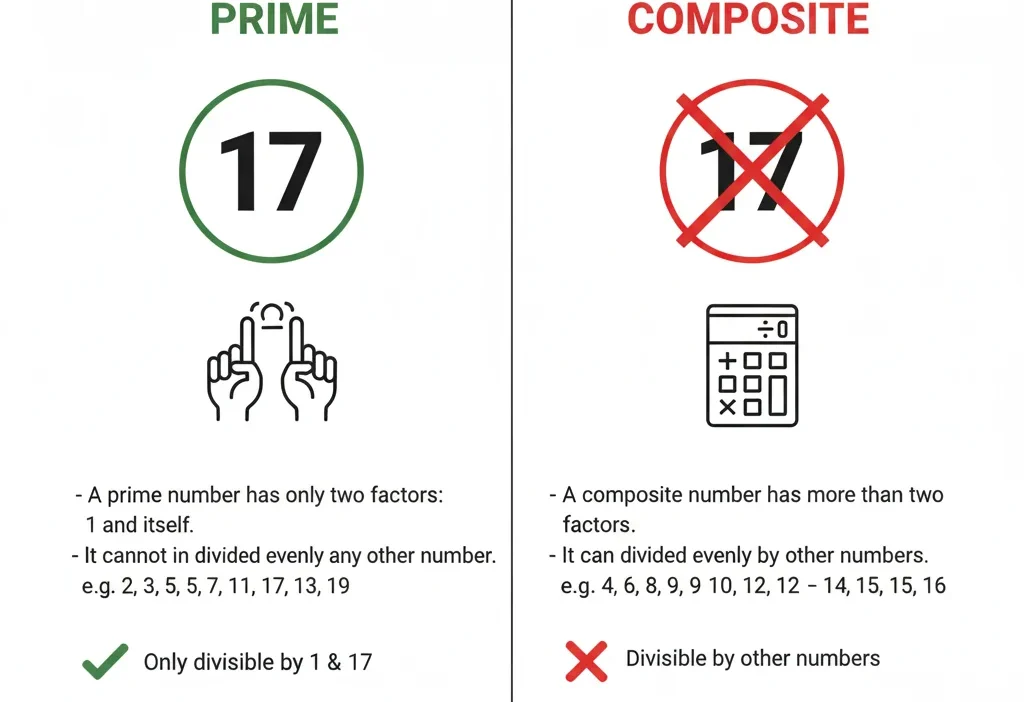
The number 17 is a prime number because it has only two factors: 1 and 17.
It cannot be divided evenly by any other number.
Have you ever looked at a number and wondered, “Is this prime or composite?” Many students—and even adults—confuse these two math terms. One of the most commonly searched questions is “17 prime or composite?” because 17 looks simple, but people still mix it up.
In this friendly guide, you’ll learn exactly what prime and composite numbers mean, why 17 is prime, and how to check any number quickly—even if you’re in class 4. We’ll use easy examples, real-life situations, simple stories, and a clear comparison table to make everything unforgettable.
By the end, you’ll be able to confidently explain the difference between prime and composite numbers, avoid common mistakes, and even take a quick quiz to test what you learned.
What Does Each Word Mean?
What Is a Prime Number?
A prime number is a number that has only two factors:
- 1
- The number itself
That’s it. No other number can divide it evenly.
Easy Examples of Prime Numbers
- 2 → factors: 1, 2
- 11 → factors: 1, 11
- 17 → factors: 1, 17
Mini Story to Remember
Think of a prime number as a special VIP guest at a party. Only two people are allowed to talk to it: 1 and itself. No one else can enter.
What Is a Composite Number?
A composite number has more than two factors.
This means many numbers can divide it evenly.
Easy Examples of Composite Numbers
- 4 → factors: 1, 2, 4
- 12 → factors: 1, 2, 3, 4, 6, 12
- 21 → factors: 1, 3, 7, 21
Short Story
Imagine a composite number as a celebrity with a big crowd. Many numbers can divide it, so it has many guests.
The Key Difference Between Prime and Composite Numbers
Prime numbers have only two factors.
Composite numbers have three or more factors.
Since 17 has only two factors (1 and 17), it is a prime number.
Comparison Table: Prime vs Composite (Using 17 as Example)
| Feature | Prime Number | Composite Number |
|---|---|---|
| Number of factors | Exactly 2 | Three or more |
| Example | 17 → (1, 17) | 12 → (1, 2, 3, 4, 6, 12) |
| Can it be divided by numbers other than 1 and itself? | No | Yes |
| Simple memory | “Private guest list” | “Crowd of guests” |
Quick Tip to Remember
If a number has only two factors, it is prime.
If it has three or more factors, it is composite.
So, 17 is prime.
Common Mistakes and How to Avoid Them
❌ Mistake 1: Thinking 17 is composite because it’s not even
Many students think:
“If it’s not even, it must be composite.”
This is wrong.
Odd numbers can also be prime!
Examples: 3, 5, 7, 11, 13, 17, 19…
❌ Mistake 2: Forgetting to check small divisors
Students often forget to test:
- 2
- 3
- 5
- 7
When you check these for 17, none of them divide evenly.
❌ Mistake 3: Assuming big numbers can’t be prime
Some students think only small numbers are prime.
But large numbers can also be prime.
When to Use “Prime” (Meaning and Examples)
Use prime when you are talking about a number that has only two factors.
Easy Example Sentences
- 17 is a prime number because only 1 and 17 divide it.
- Students learned how to find prime numbers in math class.
- The teacher gave a list of prime numbers to memorize.
- Prime numbers help in advanced math like encryption.
- Counting prime numbers can be fun with games.
When to Use “Composite” (Meaning and Examples)
Use composite when a number has more than two factors.
Easy Example Sentences
- 12 is a composite number with many factors.
- Composite numbers can be broken into smaller parts.
- The class made a chart of all composite numbers under 50.
- Knowing composite numbers helps in finding factors.
- Not every big number is composite.
Memory Hack
👉 Prime = Private (only 2 guests)
👉 Composite = Crowd (many guests)
Quick Recap: Prime vs Composite (Using 17)
- Prime numbers have exactly two factors.
- Composite numbers have more than two factors.
- 17 has only two factors → it is prime.
- Prime = special number with a private guest list.
- Composite = many visitors (many factors).
Advanced Tips (For Higher Grades)
1. Origin of the Words
- Prime comes from Latin meaning first or important.
- Composite means made of many parts.
2. In Exams
Questions like “Is 17 prime or composite?” appear commonly in:
- math tests
- entrance exams
- competitive exams
- school worksheets
3. In Real Life
Prime numbers are used in:
- coding
- internet security
- patterns
- music
- puzzles
4. Online Writing Mistake
Some students write:
“17 is composite number.”
But the correct form is:
“17 is a composite number.”
Mini Quiz (Test Yourself!)
Fill in the blanks:
- 17 has only ______ factors.
- A prime number has ______ factors.
- A composite number has ______ or more factors.
- 12 is a ______ number.
- 17 is a ______ number.
- Prime numbers have a ______ guest list.
- Composite numbers have a big ______.
Conclusion
Now you clearly understand the meaning of prime and composite, the difference between them, and why 17 is a prime number. You also learned how to check any number quickly, avoid common mistakes, and use these words correctly in everyday math.
Keep practicing with other numbers, make your own list, and challenge yourself to find patterns. The more you practice, the easier math becomes. You can do it!
FAQ
1. Is 17 a prime number or composite number?
17 is a prime number because it has only two factors: 1 and 17.
2. How do you know if 17 is prime?
Try dividing 17 by smaller numbers (2, 3, 5, 7). None divide evenly, so 17 is prime.
3. What is the difference between prime and composite numbers?
Prime numbers have two factors. Composite numbers have three or more.
4. Can an odd number be composite?
Yes! Numbers like 9, 15, and 21 are odd but composite.
5. What are the factors of 17?
The only factors of 17 are 1 and 17.

Jenn Ashworth offers clear, engaging explanations of language and usage, helping readers grasp meanings, nuances, and differences with accuracy and ease.