Have you ever stopped while writing and wondered:
“Should I write aid or aide?”
Don’t worry — many people confuse these two English words because they look almost the same and sound nearly identical. Just one small letter changes the entire meaning, which leads to mistakes in essays, emails, or even professional reports.
In this simple guide, we will:
- Explain what each word means (with simple definitions)
- Show the clear difference between aid and aide
- Teach you when to use each word with easy examples
- Give you a quick memory trick to never forget the correct word again
Even if you are a beginner or a 4th-grade student, you will understand everything by the end of this article.
Let’s begin!
What Does Each Word Mean? (Simple Definitions)
✅ Word 1: Aid
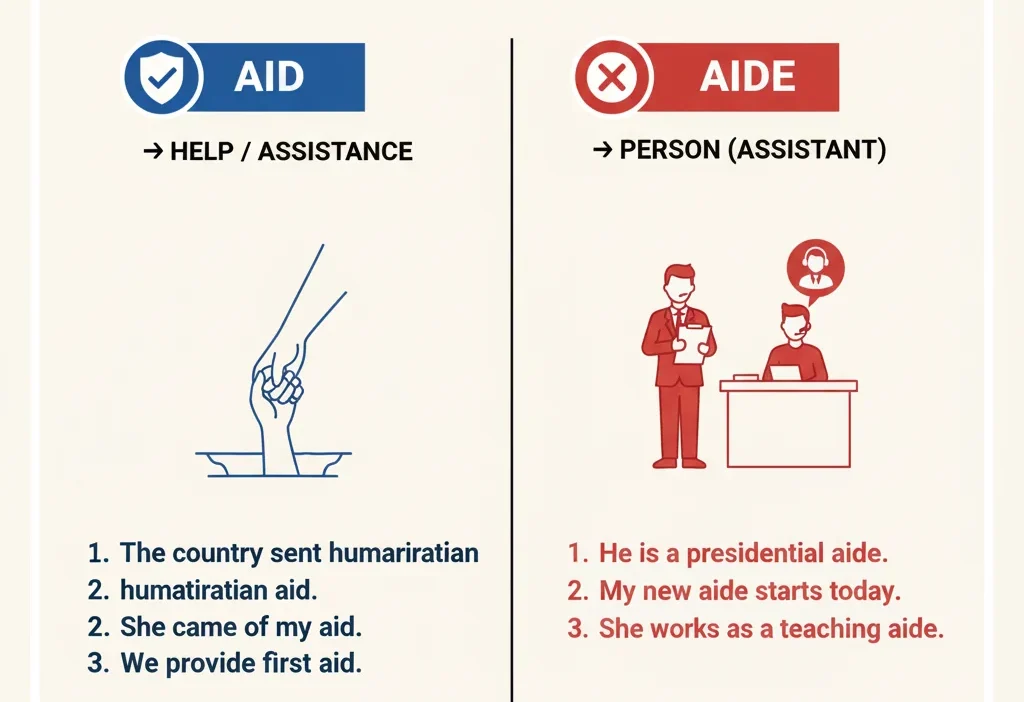
Aid means help, support, or assistance.
- Part of Speech: Verb and Noun
- Meaning: To help (verb) OR something that helps (noun)
Examples of “aid” in sentences (easy):
| Part of Speech | Example Sentence |
|---|---|
| Verb (action) | The teacher aided the student with homework. |
| Noun (thing) | The charity gives aid to poor families. |
| Noun (thing) | A calculator is a useful aid in math class. |
✔️ Think of “aid” as HELP.
✅ Word 2: Aide
Aide means a person whose job is to help someone (a helper).
- Part of Speech: Noun
- Meaning: A person who gives help or support to someone important
Examples of “aide” in sentences (easy):
| Part of Speech | Example Sentence |
|---|---|
| Noun | The doctor’s aide helped prepare the room. |
| Noun | She works as an aide to the school principal. |
| Noun | The president arrived with his personal aide. |
✔️ Think of “aide” as HELPER (a person).
✅ The Key Difference Between Aid and Aide
| Feature | Aid | Aide |
|---|---|---|
| Meaning | Help or support | A person who helps someone |
| Part of Speech | Verb or noun | Noun only |
| Memory Trick | AID = HELP | AIDE = PERSON |
| Example | The group sent aid to flood victims. | The nurse’s aide gave me the medicine. |
⭐ Quick Memory Tip:
Aid = Help (object/action)
Aide = Helper (person)
Just remember:
➡ “Aide” has an extra “e”, and that “e” can remind you of “Employee” or “Person“.
✅ Common Mistakes and How to Avoid Them
❌ Incorrect: The government sent aide to the country.
✅ Correct: The government sent aid to the country.
👉 Here, “help” was sent, not a person.
❌ Incorrect: She worked as an aid to the manager.
✅ Correct: She worked as an aide to the manager.
👉 Here, she is the helper, so use aide.
❌ Incorrect: Can someone aid me with this project? (Correct usage shown below)
✅ Correct: Can someone aid me with this project?
👉 Here, “aid” is used as a verb meaning “help”.
✅ When to Use Aid (with examples)
Use aid when you mean help or support (not a person).
Use “aid” when:
- Giving help (verb)
- Receiving help (noun)
- Talking about objects that help (visual aids, study aids, etc.)
Example sentences:
- The medicine will aid your recovery.
- The charity provides food aid to the alternative.
- Maps can be useful aids during travel.
- Technology aids students in learning faster.
- The volunteers gave aid after the earthquake.
⭐ Memory Hack:
Aid = Help (Verb or Thing)
✅ When to Use Aide (with examples)
Use aide when referring to a person whose job is to help someone.
Use “aide” when:
- Talking about an assistant
- Referring to someone working under a leader
- Mentioning helpers in medical or political roles
Example sentences:
- The teacher’s aide helped organize the class.
- His personal aide scheduled his meetings.
- The president spoke to reporters with his aide beside him.
- The nurse’s aide brought the wheelchair.
- She wants to become a medical aide after training.
⭐ Memory Hack:
Aide = Helper (Person)
The extra “E” = “Employee”
✅ Quick Recap: Aid vs. Aide
- Aid = help (can be a verb or noun)
- Aide = person who helps (noun only)
🔹 Aid = help
🔹 Aide = helper (person)
Easy, right? 😊
✅ Advanced Tips (for essays, reports, or professional writing)
- In formal writing, using the correct word shows accuracy.
- In news articles or government reports, “aid” usually refers to financial or emergency help.
Example:
“Foreign aid was approved by the government.”
- In medical or political settings, “aide” is common:
Example:
“A presidential aide prepared the speech.”
🧠 Mini Quiz — Test Yourself!
Fill in the blanks with aid or aide:
- A nurse’s ________ brought me water.
- The country received financial ________ after the flood.
- Can you ________ me with this project?
- The principal’s ________ arranged the meeting.
- This chart is a useful study ________.
Answers:
- aide
- aid
- aid
- aide
- aid
✅ 5 Frequently Asked Questions (FAQs)
Q1: Is “aid” a verb or noun?
➡ It is both. As a noun (help), as a verb (to help).
Q2: Does “aide” always refer to a person?
➡ Yes. “Aide” is only used for a person who helps.
Q3: Can I use “aid” instead of “help”?
➡ Yes. “Aid” is a more formal word for “help.”
Q4: Why does “aide” have an extra “e”?
➡ The extra “e” reminds you of “employee” — it means a person.
Q5: Which one should I use in “financial ___”?
➡ Aid — because money is a type of help, not a person.
Conclusion
Understanding aid vs. aide is very simple once you remember:
- Aid = help (action or thing)
- Aide = helper (person)
Whenever you write and get confused, just ask yourself:
“Am I talking about help… or a helper?”
Using the correct word will make your writing clearer, more professional, and easier to understand.
Keep practicing — small grammar wins lead to big confidence.
You’re improving every day! ✨

Polly Clark creates clear, insightful guides on language and usage, helping readers understand meanings, differences, and nuances with clarity and confidence.