English can be tricky — especially when two words look and sound almost the same! One common confusion is between “aide” and “aid.”
People often wonder: Is there really a difference? Yes! While both relate to help or assistance, they are used in slightly different ways.
In this simple guide, you’ll learn the difference between “aide” and “aid”, their meanings, correct usage, and easy examples you can remember forever. Whether you’re writing an essay, email, or social media post, this lesson will help you use both words confidently — even if you’re just starting to learn English.
🧠 What Does Each Word Mean?
Let’s start by understanding each word clearly and simply.
1. Aide – (noun)
Meaning:
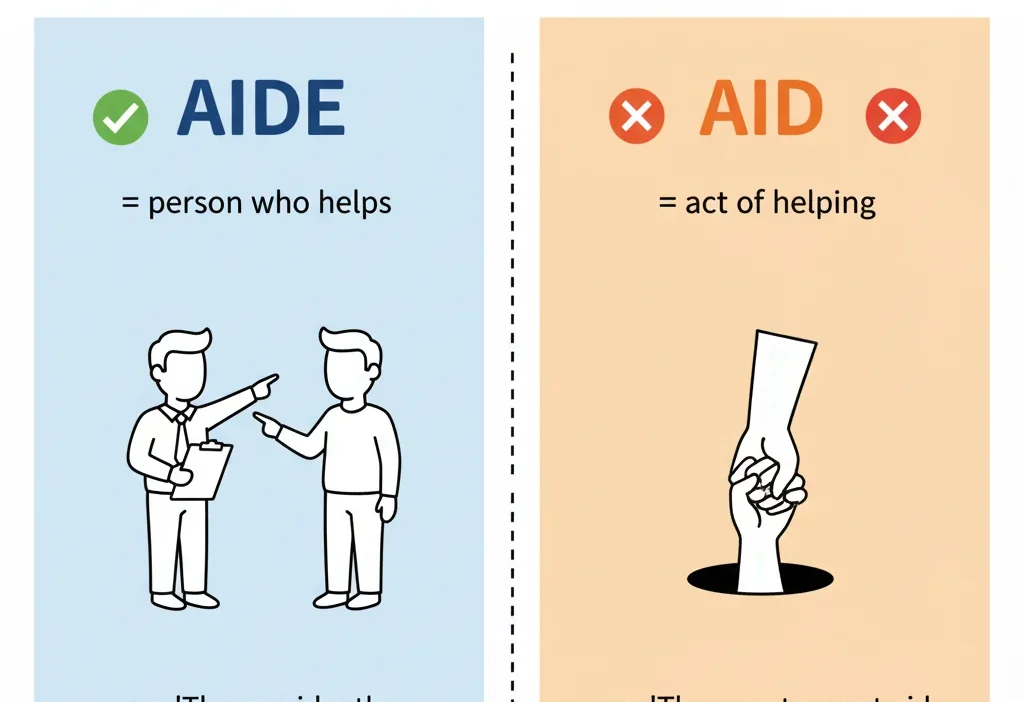
An aide is a person who helps or assists someone, especially in an official or professional setting.
Part of Speech: Noun
In Simple Words:
An aide = a helper or assistant (a person).
✅ Examples:
- The teacher’s aide helped students with their homework.
- The president’s aide arranged the meeting.
- My aunt works as a nurse’s aide at the hospital.
👉 Quick Memory Tip:
If you’re talking about a person, use aide (with an “e” at the end for employee or helper).
2. Aid – (noun/verb)
Meaning:
The word aid means help or assistance, or to give help.
Part of Speech:
- As a noun, it means help or support.
- As a verb, it means to help or assist someone or something.
In Simple Words:
Aid = help or act of helping (thing or action).
✅ Examples (noun):
- The country sent aid to the flood victims.
- The charity provides medical aid to poverty families.
- He received first aid after the accident.
✅ Examples (verb):
- This machine will aid your recovery.
- The guide will aid you in completing your task.
- Vitamins aid growth in children.
👉 Quick Memory Tip:
If you’re talking about help or the act of helping, use aid (no “e” at the end).
⚖️ The Key Difference Between “Aide” and “Aid”
Here’s a simple comparison to make it crystal clear:
| Feature | Aide | Aid |
|---|---|---|
| Part of Speech | Noun (person) | Noun & Verb (thing or action) |
| Meaning | A helper or assistant | Help or to help |
| Used For | People | Actions or things |
| Example Sentence | The manager’s aide took notes. | The nurse gave aid to the patient. |
✅ Quick Tip to Remember:
Aide is a person who gives aid (help).
👉 One e makes all the difference!
❌ Common Mistakes and How to Avoid Them
Let’s look at some common mix-ups:
| ❌ Incorrect | ✅ Correct | 💡 Why It’s Wrong |
|---|---|---|
| She gave financial aide to the poverty . | She gave financial aid to the poverty . | “Aide” means a person, not money or help. |
| The teacher’s aid was kind. | The teacher’s aide was kind. | We’re talking about a person — use “aide.” |
| The company will aide your career growth. | The company will aid your career growth. | “Aid” (verb) means to help — no “e” needed. |
How to Fix It:
- Use “aide” when talking about a person.
- Use “aid” when talking about help, support, or the act of helping.
🧍 When to Use “Aide”
You should use aide when referring to a person who helps someone — often in offices, schools, hospitals, or government.
✅ Examples:
- The senator’s aide prepared her speech.
- My mom works as a home health aide.
- The coach’s aide organized the players.
- The nurse’s aide helped feed the patient.
- Every manager needs a good aide to stay organized.
💡 Memory Hack:
Think of the “E” in aide as standing for Employee — a person who helps!
🤝 When to Use “Aid”
Use aid when you mean help, support, or to assist — either as a noun or verb.
✅ Examples (noun):
- The organization provides aid to refugees.
- He learned first aid in school.
- Hearing aid devices help people hear better.
- She received financial aid for college.
✅ Examples (verb):
- Exercise will aid your recovery.
- This tutorial will aid you in learning faster.
- Proper rest aids mental clarity.
- The new teacher will aid in student development.
💡 Memory Hack:
Remember: “Aid = Assist In Doing Something.”
If it’s an action or thing, use “aid.”
🔁 Quick Recap: Aide vs Aid
Here’s a short summary for quick review:
- Aide (noun) → A person who helps (example: teacher’s aide)
- Aid (noun) → Help or support (example: medical aid)
- Aid (verb) → To help or assist (example: Vitamins aid growth)
- Trick: The E in “aide” stands for Employee — a person!
✅ Simple Sentence to Remember:
An aide gives aid to others.
📚 Advanced Tips: Origins, Writing, and Usage
- The word “aid” comes from the Latin adiutare, meaning to help.
- “Aide” was borrowed from French, meaning assistant.
- In formal writing or business English, “aid” is often used for official help:
- Example: “Foreign aid” or “financial aid.”
- “Aide” is more common in titles or job roles:
- Example: “Teacher’s aide” or “President’s aide.”
- In texting or online writing, people often drop the “e” — be careful! “Aide” without the “e” changes the meaning completely.
Personal Affects / Effects: Tiny Detail That Changes Everything!
📝 Mini Quiz: Test Your Knowledge!
Fill in the blanks with aide or aid:
- The nurse’s ______ helped care for patients.
- The charity sent food and medical ______ to the victims.
- My uncle works as the mayor’s ______.
- Drinking water will ______ digestion.
- He offered first ______ to the injured man.
- The teacher’s ______ prepared the worksheets.
- Vitamins can ______ your body’s natural defense system.
(Answers: 1. aide, 2. aid, 3. aide, 4. aid, 5. aid, 6. aide, 7. aid)
❓ 5 FAQs About “Aide” vs “Aid”
1. What is the main difference between “aide” and “aid”?
👉 “Aide” refers to a person who helps, while “aid” refers to help itself or the act of helping.
2. Can “aid” be used as both a noun and a verb?
Yes! Example: “He received aid” (noun) and “They aid the poverty ” (verb).
3. Is “aide” a French word?
Yes. It comes from the French word aide, meaning assistant.
4. Which is correct: “teacher’s aide” or “teacher’s aid”?
✅ “Teacher’s aide” is correct because it refers to a person.
5. How can I remember the difference easily?
Think: “An aide gives aid.” One letter “E” turns help into a helper!
🏁 Conclusion
Now you know the simple but important difference between aide and aid.
- Use aide for a person who helps.
- Use aid for help or to help someone.
These two tiny words can make a big difference in your writing. Practice them often, and soon you’ll use both naturally — without thinking twice!
✨ Keep learning, keep improving, and remember — every word you master brings you closer to English confidence!

Jenn Ashworth offers clear, engaging explanations of language and usage, helping readers grasp meanings, nuances, and differences with accuracy and ease.