Primary Keywords: aide vs aid, difference between aide and aid, aide or aid, correct usage of aide and aid
Secondary Keywords: grammar difference, correct word, meaning in English, common mistake, usage examples, grammar tips, simple explanation
Semantic Keywords: what’s the difference, how to use, easy grammar rule, basic English guide, confusing words explained
Do you ever wonder whether to write “aide” or “aid”? You’re not alone! These two words sound exactly the same but have different meanings and spellings. People often confuse them because they both come from the idea of helping someone.
In this guide, you’ll learn the difference between “aide” and “aid,” what each one means, and how to use them correctly in sentences. By the end, you’ll never mix them up again — even a beginner or a 4th grader will find this super easy to understand. Let’s make English simple and fun!
What Does Each Word Mean?
Let’s start by learning what “aid” and “aide” actually mean.
1. Meaning of “Aid”
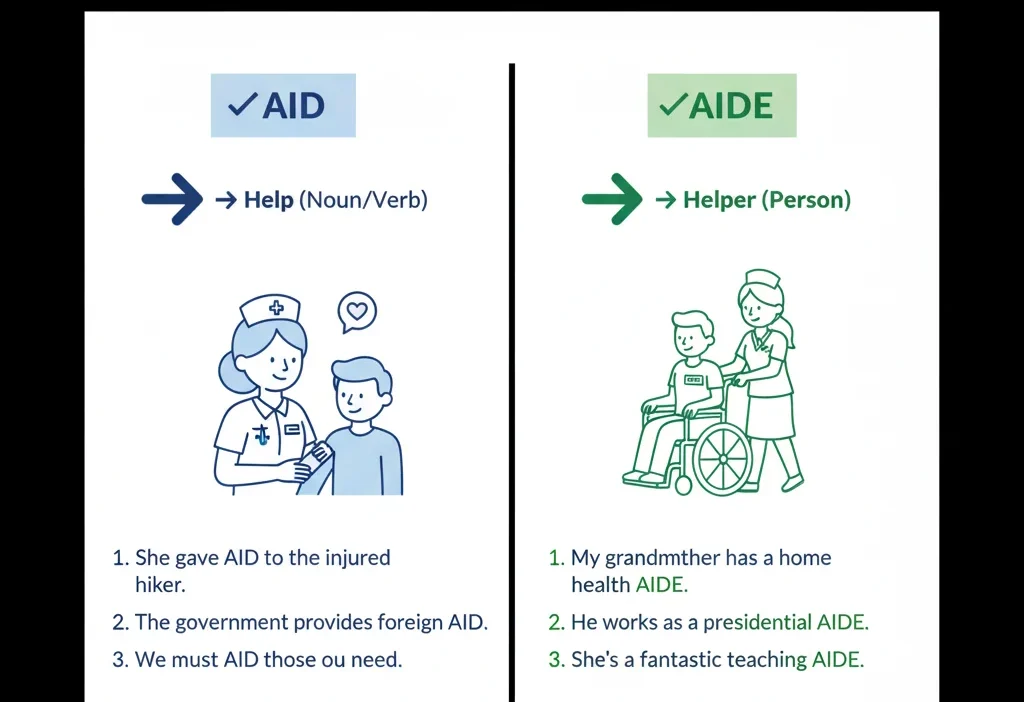
“Aid” can be a noun or a verb, and it always relates to help or assistance.
- As a noun: “Aid” means help or support.
- As a verb: “Aid” means to give help or assist someone.
Examples:
- The nurse gave aid to the injured boy. (noun)
- We should aid our friends when they are in trouble. (verb)
- The teacher’s kind words gave me aid when I felt sad.
Think of “aid” as the action or thing that helps.
2. Meaning of “Aide”
“Aide” is a noun only. It means a person who helps someone, especially an important person like a teacher, doctor, or leader.
Examples:
- The nurse’s aide helped carry the patient.
- The president’s aide arranged the meeting.
- My teacher’s aide helped grade the papers.
So, “aide” is always a person — the helper.
🧠 Quick Tip to Remember:
“Aid” is help or the act of helping, while “aide” is the helper.
The Key Difference Between Aide and Aid
Here’s a simple table to make the difference crystal clear:
| Feature | Aid | Aide |
|---|---|---|
| Part of Speech | Noun or Verb | Noun |
| Meaning | Help, support, or the act of helping | A person who helps someone |
| Example Sentence | She gave aid to the injured dog. | The doctor’s aide was very kind. |
| Plural Form | Aids | Aides |
| Tip to Remember | “Aid” = action or help | “Aide” = helper (person) |
💡 Memory Hack:
If the sentence talks about a person, use “aide.”
If it talks about help or support, use “aid.”
Common Mistakes and How to Avoid Them
Many English learners mix these up because they sound the same. Let’s look at a few mistakes and how to fix them.
❌ Incorrect: The president’s aid planned the event.
✅ Correct: The president’s aide planned the event.
👉 Use aide because it refers to a person.
❌ Incorrect: She gave aide to the poor.
✅ Correct: She gave aid to the poor.
👉 Use aid because it means help or support.
How to Avoid the Mistake:
Remember the letter “e” in aide stands for employee (a person). That’s your clue!
When to Use “Aid”
You should use “aid” when you’re talking about help, support, or assistance. It can be physical, emotional, or financial help.
Examples:
- The Red Cross provides aid during disasters.
- Glasses can aid your eyesight.
- Our teacher’s notes will aid us in studying for the test.
- The medicine gave her quick aid from pain.
- He worked hard to aid his team’s success.
In short, “aid” focuses on the help itself, not the person who helps.
When to Use “Aide”
Use “aide” when you’re referring to a person who assists someone — often in a job or official role.
Examples:
- The nurse’s aide cleaned the room.
- The politician’s aide wrote the speech.
- The teacher’s aide handed out the worksheets.
- A military aide travels with the general.
- My mom works as a doctor’s aide at the hospital.
🧠 Memory Trick:
“Aide” ends with an “e,” just like the word “employee.” Both refer to people.
Quick Recap: Aide vs Aid
Here’s a short summary to lock it in your memory:
✅ Aid = help, support, or the act of helping. (noun/verb)
✅ Aide = a person who helps. (noun only)
In short:
- Use “aid” when you mean to help or help itself.
- Use “aide” when you mean a helper.
Examples:
- The nurse gave aid to the injured man.
- The nurse’s aide assisted with the bandages.
See the difference? One is what you give, and the other is who gives it!
Advanced Tips: Origin, Formal Usage & Common Mix-Ups
- Word Origin:
Both words come from the Latin word adiutare, meaning to help. “Aid” came first in English, while “aide” was borrowed later from French. - Formal Writing:
In essays or reports, use “aid” for general help (e.g., financial aid, foreign aid), and “aide” only for people (e.g., teacher’s aide). - In Texting or Informal Writing:
Many people type “aid” when they actually mean “aide.” Be careful — spellcheck won’t always catch it since both are real words.
Example of misuse:
“She’s my teacher’s aid” — ❌ sounds fine but is grammatically wrong.
Correct: “She’s my teacher’s aide.” ✅
Mini Quiz: Test Your Understanding
Fill in the blanks with aid or aide.
- The doctor’s ______ helped during the operation.
- The organization provides food and medical ______ to flood victims.
- Glasses can ______ you in seeing clearly.
- The mayor’s ______ organized the event.
- Students collected money to give ______ to earthquake survivors.
- The nurse’s ______ was very friendly.
- Parents should always ______ their children with homework.
(Answers: 1. aide, 2. aid, 3. aid, 4. aide, 5. aid, 6. aide, 7. aid)
FAQs About Aide vs Aid
Q1. What’s the main difference between aide and aid?
A: “Aid” means help or the act of helping; “aide” means a person who helps.
Q2. Can I use “aid” as a verb?
A: Yes! You can say “I will aid you with your homework.”
Q3. Is “aide” ever used as a verb?
A: No. “Aide” is only a noun.
Q4. Are “aid” and “aide” pronounced differently?
A: No, they sound the same — that’s why they’re confusing!
Q5. What’s a simple way to remember?
A: If it’s about help, use “aid.” If it’s a helper, use “aide.”
Conclusion
Now you know exactly when to use aide and aid!
Remember:
- “Aid” = help or to help.
- “Aide” = a person who helps.
By practicing these small grammar tips, your English will become clearer and more confident. Every time you write, take a second to think — am I talking about help or a helper? You’ll never go wrong again!

Francis Sufford crafts thoughtful, insightful explanations on language, meaning, and usage, blending clarity with storytelling to guide readers effectively.