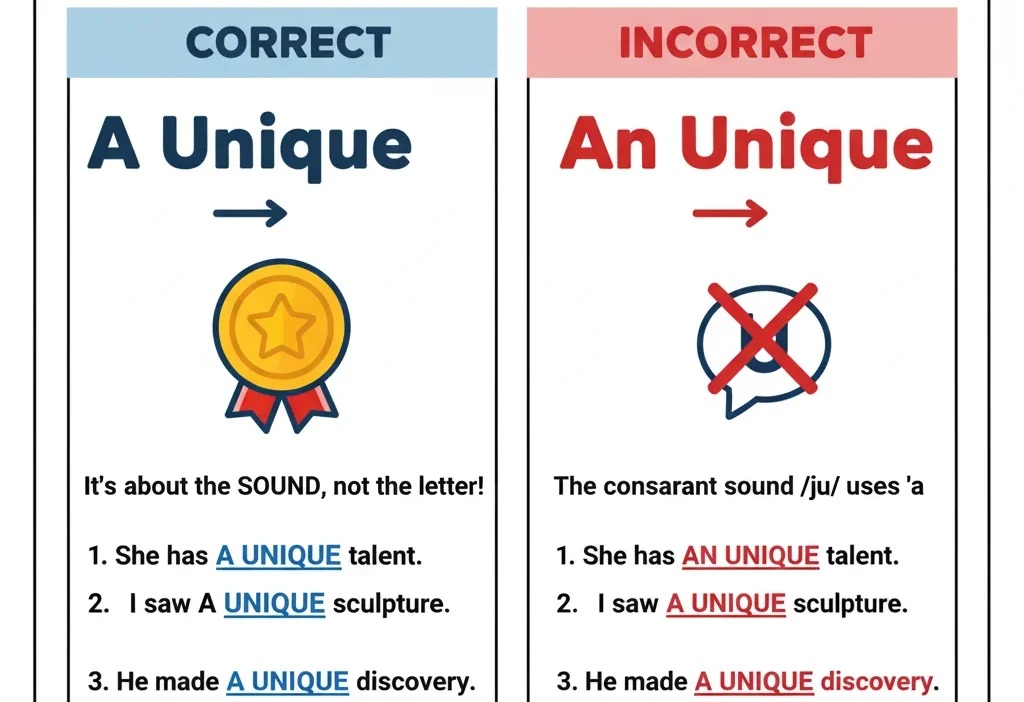
“Use ‘a unique’ because ‘unique’ begins with a consonant sound (‘yoo’), not a vowel sound, making ‘an unique’ incorrect.”
Confused about whether to write “a unique” or “an unique”? You’re not alone. Many people mix this up because the word starts with a vowel letter (u), but English grammar depends on sounds, not letters.
- Correct: “a unique”
“She is a unique talent in the music industry.”
✅ Reason: Unique starts with the consonant sound “yoo”, so it takes “a”. - Incorrect: “an unique”
“She is an unique talent.” ❌
This rule applies to other words starting with “u” that make a “yoo” sound, like university, European, uniform, etc.
Using the wrong article can make your writing look unpolished, unprofessional, or grammatically incorrect, especially in essays, articles, reports, or formal documents.
In this article, you’ll also learn:
- Common mistakes with a vs an
- Rules for choosing the correct article based on initial sound
- Practical examples with unique and other tricky words
By the end, you’ll confidently know when to use a unique in any sentence, making your writing clear, professional, and mistake-free.
🔤 What Does Each Word Mean?
Before we talk about “a” and “an,” let’s understand what they mean and how they’re used in English grammar.
The Article “A”
- Meaning: “A” is used before a singular word that begins with a consonant sound.
- Part of Speech: Article (used before nouns)
- Examples:
- A cat is sleeping on the sofa.
- I saw a dog in the park.
- She bought a book yesterday.
Here, all words after “a” start with a consonant sound: /k/, /d/, and /b/.
The Article “An”
- Meaning: “An” is used before a singular word that begins with a vowel sound (not just a vowel letter).
- Part of Speech: Article
- Examples:
- An apple a day keeps the doctor away.
- I saw an elephant at the zoo.
- She is an honest person.
Notice that “honest” begins with the letter h (a consonant), but it’s silent—so the word begins with the vowel sound /ɒ/, which is why we say “an honest person.”
📚 The Key Difference Between “A Unique” and “An Unique”
Let’s look at what causes confusion.
| Expression | Correct or Incorrect | Explanation | Example Sentence |
|---|---|---|---|
| A unique | ✅ Correct | The word unique begins with the /juː/ sound (like “you”), which is a consonant sound. | She had a unique talent for painting. |
| An unique | ❌ Incorrect | “Unique” doesn’t start with a vowel sound, so “an” should not be used. | ✖ She had an unique talent. |
✅ Quick Tip:
Always listen to the sound that comes after the article, not the letter.
If it sounds like it starts with a vowel (a, e, i, o, u sound), use an.
If it sounds like it starts with a consonant, use a.
⚠️ Common Mistakes and How to Avoid Them
❌ Mistake 1: Writing “an unique idea”
Why it’s wrong:
Although “unique” starts with the letter “u,” the sound is /juː/ (“you”), which is a consonant sound.
Correct version:
✅ That’s a unique idea!
❌ Mistake 2: Using “an” for words that start with a consonant sound
Example: ✖ An university → ✅ A university
Why: The word university begins with the sound /juː/, the same as unique.
❌ Mistake 3: Thinking vowel letters always mean vowel sounds
Remember: it’s about the sound, not the spelling.
✅ An hour (because “h” is silent)
✅ A unicorn (because it starts with the “you” sound)
🗣️ When to Use “A Unique”
Use “a unique” when describing something one-of-a-kind or special. The word “unique” means unlike anything else.
✅ Examples:
- She has a unique way of solving problems.
- This artist has a unique style of painting.
- It was a unique experience to see snow for the first time.
- He gave me a unique birthday gift.
- That’s a unique solution to the puzzle.
💡 Memory Trick:
If the word starts with the “you” sound (like unique, unicorn, university), always use “a.”
210+ Understand Colon vs Semicolon Easily 2025 Grammar Guide
🌟 When to Use “An Unique”
The answer is simple — never.
“An unique” is grammatically incorrect in modern English. However, centuries ago, before English pronunciation evolved, some speakers might have pronounced “unique” with a softer “u” sound, closer to “oo.” That’s why you might see old texts using “an unique,” but in today’s English, “a unique” is always the correct choice.
🧩 Quick Recap: “A Unique” vs “An Unique”
- ✅ “A unique” → Correct
Because “unique” starts with a consonant sound (/juː/). - ❌ “An unique” → Incorrect
“An” is only for words starting with a vowel sound.
In short:
➡ “A” = before consonant sounds
➡ “An” = before vowel sounds
Examples to remember:
- A unicorn
- A European country
- A unique design
- An umbrella
- An honest man
📘 Advanced Tips: The Story Behind “A” and “An”
The articles “a” and “an” come from the Old English word ān, meaning “one.” Over time, English speakers began adding the “n” sound before vowel sounds to make pronunciation smoother — that’s how “an” was born.
So, the rule isn’t about letters—it’s about how the word sounds when spoken. If it’s easier to pronounce with “an,” we use it. Otherwise, we use “a.”
That’s why we say:
- An apple (flows better than “a apple”)
- A unique idea (flows better than “an unique idea”)
In writing and exams, using the wrong article might make sentences sound awkward or incorrect. So, always read the sentence aloud — if it sounds smooth, it’s probably right!
🧠 Mini Quiz: Test Yourself!
Fill in the blanks with “a” or “an.”
- She found ___ unique shell on the beach.
- He wants to become ___ engineer.
- It’s ___ hour before dinner.
- I met ___ university student today.
- That’s ___ unusual sight!
💬 FAQs
1. Is “an unique” ever correct?
No, modern English always uses “a unique” because “unique” starts with a consonant sound.
2. Why do people confuse “a unique” and “an unique”?
Because “unique” begins with the vowel letter u, but not a vowel sound. The confusion comes from spelling, not pronunciation.
3. Do we use “an” only before vowels?
We use “an” before vowel sounds, not just vowels. Example: an honest man.
4. Can I say “an university”?
No, the correct phrase is “a university.” The sound at the start is “you,” a consonant sound.
5. What’s the easiest way to remember?
If it sounds like it starts with “you,” use “a.” If it starts with a vowel sound like “ah” or “eh,” use “an.”
🏁 Conclusion
You’ve learned the difference between “a unique” and “an unique” — and now you know that “a unique” is always correct. Remember, the trick lies in the sound, not the spelling. English can seem tricky, but once you understand the logic behind pronunciation, everything becomes simple.
Keep practicing with examples every day, and soon you’ll use English articles like a pro! 🌟

Gwendoline Riley delivers clear, compelling insights into language and usage, helping readers understand meanings, nuances, and differences with confidence.