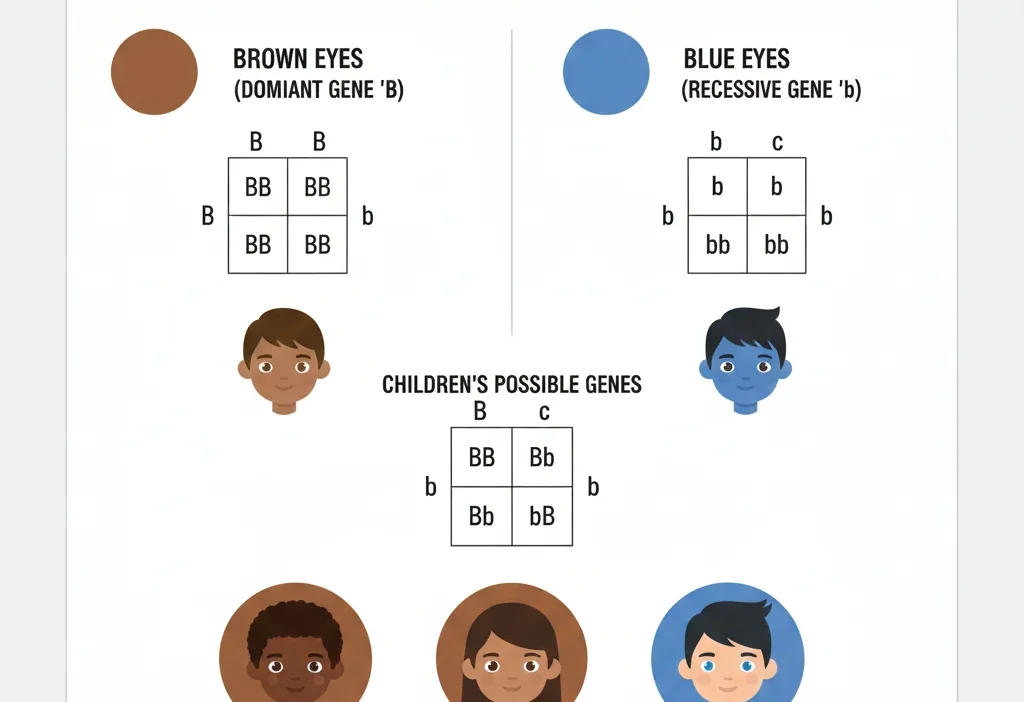
👉 Blue eyes are recessive, not dominant.
This means a child usually needs two blue-eye genes—one from each parent—to have blue eyes. If a dominant brown-eye gene is present, it usually hides the blue.
Many people ask, “are blue eyes dominant or recessive?”
The question sounds simple, but the answer often feels confusing. Some children have blue eyes even when their parents have brown eyes. This makes people wonder if blue eyes are secretly dominant or if genetics works in a strange way.
In this easy guide, you will learn the meaning of dominant and recessive, how blue eyes really work, and why people mix these terms up. We will use simple words, short sentences, and real-life examples so even a class 4 student can understand.
By the end, you will clearly know the difference, avoid common mistakes, and confidently explain are blue eyes dominant or recessive to anyone.
What Does Each Word Mean?
To understand are blue eyes dominant or recessive, we first need to know what dominant and recessive mean.
What Does “Dominant” Mean?
Dominant means stronger or shows first.
In genetics:
- A dominant gene shows its trait even if there is only one copy.
- It hides the weaker gene.
Easy examples:
- If brown eye gene is present, brown eyes usually show.
- One dominant gene is enough to decide the eye color.
- Think of a loud voice that everyone hears first.
Story example:
Ali gets one brown-eye gene and one blue-eye gene. His eyes are brown. Why? Because brown is dominant.
What Does “Recessive” Mean?
Recessive means hidden or weaker.
In genetics:
- A recessive gene shows only when both copies are the same.
- If a dominant gene is present, the recessive one stays hidden.
Easy examples:
- Blue eyes appear only when no brown gene is present.
- Two blue-eye genes are needed.
- Think of a quiet voice that is heard only when no loud voice is around.
Story example:
Sara gets one blue-eye gene from her mother and one from her father. She has blue eyes because no brown gene is present.
The Key Difference Between Dominant and Recessive
Here is a simple table to clearly answer are blue eyes dominant or recessive:
| Feature | Dominant (Brown Eyes) | Recessive (Blue Eyes) |
|---|---|---|
| Meaning | Strong gene | Hidden gene |
| Shows when | One copy is enough | Two copies needed |
| Example | Brown eyes | Blue eyes |
| Can be hidden? | No | Yes |
| Common result | Most people | Fewer people |
Quick Tip to Remember:
👉 Brown blocks blue.
If brown is there, blue stays hidden.
Common Mistakes and How to Avoid Them
People often misunderstand are blue eyes dominant or recessive because of these mistakes.
❌ Mistake 1: “Two brown-eyed parents can’t have a blue-eyed child”
✅ Correct: They can.
Both parents may carry a hidden blue-eye gene.
Why this happens:
People forget that recessive genes can hide.
❌ Mistake 2: “Blue eyes are stronger because they are rare”
✅ Correct: Rarity does not mean dominance.
Why this happens:
People mix up “rare” with “dominant.”
❌ Mistake 3: “If one parent has blue eyes, the child will have blue eyes”
✅ Correct: Not always.
Fix:
The child must receive two blue-eye genes.
When to Use “Dominant” (Brown Eyes)
Use dominant when:
- One gene controls the result.
- The trait appears easily.
- It hides another trait.
Real-life examples:
- Brown eyes usually appear even with one gene.
- Curly hair is often dominant.
- A loud speaker covers quiet sounds.
- Brown eyes hide blue eyes.
- Dominant traits decide faster.
Simple rule:
If it shows quickly, it is likely dominant.
When to Use “Recessive” (Blue Eyes)
Use recessive when:
- The trait stays hidden.
- Two same genes are needed.
- No dominant gene is present.
Real-life examples:
- Blue eyes need two blue genes.
- Left-handedness can be recessive.
- A quiet color shows only when alone.
- Blue eyes appear less often.
- Recessive traits wait their turn.
Memory Hack:
👉 Recessive = requires two
(Think: “re” sounds like “two”)
Quick Recap: Are Blue Eyes Dominant or Recessive?
- ✅ Blue eyes are recessive
- ✅ Brown eyes are dominant
- ✅ Two blue genes = blue eyes
- ✅ One brown gene = brown eyes
- ✅ Recessive traits can hide
Advanced Tips (Optional but Helpful)
Origin and Science Note
Early science taught eye color as simple. Today, we know it is more complex. Still, blue eyes are considered recessive in basic genetics taught in schools.
In Exams and Essays
- Always write: Blue eyes are recessive
- Avoid saying blue eyes are dominant
Online and Texting Errors
Wrong usage can confuse meaning:
- ❌ “Blue eyes dominate brown eyes”
- ✅ “Brown eyes dominate blue eyes”
Mini Quiz: Test Yourself
Fill in the blanks:
- Blue eyes are ________.
- Brown eyes are ________.
- A recessive trait needs ________ genes.
- A dominant trait needs ________ gene.
- If brown is present, blue stays ________.
Answers:
- Recessive
- Dominant
- Two
- One
- Hidden
FAQs
1. Are blue eyes dominant or recessive?
Blue eyes are recessive.
2. Can two brown-eyed parents have a blue-eyed child?
Yes, if both carry a blue-eye gene.
3. Why are blue eyes rare?
Because they need two recessive genes.
4. Is eye color always simple genetics?
No, but basic genetics still calls blue eyes recessive.
5. Can eye color change later?
Usually no. Most eye color sets in early childhood.
Conclusion
Now you clearly know the answer to are blue eyes dominant or recessive.
Blue eyes are recessive, and brown eyes are dominant. A child needs two blue-eye genes to have blue eyes. If even one brown gene appears, brown eyes usually show.
Understanding this difference helps in school, exams, and daily conversations. Genetics does not have to be hard. With simple rules and examples, anyone can learn it.
Keep practicing, keep learning, and enjoy discovering how amazing science and language can be together

Eley Williams writes clear, engaging guides on confusing words and phrases, helping readers understand meanings, differences, and correct usage with ease.