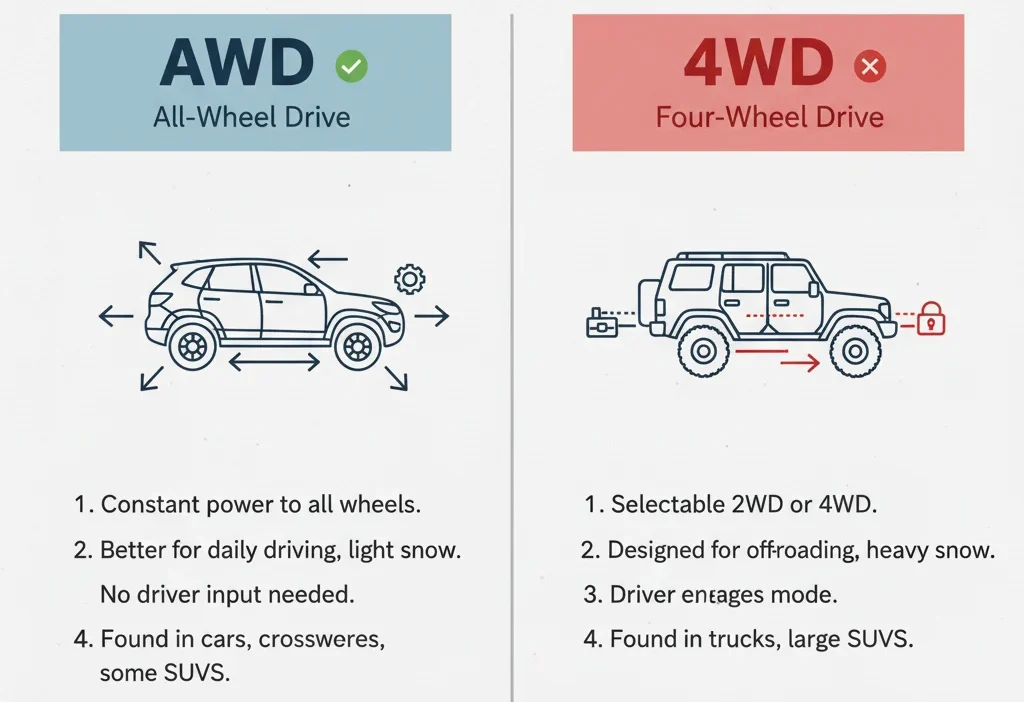
AWD (All-Wheel Drive) automatically sends power to all wheels all the time.
4WD (Four-Wheel Drive) is a stronger, more powerful system you turn on when you need extra control on rough or muddy roads.
AWD = everyday driving.
4WD = tough off-road driving
Many people mix up AWD or 4WD because both systems power all the wheels of a vehicle. At first, they sound the same — but in real life, they work differently, feel different, and are used in different situations.
This complete, beginner-friendly guide will help you clearly understand the meaning, difference, usage, examples, and simple rules for when to choose AWD vs 4WD.
You’ll learn everything step-by-step — explained in simple words so even a 4th-grade student can understand easily. By the end, you will know exactly which system is better for daily driving, long trips, rain, snow, mud, or off-road adventures.
Let’s make this confusing topic super simple!
What Does AWD Mean? (All-Wheel Drive)
AWD = All-Wheel Drive.
This system sends power to all four wheels automatically, without the driver doing anything.
Part of Speech:
- Letter Combination / Abbreviation used in automobile terminology
- Stands for All-Wheel Drive
Simple Definition:
AWD helps a car stay stable on normal roads, especially in rain, light snow, or slippery streets.
Easy Examples of AWD:
- Your car automatically sends power to all wheels when it senses a slippery road.
- AWD helps you stay safe when turning on a wet road.
- Many family cars and small SUVs use AWD for comfort and safety.
Mini Memory Story:
Think of AWD like shoes with good grip. They help you stay stable every day — walking, running, or climbing stairs — without you doing anything special.
What Does 4WD Mean? (Four-Wheel Drive)
4WD = Four-Wheel Drive.
This system is more powerful than AWD and is mostly found in trucks and big SUVs.
Part of Speech:
- Letter Combination / Abbreviation used in automobile terminology
- Stands for Four-Wheel Drive
Simple Definition:
4WD helps a vehicle drive through mud, snow, rocks, hills, or off-road areas. You usually turn it on when needed.
Easy Examples of 4WD:
- You press a button to activate 4WD when driving on muddy, uneven ground.
- A 4WD truck climbs a steep hill easily.
- Off-road vehicles use 4WD on rocky paths.
Mini Memory Story:
Think of 4WD like strong hiking boots. You don’t wear them every day — only when the trail gets rough.
The Key Difference Between AWD and 4WD
Here’s the most simple explanation:
👉 AWD = Always ON (Automatic)
👉 4WD = Manually ON (Powerful)
AWD is for everyday roads, while 4WD is for challenging terrains.
Comparison Table: AWD vs 4WD
| Feature | AWD (All-Wheel Drive) | 4WD (Four-Wheel Drive) |
|---|---|---|
| Full Form | All-Wheel Drive | Four-Wheel Drive |
| Power Flow | Automatic to all wheels | Driver-controlled |
| Best For | City, light snow, rain | Mud, rocks, deep snow, off-road |
| Driver Control | No action needed | Must be activated |
| Power Level | Medium | Strong & high torque |
| Common In | Cars & small SUVs | Trucks & off-road SUVs |
| Everyday Use | Yes | Not always |
Quick Tip to Remember
AWD = “Everyday Comfort”
4WD = “Adventure Power”
If the road is smooth → AWD
If the road is tough → 4WD
Common Mistakes and How to Avoid Them
❌ Mistake 1: Thinking AWD and 4WD are the same
✔ Fix:
AWD is automatic; 4WD is for heavy-duty off-road control.
❌ Mistake 2: Using 4WD all the time
✔ Fix:
4WD is not for regular streets — it can harm the vehicle. Use it only on difficult terrain.
❌ Mistake 3: Believing AWD can handle deep mud
✔ Fix:
AWD is helpful, but 4WD is stronger for mud, rocks, and steep hills.
When to Use AWD (All-Wheel Drive)
Use AWD when you want safety and comfort on normal roads.
Best Situations for AWD:
- Driving in rain
- Light snow
- Wet or slippery streets
- Smooth highways
- Everyday city driving
Simple AWD Examples:
- “I used my AWD car to drive safely in the rain.”
- “AWD helped me stay stable on a slippery road.”
- “Our family SUV has AWD for everyday comfort.”
- “AWD is perfect for long highway trips.”
- “The car automatically adjusts power when needed.”
When to Use 4WD (Four-Wheel Drive)
Use 4WD in difficult or off-road conditions.
Best Situations for 4WD:
- Muddy off-road paths
- Deep snow
- Rocky hills
- Sand dunes
- Rural or unpaved roads
- Adventure driving
Simple 4WD Examples:
- “I turned on 4WD to cross the muddy trail.”
- “Our truck needs 4WD for snowy mountains.”
- “4WD helps when driving over rocks.”
- “We used 4WD during our desert trip.”
- “4WD gives extra power when climbing steep hills.”
Memory Hack:
Think of 4WD as “FOR Weather Danger” — when conditions are tough, turn it on.
Quick Recap: AWD vs 4WD
AWD (All-Wheel Drive)
- Automatic
- Everyday use
- Best for rain, light snow
- Found in smaller SUVs/cars
4WD (Four-Wheel Drive)
- Strong manual system
- For tough off-road terrain
- Best for mud, hills, rocks, deep snow
- Found in trucks & large SUVs
🌟 Rule of Thumb:
Normal roads = AWD
Hard/off-road roads = 4WD
Advanced Tips (Optional Section)
1. Origin of Terms
- AWD became popular when car makers wanted safer daily driving systems.
- 4WD originated from military and off-road vehicles needing maximum power.
2. Formal Usage
Both terms appear in:
- Car reviews
- Science textbooks
- Driving manuals
- Vehicle specifications
3. Online Misuse
People often use “AWD” and “4WD” incorrectly on social media, thinking they mean the same. Always check your car’s manual.
Yin 17 Prime or Composite: The Hidden Truth You Missed 🔍
Mini Quiz (Test Yourself!)
Fill in the blanks:
- AWD is ________ (automatic / manual).
- 4WD is best for ________ roads.
- AWD is commonly found in ________.
- You should turn on 4WD only on ________ terrain.
- AWD helps in ________ weather conditions.
Conclusion
Understanding AWD or 4WD is easy when explained simply: AWD is perfect for daily driving, while 4WD is made for rough, challenging terrain. Now you know what each system means, how they work, and when to use them correctly.
Practice identifying which system your vehicle uses and choose wisely based on road conditions. The more you learn, the safer and more confident you will become while driving.
Keep learning — every small step improves your understanding of the world of vehicles and driving.
FAQs
1. What is the main difference between AWD and 4WD?
AWD is automatic and used for everyday driving, while 4WD is manually activated and used for off-road terrains.
2. Is AWD or 4WD better for snow?
AWD is good for light snow; 4WD is better for deep snow or icy hills.
3. Can I use 4WD on normal roads?
No. Using 4WD on smooth roads can damage the vehicle.
4. Which is safer: AWD or 4WD?
AWD is safer for daily conditions; 4WD is safer for extreme terrains.
5. Do AWD cars use more fuel?
Yes, slightly more than two-wheel drive cars because all wheels receive power.

Gwendoline Riley delivers clear, compelling insights into language and usage, helping readers understand meanings, nuances, and differences with confidence.