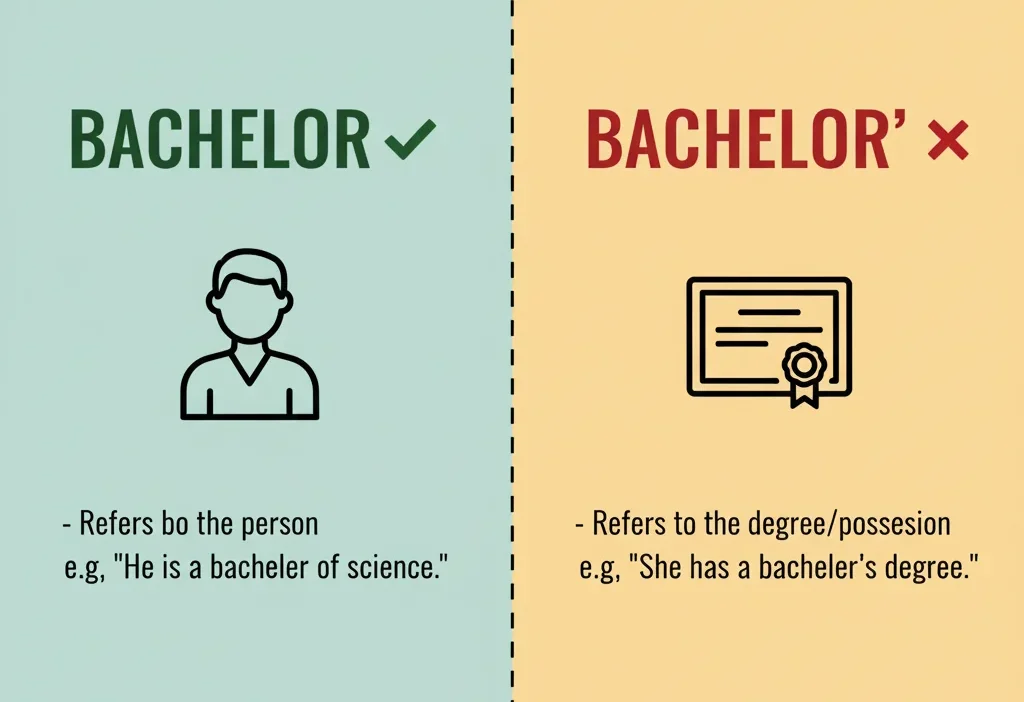
“Bachelor” is a noun meaning an unmarried man or a college degree (Bachelor of Arts, etc.).
“Bachelor’s” is a possessive form meaning ‘belonging to a bachelor’ or short for “bachelor’s degree.”
If the word ends with ’s, it shows ownership or a type of degree.
Have you ever paused while writing and wondered, “Should I write bachelor or bachelor’s?”
Don’t worry — you’re not alone! These two words look similar, sound almost the same, and are used in related ways. That’s why so many students, professionals, and even native speakers mix them up.
In this simple and friendly guide, you will learn the meaning, difference, and correct usage of bachelor vs bachelor’s with easy examples that even a 4th-grade student can understand.
By the end, you’ll know exactly which word to use in school work, online posts, resumes, professional emails, and everyday writing.
Let’s make English simple — one word at a t
What Does Each Word Mean?
Meaning of “Bachelor”
Bachelor is a noun. It has two common meanings:
- An unmarried man
- A type of college degree (like Bachelor of Science, Bachelor of Arts)
Easy Examples
- He is a bachelor who lives alone.
- Sara finished her Bachelor of Arts.
- My uncle stayed a bachelor until he was 40.
Think of “bachelor” as a thing or title — a person or a degree name.
Meaning of “Bachelor’s”
Bachelor’s is the possessive form of bachelor.
It shows ownership, or it is used as a short form of “bachelor’s degree.”
Easy Examples
- He lives in a bachelor’s apartment.
- She earned her bachelor’s in computer science.
- This is my bachelor’s degree certificate.
If the word has ’s, something belongs to or is owned by a bachelor.
The Key Difference Between Bachelor and Bachelor’s
The simplest rule:
| Word | Meaning | Usage | Example |
|---|---|---|---|
| Bachelor | A person (unmarried man) OR the full name of a degree | Used as a noun | He is a bachelor. |
| Bachelor’s | Possessive form OR short form of bachelor’s degree | Used to show ownership or type of degree | She has a bachelor’s in English. |
Quick Tip to Remember
➡ If the sentence needs the idea of “degree” or “belonging to someone,” use bachelor’s.
➡ If you are talking about a person or the full degree title, use bachelor.
Common Mistakes and How to Avoid Them
❌ Mistake 1: Using “bachelor” instead of “bachelor’s”
Wrong: I completed my bachelor in biology.
Correct: I completed my bachelor’s in biology.
Why?
The degree requires the possessive form: bachelor’s degree.
❌ Mistake 2: Adding ’s when not needed
Wrong: He is a bachelor’s.
Correct: He is a bachelor.
Why?
We are talking about a person, not ownership.
❌ Mistake 3: Confusing degree titles
Wrong: Bachelor’s of Arts
Correct: Bachelor of Arts (no apostrophe)
Why?
Official degree names don’t take apostrophes.
When to Use “Bachelor”
Use bachelor when:
1. Talking about an unmarried man
- He is a bachelor.
- Three bachelors live in that house.
2. Using the full official degree title
- I want to study Bachelor of Science.
- She was accepted into the Bachelor of Commerce program.
3. Talking about someone with that title
- He remained a bachelor all his life.
- My cousin is a bachelor and loves traveling.
Real-Life Situations
- Filling a form (marital status)
- Talking about a male family member
- Mentioning a full degree name in school or work
When to Use “Bachelor’s”
Use bachelor’s when:
1. Short for “bachelor’s degree”
- She earned her bachelor’s last year.
- I’m doing my bachelor’s in business.
2. Showing possession (ownership)
- This is a bachelor’s apartment.
- The bachelor’s dog barked loudly.
3. Talking about the type of degree
- What is your bachelor’s major?
- He finished his bachelor’s with honors.
Memory Hack
👉 If the sentence sounds like it could have “degree,” use bachelor’s.
Try reading the sentence silently with the word “degree.”
If it makes sense, choose bachelor’s.
Example:
“She completed her bachelor’s…”
= She completed her bachelor’s degree ✔
Quick Recap: Bachelor vs Bachelor’s
- Bachelor = unmarried man OR full degree title
- Bachelor’s = shows ownership OR short for bachelor’s degree
- Use bachelor in: “He is a bachelor.”
- Use bachelor’s in: “She completed her bachelor’s.”
- Official degree titles never use an apostrophe.
Advanced Tips (Optional)
1. Word Origins
- Bachelor comes from the Medieval Latin word baccalarius, meaning a young trainee or a junior knight.
- Later, it began to mean a young unmarried man or someone earning their first-level university degree.
2. Academic Writing
In essays, resumes, CVs, and applications:
- Bachelor of Science (BSc) → full title
- bachelor’s degree in science → general reference
3. Online Writing
Because people type fast on phones, they often drop apostrophes.
But in formal writing, the apostrophe (’s) is very important.
It changes the meaning completely!
Mini Quiz (Test Yourself!)
Fill in the blanks with bachelor or bachelor’s:
- She finished her ______ in psychology.
- He is a 35-year-old ______.
- I applied for the ______ of Business program.
- My sister wants to do her ______ in math.
- This is a ______ apartment.
Answers: 1. bachelor’s, 2. bachelor, 3. Bachelor, 4. bachelor’s, 5. bachelor’s
FAQs
1. What is the difference between bachelor and bachelor’s?
Bachelor means an unmarried man or the official title of a degree.
Bachelor’s shows possession or refers to a bachelor’s degree.
2. Do we say bachelor degree or bachelor’s degree?
The correct form is bachelor’s degree (with ’s).
3. Is bachelor’s capitalized?
Only when it starts a sentence.
Otherwise, write: bachelor’s degree (lowercase).
4. What is the plural of bachelor?
Plural = bachelors (no apostrophe).
5. Which is used in resumes?
Use: Bachelor of Science / Bachelor of Arts for full official names.
Use: bachelor’s degree for general statements.
Conclusion
Now you know the exact difference between bachelor and bachelor’s, how to use each correctly, and how to avoid the most common mistakes.
With the simple rules, examples, and memory tricks in this guide, you can confidently write essays, resumes, online posts, and messages without confusion.
Keep practicing — every small step makes your English stronger and clearer!
Polly Clark creates clear, insightful guides on language and usage, helping readers understand meanings, differences, and nuances with clarity and confidence.