Do you find yourself hesitating every time you write backwards or backward? You’re not alone. This simple word pair creates surprising confusion for native speakers, students, and professionals worldwide. The choice between backwards and backward isn’t about right versus wrong, but about geography, context, and style.
People search for this keyword because they’ve seen both forms used in respected publications, heard them in films from different countries, and received mixed feedback from grammar checkers. Is one more formal? Is the other incorrect? This confusion often stems from the subtle but consistent differences between American and British English conventions.
This article solves that uncertainty completely. We’ll explore the historical roots of this linguistic split, provide clear rules for American versus Commonwealth usage, and show you real-world examples from emails to global news headlines.
Whether you’re an academic writing a paper, a marketer crafting global content, or simply someone who values precise language, understanding the backwards/backward distinction will make your writing more polished and regionally appropriate. Let’s move forward and clear up this backward(s) confusion for good.
Backwards / Backward
The quick answer is that both backwards and backward are correct, but their preferred use depends on where you are and how you’re using the word.
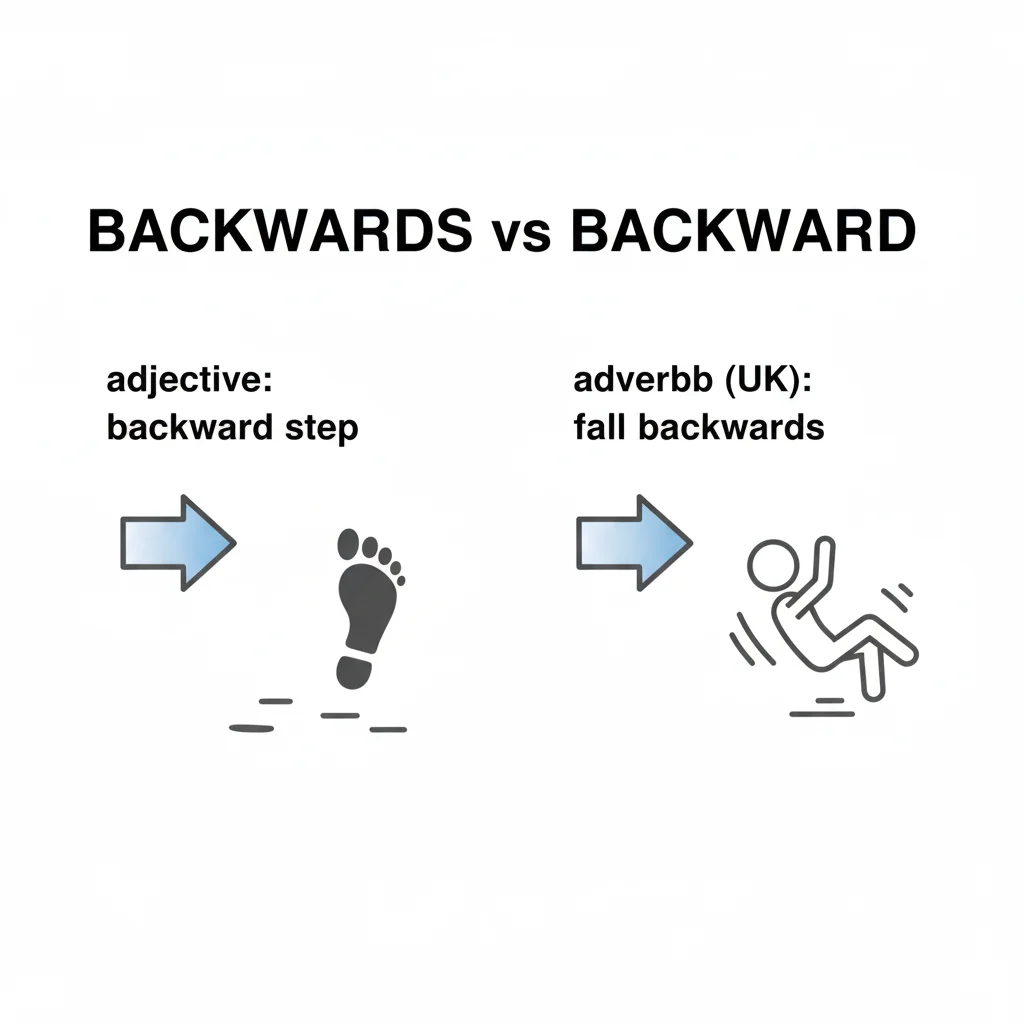
Use backward (without the ‘s’) as an adjective. Use backwards (with the ‘s’) as an adverb in British English and other Commonwealth varieties. In American English, use backward for both the adjective and the adverb.
- Adjective (Both Varieties): “She gave a backward glance.” (Describing the noun ‘glance’)
- Adverb (UK/Commonwealth): “He stumbled backwards.” (Describing the verb ‘stumbled’)
- Adverb (US): “He stumbled backward.”
Think of it this way: Americans generally prefer the shorter form for everything, while British English makes a grammatical distinction. When in doubt in a global context, backward is widely understood and often the safer choice.
The Origin of Backwards / Backward
To understand the two spellings, we must look back—or backwards—in time. The word comes from the Old English “bæcweard,” a combination of “bæc” (back) and “-weard” (meaning “in the direction of”). This “-weard” suffix is the ancestor of our modern “-ward.”
For centuries, English used the “-ward” form for both adjectives and adverbs. The “-s” in backwards emerged in the late 14th century as a genitive (possessive) adverb ending, similar to how we say “always” (of all ways) or “sideways.” This “-wards” form became standard for directional adverbs.
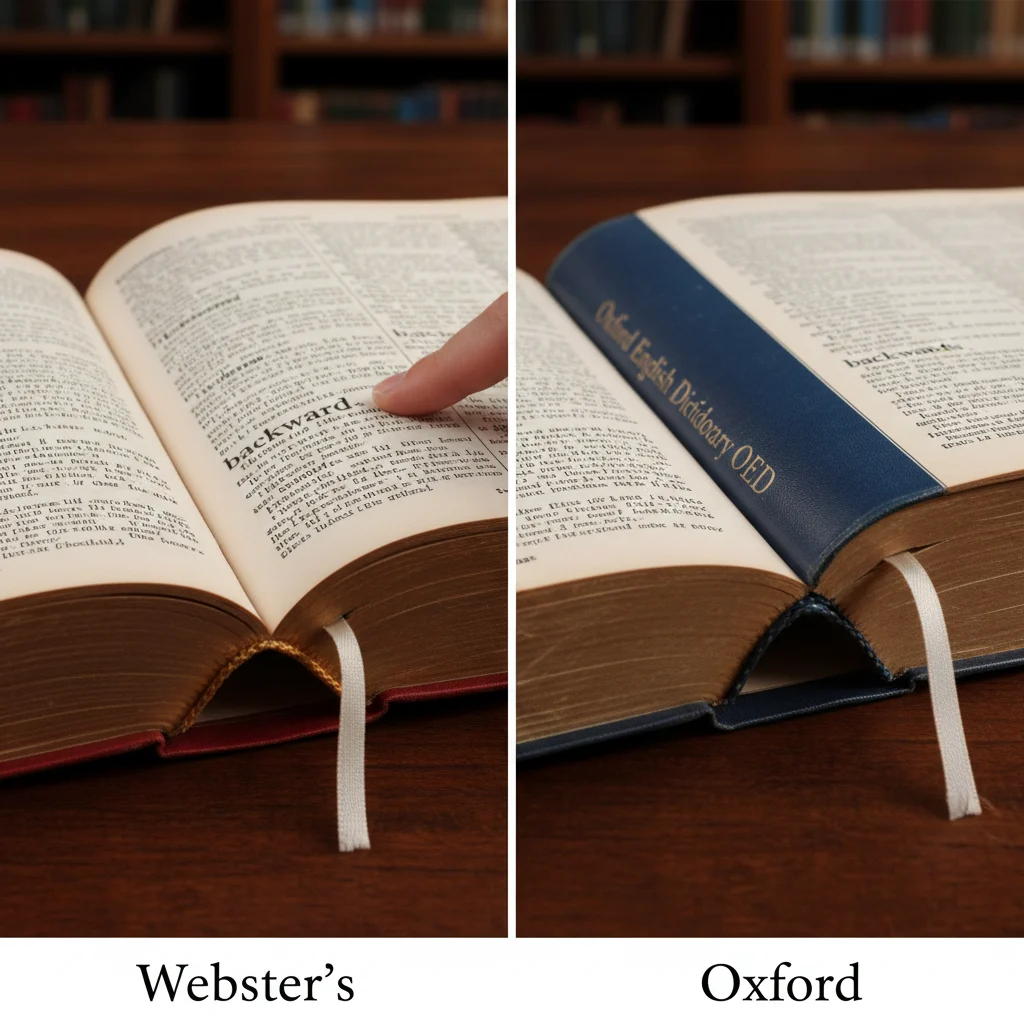
The divergence began with the simplification trends in early American English, championed by lexicographers like Noah Webster. Webster’s influential dictionaries advocated for spelling reform, favoring “-ward” over “-wards” in all adverbial uses to create a more logical and streamlined language. This cemented backward as the default for American English, while British English retained the traditional distinction.
British English vs. American English Spelling
The core difference lies in a consistent spelling rule applied to all “-ward” direction words.
American English Rule: Use -ward for both adjectives and adverbs.
- Backward, forward, toward, upward, downward, homeward.
- “Look forward.” (Adverb)
- “A forward pass.” (Adjective)
British English Rule: Use -ward for adjectives and -wards for adverbs.
- Adjective: Backward, forward, toward, upward.
- Adverb: Backwards, forwards, towards, upwards.
- “Move forwards.” (Adverb)
- “A forward position.” (Adjective)
Comparison Table: Backwards / Backward Usage
| Context | American English | British English |
|---|---|---|
| Adverb (Direction) | She fell backward. | She fell backwards. |
| Adjective | A backward step. | A backward step. |
| Figurative Adverb | The project moved backward. | The project moved backwards. |
| Common Phrases | Bend over backward; backward-looking | Bend over backwards; backwards-compatible |
Which Spelling Should You Use?
Your choice should be guided by your primary audience.
For a US Audience: Use backward for all adverbial and adjectival uses. This is the standard in American publishing, academia, and media. Using “backwards” as an adverb might be marked as informal or a minor error by strict American editors.
For a UK, Australian, Canadian, or other Commonwealth Audience: Observe the distinction. Use backwards as the adverb and backward as the adjective. Using “backward” as an adverb here might be accepted but will be identified as an Americanism.
For Global or International Content (e.g., websites, scientific journals): The trend, largely due to the influence of American media and tech, is leaning toward using backward for both roles. It is the more universally recognized form and avoids the regional distinction. Many international style guides now recommend “-ward” for simplicity.
Common Mistakes with Backwards / Backward
- Using “Backwards” as an Adjective: Saying “a backwards glance” is non-standard in all major English varieties. The adjective is always backward.
- Incorrect: He has a backwards way of thinking.
- Correct: He has a backward way of thinking.
- Overcorrecting in British English: An American writer, learning the distinction, might wrongly apply “-wards” as an adjective in British context.
- Incorrect (in UK): It was a backwards movement. (Should be backward, as it’s an adjective)
- Correct (in UK): It moved backwards.
- Inconsistency in a Single Document: The most common professional error is mixing styles, using both “backward” and “backwards” as adverbs within the same report or article. Pick one convention (US or UK) and stick with it for all “-ward” words.
Backwards / Backward in Everyday Examples
- Email (Business – US): “We cannot afford to take a backward step in market share. Let’s ensure the new strategy doesn’t move us backward.”
- News Headline (UK – The Guardian): “Government accused of putting climate policy backwards with new fossil fuel subsidies.”
- Social Media (Informal): “Me trying to read backwards text in a puzzle game 😅 #brainhurt”
- Formal Writing / Academic (International Journal): “The study’s backward analysis of the data revealed a previously unseen correlation.”
- Instruction Manual: “To assemble, slide part B backward until it clicks.” (Commonly uses US/international form for clarity).
Backwards / Backward – Google Trends & Usage Data
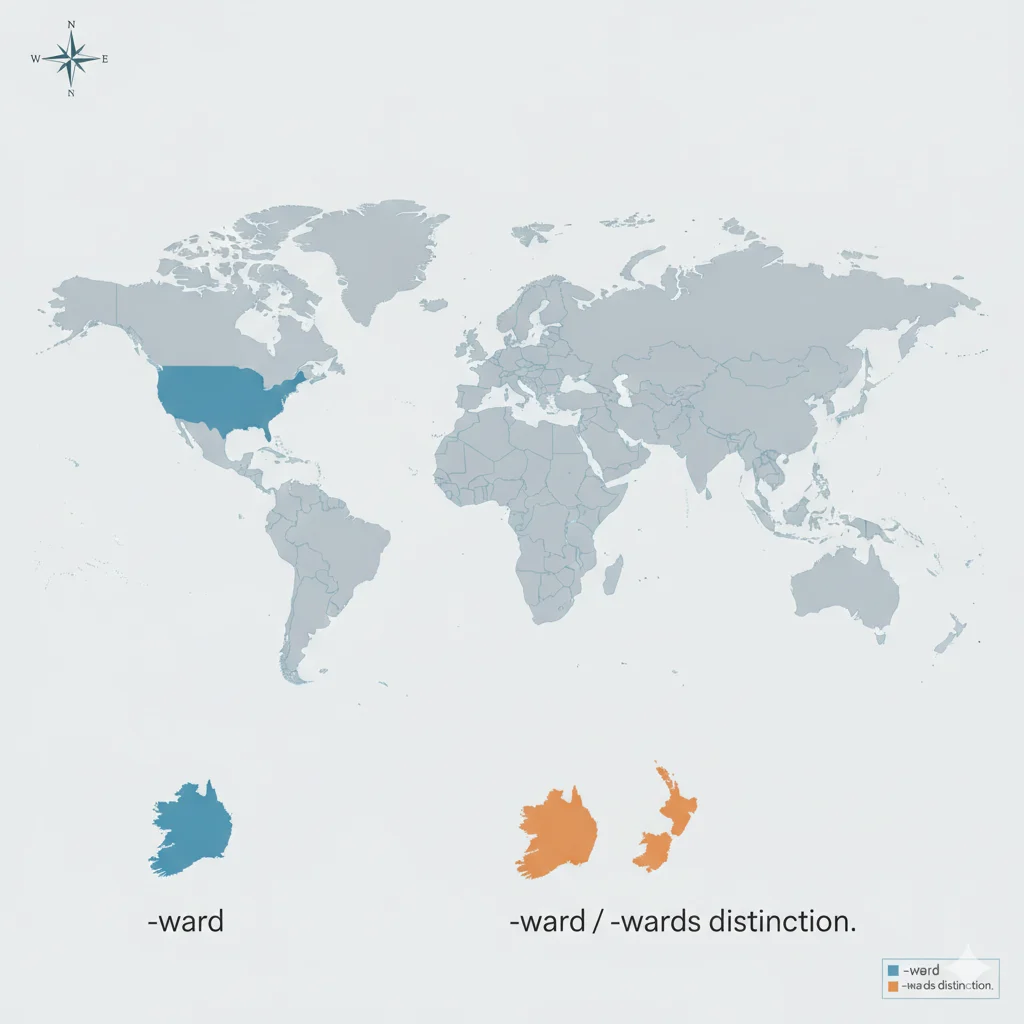
Analysing search data and text corpora reveals clear patterns. Searches for “backward” are consistently more frequent globally than for “backwards,” by a significant margin. This reflects the dominance of American English online and in international business.
However, the regional split is evident. In the United States and the Philippines (which follows US standards), “backward” is overwhelmingly preferred. In the United Kingdom, Ireland, Australia, and New Zealand, searches for “backwards” are much more frequent relative to the US, though “backward” still leads due to its adjectival use and global content exposure.
The phrase “backwards compatible” (common in tech) has become a notable exception, solidifying the “-s” form in that specific professional jargon worldwide, even in American English
(FAQs)
1. What is the core difference between “backward” and “backwards”?
“Backward” is always the correct adjective. The difference is in the adverb: American English uses “backward” as the adverb, while British English uses “backwards.”
2. What is correct, backward or backwards?
Both are correct, but their correctness depends on context. If you’re writing in American English, “backward” is correct for both adjective and adverb. In British English, “backward” is the adjective and “backwards” is the adverb.
3. What does “backwards design” mean?
It’s an educational planning method where you start with the desired end goal (learning outcomes) and then work backwards to create lessons and assessments. The term is commonly spelled with the ‘s’.
4. How is “backwards” used in a sentence?
(UK): “She walked backwards towards the door.” (Adverb)
(US): You would use “backward” in that sentence. An example using the adjective in any variety: “His views were surprisingly backward.”
5. What is a synonym for “backward”?
Synonyms depend on context. For direction: rearward, in reverse. For development: underdeveloped, unsophisticated. Opposite of forward-thinking: regressive, retrograde.
6. Is it “backwards letters” or “backward letters”?
If you mean letters written in reverse order or orientation, the common phrase is “backwards letters” (e.g., children writing ‘s’ or ‘b’ backwards). This holds the ‘-s’ even in American English in this informal, descriptive phrase.
7. Are there tools to write backwards text?
Yes, many online generators create backwards text or reverse text by inverting the character order. This is often used for social media fun or design purposes.
Conclusion
Navigating the backwards / backward dilemma is ultimately about awareness and audience. The key takeaway is not that one form is superior, but that they serve different linguistic traditions. For clear, professional communication, the simplest rule is this: know who you are writing for. Americans expect backward as the default for all uses. British and Commonwealth readers expect the grammatical distinction between the adjective backward and the adverb backwards.
In our interconnected world, if you are writing for an international audience—on a website, in a scientific paper, or in a software manual—the streamlined American convention of using backward is increasingly becoming the global standard. It’s widely understood and avoids regional confusion. So, next time you pause over this word, don’t stumble backwards. Move forward confidently with the right choice for your context.

Francis Sufford crafts thoughtful, insightful explanations on language, meaning, and usage, blending clarity with storytelling to guide readers effectively.