Bacteria are biotic, not abiotic.
They are living organisms, because they grow, reproduce, use energy, and respond to their surroundings.
Have you ever wondered, “Are bacteria biotic or abiotic?” Many students get confused because bacteria are tiny — so tiny that you cannot see them without a microscope. This makes people think they might be non-living, like dust or air. But the truth is surprising and very important to understand.
In this simple, beginner-friendly guide, you will learn:
✔ What “biotic” and “abiotic” mean
✔ Whether bacteria are biotic or abiotic
✔ The difference using real-life examples
✔ How to remember the correct usage easily
✔ A comparison table + common mistakes + mini quiz
Every explanation is written in easy English, perfect for students, beginners, and anyone who wants a clear and correct answer. By the end, you will never mix up bacteria, biotic, and abiotic again!
What Does Each Word Mean? (Bacteria, Biotic, Abiotic)
1. What Are Bacteria?
Bacteria are very tiny living organisms.
You cannot see them without a microscope. They can live almost everywhere — in water, soil, air, your mouth, and even inside your stomach.
Part of Speech: noun (a name of tiny organisms)
Simple Examples:
- Bacteria help make yogurt.
- Some bacteria make us sick.
- Bacteria live in the soil and help plants grow.
Mini Story:
Imagine a group of tiny workers that you cannot see. Some help plants, some help your stomach, and some cause illness. These invisible workers are bacteria.
2. What Does “Biotic” Mean?
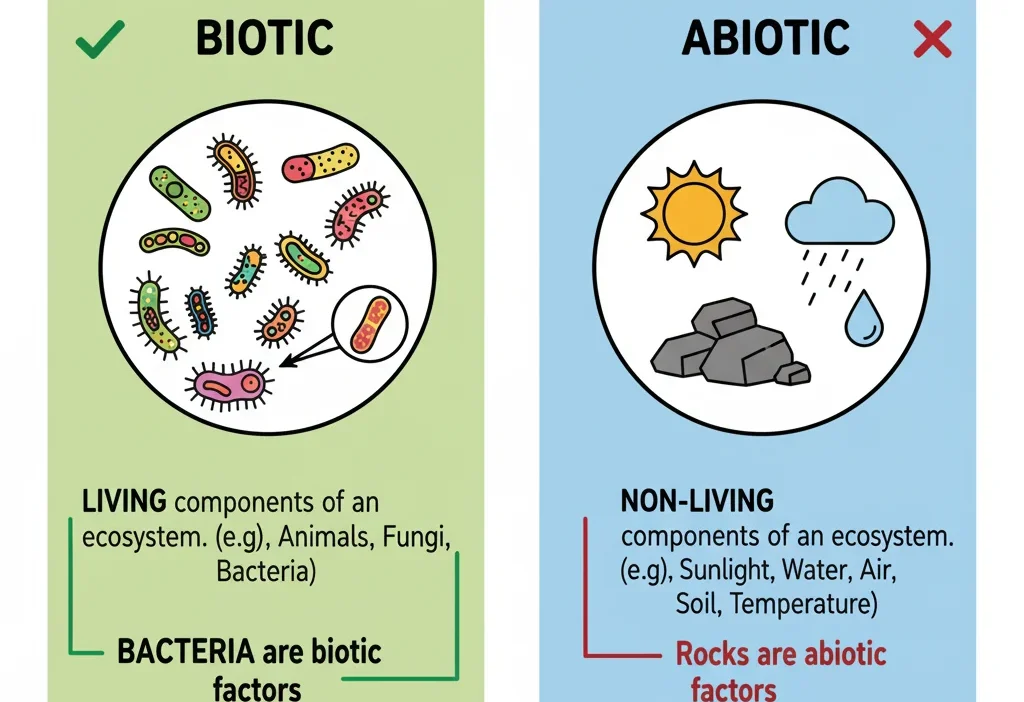
Biotic means living things.
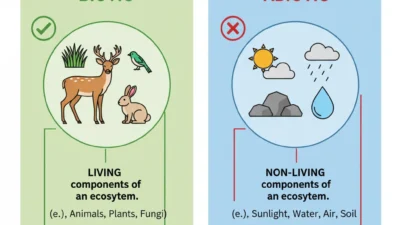
Anything that grows, breathes, eats, reproduces, or responds to the environment is biotic.
Part of Speech: adjective (describes something living)
Examples:
- Humans are biotic.
- Trees are biotic parts of nature.
- Bacteria are biotic organisms.
3. What Does “Abiotic” Mean?
Abiotic means non-living things.
These do not grow, breathe, reproduce, or react like living things.
Part of Speech: adjective (describes something non-living)
Examples:
- Rocks are abiotic.
- Air is an abiotic factor.
- Sunlight is abiotic.
Mini Memory Trick:
- Abiotic = A (not) living
- Think of A = absent of life
The Key Difference Between Biotic and Abiotic (With Table)
Biotic = living
Abiotic = non-living
Here is a simple comparison:
| Feature | Biotic | Abiotic |
|---|---|---|
| Meaning | Living things | Non-living things |
| Can reproduce? | Yes | No |
| Needs food/energy? | Yes | No |
| Examples | Bacteria, plants, animals | Rocks, water, air |
| Sentence Example | Bacteria are biotic. | Air is abiotic. |
Quick Tip to Remember
👉 If it can grow or reproduce → it is biotic.
👉 If it cannot grow or reproduce → it is abiotic.
So, Are Bacteria Biotic or Abiotic?
✔ Bacteria are biotic
✔ They are alive
✔ They can reproduce
✔ They use energy
✔ They respond to their environment
Even though they are tiny, they have all the features of living things.
Common Mistakes and How to Avoid Them
❌ Mistake 1: Calling Bacteria “Abiotic”
Wrong: Bacteria are abiotic because they are too small to be alive.
Correct: Bacteria are biotic because they can grow and reproduce.
Why This Happens: People assume small = non-living. But size has nothing to do with life.
❌ Mistake 2: Using “Biotic” as a Noun
Wrong: A bacteria is a biotic.
Correct: A bacteria is a biotic organism.
Why: Biotic is an adjective, not a noun.
When to Use “Biotic”
Use biotic when you talk about living parts of nature.
Easy Examples:
- Bacteria are biotic organisms.
- Animals and plants are biotic factors.
- The forest has many biotic elements.
- Your body contains biotic cells.
- Biotic life depends on abiotic resources.
Real-Life Situations:
- School science class
- Environmental studies
- Biology homework
Memory Hack:
Biotic → “Bio” means life.
When to Use “Abiotic”
Use abiotic when talking about non-living things in the environment.
Easy Examples:
- The sun is an abiotic factor.
- Water and soil are abiotic things.
- Temperature is an abiotic element.
- Abiotic factors affect biotic life.
- Air is an abiotic part of nature.
Memory Trick:
Abiotic → Think “A = not alive.”
Quick Recap: Biotic vs Abiotic (Simple Summary)
- Bacteria = biotic
- Biotic = living things
- Abiotic = non-living things
- If it grows, eats, moves, or reproduces → biotic
- If it never lived → abiotic
Advanced Tips (For Older Students)
- “Biotic” comes from the Greek word bios, meaning life.
- “Abiotic” comes from a-bios, meaning not life.
- In exams, bacteria are always classified under living things.
- In environmental science, the world is divided into biotic and abiotic factors.
Soil Homogeneous or Heterogeneous: The Hidden Truth Revealed
Mini Quiz: Test Yourself!
Fill in the blanks:
- Bacteria are ______ organisms.
- Rocks are ______ factors.
- Anything that can grow is called ______.
- Air and water are ______.
- Plants and animals are ______ factors.
- “A” in abiotic means ______.
- A tiny living thing like bacteria is still ______.
(Answers: biotic, abiotic, biotic, abiotic, biotic, not, living)
Conclusion
Understanding whether bacteria are biotic or abiotic is simple when we look at the basic features of living things. Even though bacteria are very tiny, they can grow, reproduce, and use energy — which means they are clearly biotic. Biotic and abiotic factors work together to form the environment around us, and learning their difference helps students understand science better.
Now that you know the meanings, differences, and correct usage, practice using these words in your homework and daily conversations. The more you use them, the easier they become!
FAQs
1. Are bacteria biotic or abiotic?
Bacteria are biotic because they are living organisms.
2. Why are bacteria considered living?
They grow, reproduce, use energy, and respond to surroundings.
3. Can something be abiotic and later become biotic?
No. Abiotic things never live.
4. Is a virus biotic or abiotic?
Viruses are tricky, but most scientists say they are neither fully biotic nor abiotic.
5. What is the main difference between biotic and abiotic?
Biotic = living things; Abiotic = non-living.

Jenn Ashworth offers clear, engaging explanations of language and usage, helping readers grasp meanings, nuances, and differences with accuracy and ease.