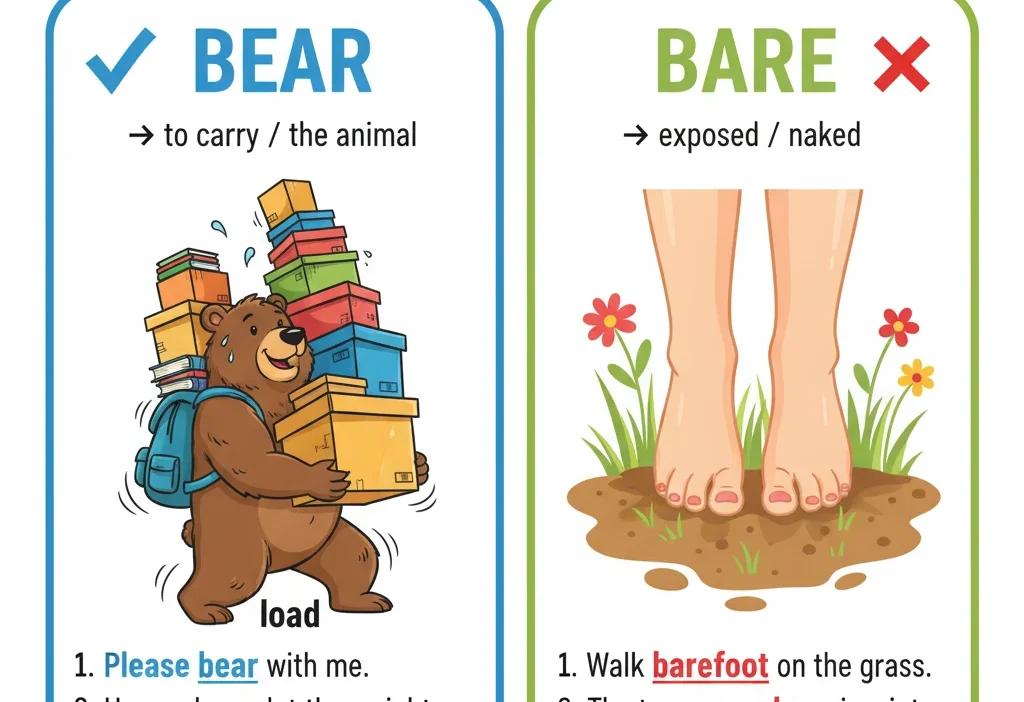
“‘Bear’ means to carry, endure, or refers to the animal, while ‘bare’ means uncovered, minimal, or exposed.”
Confused about “bear” and “bare”? You’re not alone. These two words are homophones—they sound the same but have different meanings and uses, making them easy to mix up.
- “Bear” can be a verb, meaning to carry, endure, or tolerate:
“She could barely bear the weight of the news.”
It can also be a noun, referring to the animal:
“A bear wandered through the forest.” - “Bare” is an adjective, meaning uncovered, minimal, or exposed:
“He walked on the bare floor without shoes.”
Using the wrong word can confuse readers and reduce clarity. Whether you’re writing essays, stories, social media posts, or professional content, understanding the difference ensures your sentences are clear, correct, and polished.
In this article, you’ll also find:
- Common mistakes people make with bear vs bare
- Simple tips to remember which word to use
- Practical examples for everyday writing
By the end, you’ll be able to use bear and bare confidently in any sentence, making your writing professional and mistake-free.
What Does Each Word Mean?
Let’s start with the basics — what do bear and bare actually mean?
🐻 “Bear” – Meaning and Usage
The word bear can be both a noun and a verb.
- As a noun, it means a large animal with thick fur, like a polar bear or grizzly bear.
- As a verb, it means to carry, tolerate, or give birth to.
Examples of “Bear”
- The bear climbed the tree. (noun)
- I can’t bear this noise anymore! (verb – tolerate)
- She will bear a child in June. (verb – give birth)
Mini story:
Imagine you’re camping and see a big bear carrying food—it’s easy to remember that “bear” can mean “carry” or “an animal.”
🌿 “Bare” – Meaning and Usage
The word bare is an adjective or verb.
- As an adjective, it means uncovered, naked, or without clothing.
- As a verb, it means to uncover or reveal something.
Examples of “Bare”
- He walked on the bare floor without shoes. (adjective)
- The tree was bare in winter. (adjective)
- She bared her heart in the letter. (verb – revealed)
Mini story:
Think of “bare” as something uncovered—like walking with bare feet or seeing bare walls without paint.
210+ Fact or Opinion Sentences for Practice & Learning 📝 2025
The Key Difference Between Bear and Bare
Here’s a quick look at how bear and bare differ:
| Feature | Bear | Bare |
|---|---|---|
| Part of Speech | Noun / Verb | Adjective / Verb |
| Meaning | Animal; to carry, tolerate, or give birth | Uncovered; to reveal |
| Example Sentence | “I can’t bear the pain.” | “His feet were bare.” |
| Quick Tip | Think of a bear carrying something heavy. | Think of bare meaning naked or empty. |
Quick Memory Trick:
👉 “Bear” carries things — the word itself carries more letters!
👉 “Bare” means exposed — and the word looks more empty!
Common Mistakes and How to Avoid Them
Many people confuse bear and bare because they sound alike. Let’s fix that with examples.
❌ Incorrect: I can’t bare the cold.
✅ Correct: I can’t bear the cold.
(You mean tolerate, not uncovered.)
❌ Incorrect: She went out with her bear feet.
✅ Correct: She went out with her bare feet.
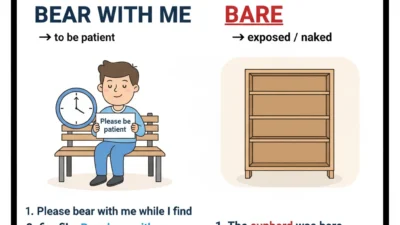
❌ Incorrect: Please bare with me for a moment.
✅ Correct: Please bear with me for a moment.
Tip: If the sentence involves “tolerate,” “carry,” or “give birth,” use bear. If it’s about “being uncovered,” use bare.
When to Use “Bear”
Use bear when you mean any of the following:
- To carry or hold:
- The bridge can bear heavy trucks.
- She bore the weight of responsibility.
- To tolerate:
- I can’t bear that smell!
- Please bear with me.
- To give birth:
- The lion will soon bear cubs.
- To support:
- The pillars bear the roof’s weight.
- As a noun (animal):
- A bear sleeps all winter.
Memory Hack:
Think of a strong bear carrying a heavy load — that’s what the word means!
When to Use “Bare”
Use bare when you’re talking about something that’s uncovered, empty, or revealed.
- Without covering or clothing:
- He was barefoot, walking on the bare ground.
- The baby’s bare skin felt soft.
- Empty or plain:
- The room looked bare after they removed the furniture.
- To uncover or show (verb):
- She bared her teeth in anger.
- He bared his soul in the poem.
Memory Hack:
If something is bare, it’s barely covered! The word itself sounds like “barely.”
Quick Recap: Bear vs Bare
Here’s everything you need to remember — fast!
- 🐻 Bear = to carry, tolerate, or the animal.
- 🌿 Bare = uncovered, naked, or to reveal.
- Bear with me = be patient.
- Bare your heart = open up emotionally.
- Bear = strong, full.
- Bare = empty, exposed.
One-line trick:
A bear carries weight. A bare thing carries nothing.
Advanced Tips: Origins, Writing, and Common Use
- Origin:
- Bear comes from Old English beran meaning “to carry.”
- Bare comes from bær meaning “naked.”
- In formal writing:
- Use bear for emotional or physical endurance (“I can’t bear this pain”).
- Use bare when describing something physically exposed (“The walls were bare”).
- In texting or online posts:
- “Please bear with me” is often misspelled as “bare with me.” Always double-check—it changes the meaning completely!
Mini Quiz: Test Your Knowledge
Fill in the blanks with the correct word (bear or bare).
- Please ______ with me while I explain.
- The baby’s ______ feet touched the grass.
- I can’t ______ the sadness anymore.
- The room looked ______ after the party.
- A ______ lives in the forest.
- She ______ her heart in her diary.
- The old table couldn’t ______ the heavy box.
Answers: 1. bear 2. bare 3. bear 4. bare 5. bear 6. bared 7. bear
210+ Grammar Tips for All of a Sudden or All of the Sudden 2025
FAQs
1. What is the difference between bear and bare?
“Bear” means to carry, tolerate, or the animal. “Bare” means uncovered or to reveal.
2. How do you remember the difference between bear and bare?
Think: A bear carries things (more letters), bare means naked (less covered).
3. Is it correct to say “bare with me”?
No. The correct phrase is “bear with me,” meaning “please be patient.”
4. Can “bare” be a verb?
Yes! “Bare” means to uncover or reveal, like “He bared his soul.”
5. What does “bear fruit” mean?
It means to produce results — “Your hard work will bear fruit.”
Conclusion
Now you know the real difference between bear and bare! You’ve learned what each word means, when to use them, and how to remember their correct usage. With a few fun tricks and examples, you can now write confidently without confusion.
Keep practicing — the more you use these words, the easier it becomes. Remember: a bear carries weight, and something bare carries nothing!

Francis Sufford crafts thoughtful, insightful explanations on language, meaning, and usage, blending clarity with storytelling to guide readers effectively.