Have you ever seen someone write “bare with me” and wondered if it’s right? You’re not alone! Many English learners — and even native speakers — get confused between bear with me and bare. They sound the same when spoken, but their meanings are completely different.
In this easy guide, we’ll explain the difference between “bear with me” and “bare”, show you their correct meanings, and give clear examples so you’ll never mix them up again. By the end, you’ll know exactly when to use each one — whether in writing, school essays, or everyday conversations.
🔍 Primary Keywords:
- bear with me or bare
- bear with me vs bare
- difference between bear and bare
- bear with me meaning
- correct usage of bear with me
🗝️ Secondary Keywords:
grammar difference, correct word choice, English examples, confusing words, usage in sentences, grammar tips, common mistake, meaning in English
💬 Semantic Keywords:
how to use bear with me, what’s the difference between bear and bare, English grammar rule, easy explanation, examples of bear with me
🧠 What Does Each Word Mean?
Let’s start by understanding both words separately.
1. Bear (verb)
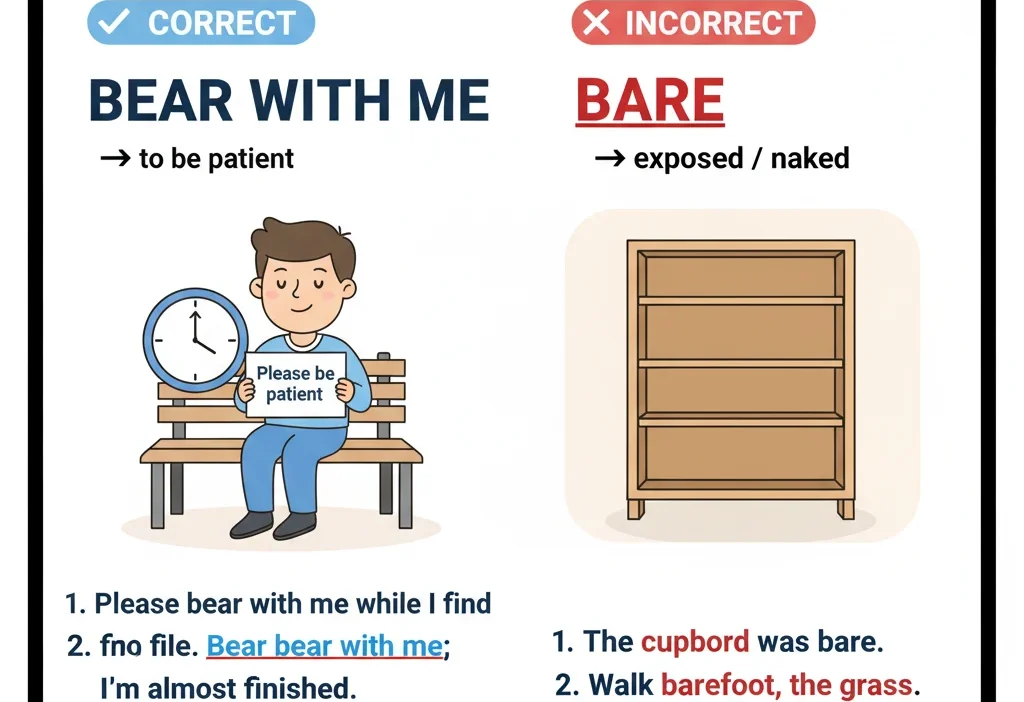
The word bear has many meanings, but in the phrase “bear with me”, it means to be patient or to wait kindly.
👉 Part of speech: Verb (an action word)
👉 Meaning: To tolerate, to be patient, or to endure something for a while.
✅ Examples:
- Please bear with me while I find your file.
- Could you bear with me for a moment while I explain?
- The students bore with the long lecture patiently.
💡 Quick story: Imagine you’re fixing your phone and it takes a few minutes. You tell your friend, “Please bear with me — it’ll just take a second!” You’re asking them to wait patiently, not to take off their clothes!
2. Bare (adjective or verb)
The word bare means naked, uncovered, or empty.
👉 Part of speech: Adjective (sometimes verb)
👉 Meaning: To expose something, or to describe something without covering.
✅ Examples:
- His feet were bare — he wasn’t wearing any shoes.
- The walls looked bare after we removed the pictures.
- She bared her teeth in anger.
💡 Easy story: When you “bare” something, you take away the cover. Like if you “bare your soul,” you share your feelings openly.
210+ Grammar Tips for All of a Sudden or All of the Sudden 2025
🆚 The Key Difference Between “Bear With Me” and “Bare”
Here’s a simple way to remember it:
- Bear with me = Be patient with me
- Bare = Naked or uncovered
🧩 Comparison Table
| Feature | Bear With Me | Bare |
|---|---|---|
| Part of Speech | Verb phrase | Adjective / Verb |
| Meaning | To ask someone to be patient | To be naked, uncovered, or exposed |
| Used In | Polite requests or delays | Describing appearance or exposure |
| Example Sentence | Please bear with me while I explain. | The trees looked bare in winter. |
💡 Quick Tip to Remember:
If you’re asking for patience, use bear.
If you’re talking about something uncovered, use bare.
Think: A “bare” bear would be a naked animal!
❌ Common Mistakes and How to Avoid Them
Mistake 1:
❌ Bare with me while I find the report.
✅ Bear with me while I find the report.
Why: You’re not asking someone to get naked with you — you’re asking for patience!
Mistake 2:
❌ He couldn’t bear the bare cold.
✅ He couldn’t bear the cold.
Why: “Bear” means tolerate. The correct sentence doesn’t need “bare” unless describing something uncovered.
Mistake 3:
❌ Please bare with me through this lesson.
✅ Please bear with me through this lesson.
Why: Always use bear when asking for understanding or time.
💡 Tip: If your sentence means “please be patient,” always choose bear with me.
🕒 When to Use “Bear With Me”
You use bear with me when you’re asking someone to wait, be patient, or understand while something takes time.
✅ Example Situations:
- During a meeting: “Please bear with me while I open the slides.”
- On a call: “Can you bear with me for a minute while I check?”
- When explaining something: “I know it’s long, but bear with me — it’ll make sense soon.”
- In daily talk: “Bear with me, I’m almost done cooking.”
- In writing: “Thank you for bearing with me through this long article!”
💡 Memory Hack:
Think of bear as a strong animal that can “carry” or “handle” things — just like being patient means you’re carrying through something tough!
🌿 When to Use “Bare”
Use bare when describing something that is uncovered, naked, or empty.
✅ Example Situations:
- “He walked on the sand with bare feet.”
- “The shelves were bare after the sale.”
- “She bared her heart in her diary.”
- “Winter left the trees bare of leaves.”
- “He bared his teeth like a tiger.”
💡 Memory Trick:
“Bare” rhymes with “naked hair.” If it’s about showing skin or emptiness — use bare.
🧾 Quick Recap: Bear With Me vs Bare
- 🐻 Bear with me = Please be patient.
- 🚫 Bare = Naked, uncovered, or empty.
Easy Summary:
- “Bear with me” → Be patient.
- “Bare” → Without covering.
- “Bear” = Verb (ask for patience)
- “Bare” = Adjective (describe something naked)
✅ Fast Reminder:
If your sentence means “wait a moment,” it’s always bear with me — never bare with me.
📘 Advanced Tips: Word Origins and Formal Use
- Bear comes from the Old English beran, meaning “to carry” or “to endure.” That’s why we use it for patience.
- Bare comes from the Old English bær, meaning “uncovered.”
In formal writing, use bear with me to politely ask readers or listeners for time or patience.
For example: “Bear with me as I explain this complex idea.”
In texting, people often write bare with me, but that’s incorrect — even though autocorrect sometimes doesn’t catch it! Always double-check before sending professional messages.
🧩 Mini Quiz: Test Yourself!
Fill in the blanks with bear or bare.
- Please _______ with me while I restart my laptop.
- The room looked _______ after we moved out.
- She couldn’t _______ the pain of losing her cat.
- The mountain trees stood _______ in winter.
- _______ with me — this story has a happy ending!
- He _______ his heart in the letter.
- Can you _______ with me for a few more minutes?
(Answers: 1. bear, 2. bare, 3. bear, 4. bare, 5. bear, 6. bared, 7. bear)
❓ FAQs: Bear With Me or Bare?
1. What does “bear with me” mean?
It means “please be patient with me” or “give me a moment.”
2. Is it ever correct to say “bare with me”?
No. “Bare with me” would mean “get naked with me,” which is not the intended meaning!
3. Why do people confuse them?
Because both words sound the same (homophones), but they have totally different meanings.
4. Can I say “bear with us”?
Yes! Example: “Please bear with us while we fix the issue.”
5. What’s an easy way to remember the difference?
Think: A “bare” bear has no fur! That’s how you remember “bare” means naked.
✨ Conclusion
Now you know the clear difference between “bear with me” and “bare.”
Use bear with me when asking for patience, and bare when describing something uncovered. Small spelling differences can completely change meaning — so always double-check before you write!
Keep practicing, use these examples in your conversations, and soon you’ll never mix them up again.

Polly Clark creates clear, insightful guides on language and usage, helping readers understand meanings, differences, and nuances with clarity and confidence.