If you’ve ever wondered whether to say “I have begun” or “I have began,” you’re not alone! Many English learners (and even native speakers) often get confused between begun and began. Both words come from the same verb — begin — but they’re used differently depending on the sentence tense.
In this guide, we’ll break down the difference between begun and began, explain their meanings, correct usage, and share easy grammar tips and examples that make remembering them super simple. By the end, you’ll know exactly when to use began and when to use begun, even in tricky situations!
Primary Keywords:
begun vs began, difference between begun and began, begun or began, began vs begun
Secondary Keywords:
grammar difference, correct usage, common mistake, examples, grammar tips, English meaning, verb tense, easy explanation
Semantic Keywords:
how to use begun and began, what’s the difference, grammar rule for begin, correct form of begin, simple grammar guide
What Does Each Word Mean?
Both began and begun come from the verb begin, which means to start something.
However, they’re used in different tenses.
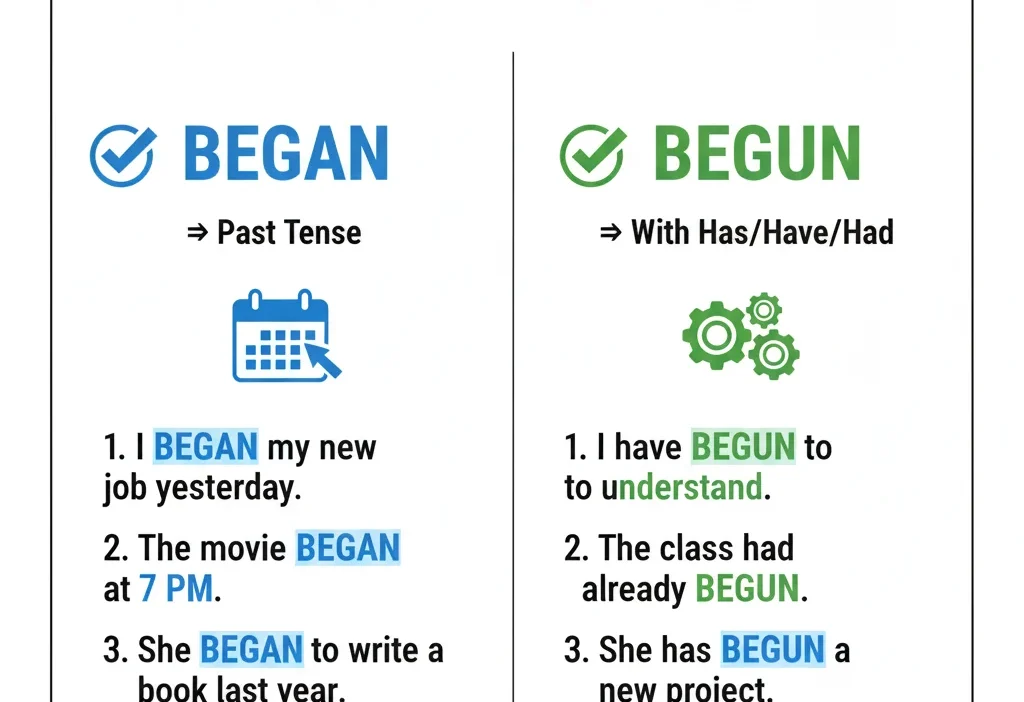
1. Began – Past Tense of Begin
“Began” is the simple past tense form of “begin.”
You use it when talking about something that started in the past and is already finished.
✅ Examples:
- I began my homework after dinner.
- She began to cry when she heard the news.
- They began their journey early in the morning.
Think of “began” as a word that stands alone. It does not need “have,” “has,” or “had.”
2. Begun – Past Participle of Begin
“Begun” is the past participle form of “begin.”
It’s always used with helping verbs like has, have, or had.
✅ Examples:
- I have begun my project.
- The rain had begun before we reached home.
- She has begun practicing for the competition.
So remember: “begun” can’t stand alone — it needs a helper verb!
The Key Difference Between Begun and Began
Here’s a simple comparison to make it crystal clear:
| Feature | Began | Begun |
|---|---|---|
| Tense | Simple Past | Past Participle |
| Helper Verb? | ❌ No | ✅ Yes (has/have/had) |
| When to Use | Something started and finished in the past | Something started in the past and continues or connects to now |
| Example | She began painting yesterday. | She has begun painting a new picture. |
🧠 Quick Tip to Remember:
If you see has, have, or had, use begun.
If there’s no helper verb, use began.
Common Mistakes and How to Avoid Them
Even advanced learners mix these two up! Let’s fix that once and for all.
🚫 Incorrect:
- I have began a new diet.
✅ Correct: - I have begun a new diet.
👉 Why? Because “have” needs a past participle — that’s begun, not began.
🚫 Incorrect:
- The movie has began already.
✅ Correct: - The movie has begun already.
👉 “Has” always pairs with begun.
🚫 Incorrect:
- We had began the test before the teacher came.
✅ Correct: - We had begun the test before the teacher came.
When to Use Began
Use began when describing something that started and ended in the past.
It works perfectly in stories, reports, or past experiences.
✅ Examples:
- The rain began at noon.
- I began to feel sleepy during the lecture.
- They began talking about their future plans.
- The teacher began the lesson with a smile.
- We began our trip last Sunday.
📝 Memory Trick:
Think of began = yesterday.
If it happened yesterday, “began” is the right choice!
When to Use Begun
Use begun when the action started earlier but connects to now — or when it’s part of a perfect tense.
✅ Examples:
- I have begun reading a new book.
- She had begun to cry before he apologized.
- The festival has begun already.
- We have begun to understand each other better.
- It had begun snowing before we arrived.
🧩 Memory Hack:
“Begun” loves helpers — if you see has, have, or had, it’s begun time!
Quick Recap: Began vs Begun
Here’s an easy summary you can remember anytime:
- 🕒 Began = Past Tense → No helper verb
Example: She began cooking an hour ago. - 🕓 Begun = Past Participle → Needs helper verb (has/have/had)
Example: She has begun cooking now.
✅ Simple Rule:
If your sentence has has/have/had, use begun.
If not, use began.
Advanced Tips: History, Grammar, and Writing Style
1. Word Origin
Both words come from the Old English word beginnan, meaning to start or originate.
Over time, English developed different forms for different tenses — giving us “begin,” “began,” and “begun.”
2. In Formal Writing
In essays, reports, and exams, using the correct form shows you understand grammar.
For example:
- Formal: The company has begun its new project.
- Informal (incorrect): The company has began its new project.
3. In Texting or Online Writing
People often skip helper verbs or use the wrong one online.
Example: I began my vlog today (✅ correct) vs I have began my vlog today (🚫 incorrect).
Even in casual messages, using the right form makes your English look polished and professional.
Mini Quiz: Test Your Understanding!
Fill in the blanks with began or begun 👇
- The concert ________ an hour ago.
- She has ________ to learn Spanish.
- They ________ working on the project last week.
- It had ________ to rain before we left.
- I ________ reading this book yesterday.
- We have ________ a new fitness routine.
- The teacher ________ explaining the lesson.
✅ Answers:
- began
- begun
- began
- begun
- began
- begun
- began
Frequently Asked Questions (FAQs)
1. What is the main difference between begun and began?
👉 “Began” is past tense; “begun” is the past participle used with has, have, or had.
2. Can I use “begun” without a helping verb?
🚫 No. “Begun” always needs has, have, or had.
3. Which is correct: “has began” or “has begun”?
✅ “Has begun” is correct. “Has began” is grammatically wrong.
4. How can I easily remember when to use them?
🧠 Use this trick: has/have/had = begun, no helper = began.
5. Why do people confuse begun and began?
Because both come from “begin” and sound similar — but their grammar roles are different!
Conclusion
Now you know the clear difference between begun and began — one tiny detail that makes a huge difference in your English writing and speaking!
Remember:
- Use began for simple past.
- Use begun with has, have, or had.
Keep practicing with short sentences every day, and soon, choosing the correct word will feel natural. Improving your English grammar is like building a muscle — the more you use it, the stronger it gets! 💪

Eley Williams writes clear, engaging guides on confusing words and phrases, helping readers understand meanings, differences, and correct usage with ease.