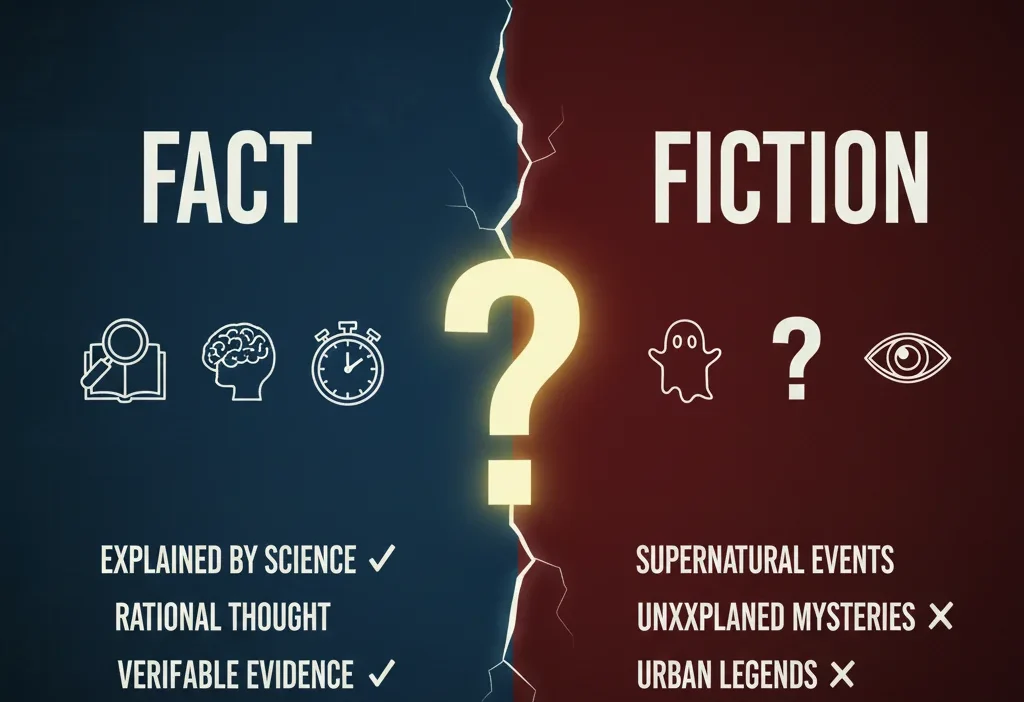
“Beyond Belief: Fact or Fiction” is not a grammar pair like then or than, but people often treat fact and fiction as confusing English terms. Fact means something real and proven, while fiction means something imagined or made up. This guide explains the difference between fact and fiction, their correct usage, grammar tips, examples, and how to avoid common mistakes.
The phrase “Beyond Belief: Fact or Fiction” became popular because of the famous TV show that challenged viewers to guess whether a story was true (fact) or made up (fiction). But many English learners get confused between the words fact and fiction in everyday writing and speaking. Since both words appear together so often, people start mixing their meanings or using one in place of the other.
In this simple, beginner-friendly guide, you will learn the meaning of fact, the meaning of fiction, how they are different, when to use each one, and how to spot mistakes. Everything is explained in clear, easy English so that even a 4th-grade student can understand. You will also get examples, a comparison table, memory hacks, grammar tips, and a quick recap to make learning fun and simple.
Let’s break down fact vs fiction—just like the show Beyond Belief: Fact or Fiction, but in a grammar-friendly way!
What Does Each Word Mean?
1. FACT — Meaning & Simple Definition
A fact is something real, true, proven, or supported by evidence.
If you can check it, test it, or prove it, it is a fact.
Part of speech: Noun
Easy examples:
- The sun rises in the east. (Fact)
- Water freezes at 0°C. (Fact)
- Pakistan is in Asia. (Fact)
Mini-story:
If a teacher says, “Your result is ready,” this is a fact because it actually happened and can be verified.
2. FICTION — Meaning & Simple Definition
Fiction means something made up, imagined, or created from someone’s mind—not real.
Part of speech: Noun
Easy examples:
- Dragons breathe fire. (Fiction)
- Harry Potter rides a broom. (Fiction)
- Talking trees give advice. (Fiction)
Mini-story:
If someone tells you a story about a cat that flies with rocket shoes, it’s fiction because it’s not real.
The Key Difference Between Fact and Fiction
People often search for “difference between fact and fiction” because they sound like a pair, especially in phrases like Beyond Belief: Fact or Fiction. The difference is actually very simple:
- Fact = True
- Fiction = Not true
⭐ Quick Tip to Remember
FACT = TRUE → both words have a T
FICTION = FAKE → both start with F
Comparison Table: Fact vs Fiction
| Feature | FACT | FICTION |
|---|---|---|
| Meaning | Real, proven, true | Imagined, unreal, invented |
| Usage | Reports, news, science, real events | Stories, novels, movies, imagination |
| Verification | Can be checked | Cannot be proven |
| Example | “Earth has one moon.” | “The moon is made of cheese.” |
Common Mistakes and How to Avoid Them
❌ Mistake 1:
“Harry Potter is a fact.”
✔️ Correct: “Harry Potter is fiction.”
Why?
Because Harry Potter is imaginary, not real.
❌ Mistake 2:
“This story is fiction because it really happened.”
✔️ Correct: “This story is fact because it really happened.”
Why?
Real events = facts.
❌ Mistake 3:
“He told me a fact, but I couldn’t prove it.”
✔️ Correct: “He told me information, but it might not be a fact.”
Why?
If it cannot be proven, it’s not a fact.
When to Use “Fact”
Use fact when something is:
- Proven
- Supported by evidence
- Real
- Verified
- Scientific or historical
Examples:
- It is a fact that rain comes from clouds.
- Her birthday is on 5 May—that’s a fact.
- The results show clear facts.
- The teacher shared an important fact today.
- It’s a fact that exercise is good for your health.
When to Use “Fiction”
Use fiction when something is:
- Imaginary
- Created for entertainment
- From books, movies, or stories
- Not true
Examples:
- Comics usually contain fiction.
- This movie is based on fiction, not real events.
- Children love fiction stories.
- The writer creates amazing fiction worlds.
- Ali enjoys reading science fiction.
⭐ Memory Hack
Fiction = Fake Stories → F + F (Fiction = Fake)
Quick Recap: Fact vs Fiction
- Fact = Real, true, proven
- Fiction = Imagined, made up
- Facts can be checked, fiction cannot.
- Use fact in reports, news, and truthful information.
- Use fiction in stories, novels, and movies.
Advanced Tips (Optional but Helpful)
1. Origin
- Fact comes from Latin factum meaning “a thing done”.
- Fiction comes from Latin fictio meaning “to form or shape”.
2. Use in Exams & Essays
- Use fact to support arguments:
“Studies show…” - Use fiction in creative writing:
“Imagine a world where…”
3. Online or Text Writing
Sometimes people mix fact and fiction online because:
- Rumors spread quickly
- Memes are often fictional
- Social media can mix truth with jokes
Always check sources before believing something is a fact.
Mini Quiz
Fill in the blanks with fact or fiction:
- The earth is round. (______)
- Unicorns live in the mountains. (______)
- My school opens at 8 AM. (______)
- This cartoon story is completely made up. (______)
- Fire is hot. (______)
- Superheroes can fly without wings. (______)
- Water is essential for life. (______)
5 FAQs
1. What is the main difference between fact and fiction?
A fact is real and proven, while fiction is imaginary or made up.
2. Is “Beyond Belief: Fact or Fiction” real or fictional?
It is a TV show that mixes real stories (facts) with fictional ones.
3. How do I know if something is a fact?
Check if it can be proven through evidence, research, or reliable sources.
4. Can a fact ever change?
Sometimes new science or information updates old facts.
5. Why is fiction important?
Fiction helps with creativity, imagination, and storytelling.
Conclusion
Understanding the difference between fact and fiction is simple when explained clearly. A fact is something real and proven, while fiction is something imagined. Just like the show Beyond Belief: Fact or Fiction, our everyday life also includes things that are true and things we imagine. Now you know how to use both words correctly, avoid common mistakes, and confidently identify what is real and what is not. Keep practicing—learning English becomes easier every day!

Jenn Ashworth offers clear, engaging explanations of language and usage, helping readers grasp meanings, nuances, and differences with accuracy and ease.