English is full of phrases that sound similar but do not mean the same thing. One of the most commonly confused pairs is:
👉 “Bring It On”
👉 “Bring On”
They look similar, they sound similar, and both start with the word bring.
But their meanings and usage are totally different.
People often mix them up in speaking, writing, texting, or even in captions.
The good news? By the end of this guide, you will know exactly:
- What each phrase means
- When to use bring it on and bring on
- The difference between them (with examples)
- Common mistakes and how to avoid them
This guide is written in simple English — so even a class 4 student can understand.
Let’s get started. 💪😊
✅ What Does “Bring It On” Mean?
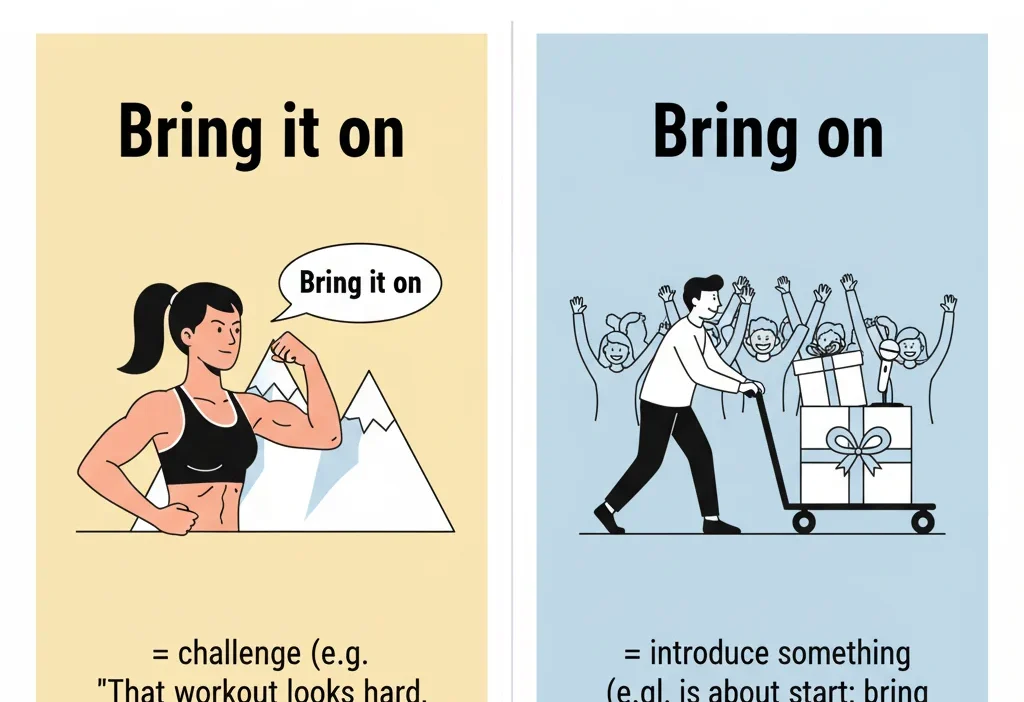
👉 “Bring it on” is a motivational or challenging phrase.
It means:
“I am ready — let’s do it!”
“I accept the challenge.”
You use bring it on when someone challenges you, and you confidently accept.
🔤 Part of Speech:
- Phrase / Expression
- Used in informal or spoken English
✅ Easy Examples:
| Situation | Sentence |
|---|---|
| Before a test | “I studied a lot. Bring it on!” |
| In a sports match | “You think your team will win? Bring it on!” |
| When someone challenges you | “You want to compete with me? Bring it on!” |
📌 Memory tip:
Think of “bring it on” as a power phrase you use when you are excited and ready.
✅ What Does “Bring On” Mean?
👉 “Bring on” means to cause something to happen or to introduce something.
It is usually followed by a noun.
It does not show challenge or excitement.
Instead, it means you are calling for something or asking for something to begin.
🔤 Part of Speech:
- Phrasal verb
(verb + preposition = bring + on)
✅ Easy Examples:
| Situation | Sentence |
|---|---|
| Starting summer vacation | “Bring on the holidays!” |
| Asking for dessert | “Bring on the cake!” |
| After stress or sadness | “Stress can bring on headaches.” |
📌 Memory tip:
If you can replace it with “cause” or “introduce”, use bring on.
🔍 The Key Difference Between Bring It On and Bring On
| Feature | Bring It On | Bring On |
|---|---|---|
| Meaning | Accepting a challenge | Causing or introducing something |
| Usage | Used as a complete phrase | Must be followed by a noun |
| Tone | Confident, bold, challenging | Neutral or casual |
| Example | “You think you can beat me? Bring it on!” | “Bring on the weekend!” |
⭐ Quick Tip to Remember:
- Bring it on → IT refers to a challenge
- Bring on → must have a noun after it
❌ Wrong: “I’m ready! Bring on!”
✅ Correct: “I’m ready! Bring it on!”
❌ Common Mistakes (and How to Fix Them)
| ❌ Incorrect | ✅ Correct | Why? |
|---|---|---|
| “I’m not afraid of the test. Bring on!” | “I’m not afraid of the test. Bring it on!” | Missing the word “it,” and referring to a challenge. |
| “Bring it on the weekend!” | “Bring on the weekend!” | Bring it on cannot be followed by a noun. |
| “Stress brings headache on.” | “Stress can bring on headaches.” | Bring on goes before the noun, not after. |
✅ When to Use Bring It On
Use bring it on when:
- Someone challenges you
- You are ready to face something difficult
- You feel confident and excited
💬 Example sentences:
- “You think you can beat me? Bring it on!”
- “Final exam tomorrow? Bring it on.”
- “You want to try again? Bring it on!”
- “I love competitions. Bring it on!”
- “You say this workout is hard? Bring it on!”
Easy rule:
If it feels like a challenge, use bring it on.
✅ When to Use Bring On
Use bring on when:
- You are introducing something
- You are asking for something to begin
- You want something to happen
💬 Example sentences:
- “Bring on the food. I’m starving.”
- “Bring on the weekend!”
- “Stress can bring on sickness.”
- “The teacher brought on a new topic today.”
- “Don’t bring on bad vibes.”
Easy rule:
If the sentence has a noun, use bring on.
🔁 Quick Recap: Bring It On vs Bring On
- Bring it on = challenge (complete phrase)
- Bring on + noun = introduce / cause something
✔ “Bring it on!” (no noun needed)
✔ “Bring on the fun!” (noun = fun)
⭐ Advanced Usage & History (Optional Reading)
- “Bring it on” became popular from movies and sports culture.
- “Bring on” is a phrasal verb used in formal and academic writing.
👉 In essays, you would use bring on, not bring it on.
Example (formal):
“Climate change can bring on severe weather effects.”
🧠 Mini Quiz
Fill in the blanks:
- “You want a challenge? _________!”
- “I’m tired. _________ the weekend.”
- Stress can _________ health problems.
- “You think you can win? _________!”
- “_______ the dessert!”
Answers:
- Bring it on
- Bring on
- Bring on
- Bring it on
- Bring on
✅ FAQs
1. What does bring it on mean?
It means I accept the challenge or I am ready.
2. Can I use “bring on” without a noun?
No. Bring on must be followed by a noun.
Example: “Bring on the weekend.”
3. Is “bring it on” formal or informal?
It is informal and often used in speech, sports, movies, or motivation.
4. Can “bring on” mean cause?
Yes. Example: “Dust can bring on allergies.”
5. Which is correct: Bring it on the weekend?
Incorrect.
Correct: Bring on the weekend.
✅ Conclusion
Understanding the difference between bring it on and bring on is simple:
- Use bring it on when you are accepting a challenge.
- Use bring on when you are introducing or causing something.
By practicing these phrases in daily conversations, texting, or writing, you will sound more natural and confident in English.
Keep learning — keep growing.
You’re doing great. 🌟

Francis Sufford crafts thoughtful, insightful explanations on language, meaning, and usage, blending clarity with storytelling to guide readers effectively.