Have you ever seen the words “brunette” and “brunet” and wondered if they mean the same thing? 🤔
They look almost identical — just one tiny “t” at the end is different. But in English, that one letter actually changes who the word describes!
In this easy guide, you’ll learn:
✅ What each word means
✅ The simple difference between brunette and brunet
✅ How to use them correctly in sentences
✅ Fun examples and memory tricks to remember forever
By the end, you’ll never mix them up again — even if English grammar feels tricky sometimes!
What Does Each Word Mean?
Let’s look at the meaning of both words in plain, simple English.
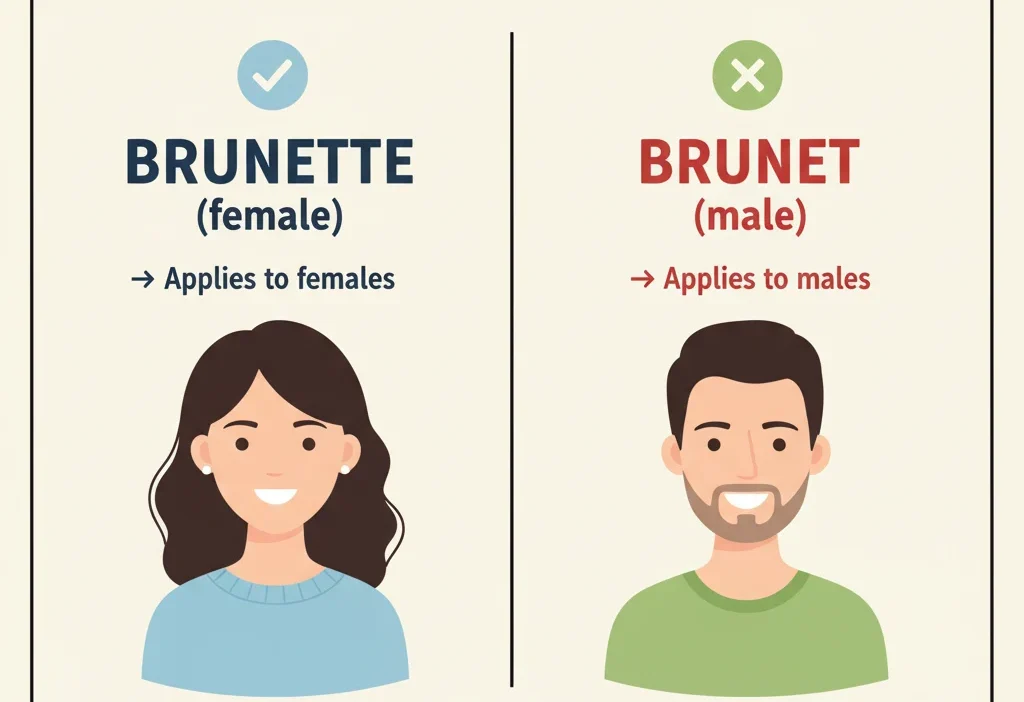
1. Brunette (with “-ette”)
- Meaning: A brunette is a woman or girl who has brown or dark hair.
- Part of Speech: Noun (and sometimes adjective).
- Used for: Females.
Examples:
- My sister is a brunette with shiny dark hair.
- The movie’s main character is a tall brunette.
- She dyed her blonde hair to become a brunette.
🪄 Memory Tip:
Think of “-ette” as a smaller or feminine form — like kitchenette or majorette. So, brunette = girl or woman with brown hair.
2. Brunet (without “-ette”)
- Meaning: A brunet is a man or boy who has brown or dark hair.
- Part of Speech: Noun (and sometimes adjective).
- Used for: Males.
Examples:
- The new student is a handsome brunet.
- My brother is the only brunet in our family.
- The actor, a dark-haired brunet, smiled at the camera.
🧠 Memory Tip:
“Brunet” ends with a plain “t” — short and simple, just like many masculine French words.
The Key Difference Between Brunette and Brunet
Here’s a simple table to make it super clear 👇
| Feature | Brunette | Brunet |
|---|---|---|
| Gender | Female | Male |
| Meaning | Woman/girl with dark or brown hair | Man/boy with dark or brown hair |
| Example Sentence | The brunette smiled at her friend. | The brunet waved at his team. |
| Origin | French feminine form | French masculine form |
| Part of Speech | Noun / Adjective | Noun / Adjective |
💡 Quick Tip:
If you’re describing a woman, use brunette.
If you’re describing a man, use brunet.
Common Mistakes and How to Avoid Them
Many English learners use “brunette” for everyone, even men.
That’s common because “brunette” is much more popular in daily English — even native speakers forget “brunet” exists!
Let’s fix that 👇
| ❌ Wrong | ✅ Correct | 💬 Why |
|---|---|---|
| He is a brunette. | He is a brunet. | “Brunette” is feminine, so use “brunet” for men. |
| The boy is a brunette. | The boy is a brunet. | “Boy” = male, so choose the masculine form. |
| She is a brunet. | She is a brunette. | For a female, use “brunette.” |
🎯 Fix it Fast:
If it’s a girl, add the “e” (brunette).
If it’s a boy, skip the “e” (brunet).
When to Use “Brunette”
Use brunette when you talk about a woman or girl with dark or brown hair.
Examples:
- The brunette actress won an award.
- I saw a brunette woman at the coffee shop.
- She used to be blonde but is now a brunette.
- The two brunette sisters looked identical.
- My teacher, a cheerful brunette, loves reading.
🧡 Memory Hack:
“Brunette” has extra letters, just like most words that describe feminine things in French.
When to Use “Brunet”
Use brunet when talking about a man or boy with brown or dark hair.
Examples:
- The brunet actor looked serious on screen.
- My best friend is a tall brunet.
- A brunet boy helped me carry my books.
- The team leader, a confident brunet, gave a great speech.
- The brunet smiled as he walked by.
💬 Visual Trick:
Think of “brunet” as “bro-net” — “bro” = boy, man. Easy, right? 😄
Quick Recap: Brunette vs Brunet
Let’s make it short and sweet:
- Brunette = 👩 Female with dark/brown hair
- Brunet = 👨 Male with dark/brown hair
- Both come from French words meaning “brown”
- Only one letter (“e”) changes the gender of the word
- In casual English, people often use brunette for both — but if you want to be correct, remember the gender rule!
📘 170+ Savior vs Saviour Grammar 2025 🧠
Advanced Tips: Origins & Modern Use
✨ Origin:
Both words come from French. In French, brun means “brown.”
- “Brunet” = small brown-haired male (diminutive of brun).
- “Brunette” = small brown-haired female.
📘 Modern English Use:
In today’s English, “brunette” is far more common.
You might rarely hear “brunet,” especially in casual speech.
However, in writing, media, or formal descriptions, “brunet” is the grammatically correct choice for men.
💬 Example (Formal Writing):
“The brunet gentleman entered the room with confidence.”
vs.
“The brunette woman greeted him warmly.”
📱 In Texting or Online:
Most people use brunette for everyone — that’s okay for casual talk. But for perfect grammar, keep the gender distinction clear.
Mini Quiz: Test Your Understanding 🧠
Fill in the blanks with brunette or brunet.
- My brother is a tall _______ with dark curls.
- The movie’s main _______ actress was amazing.
- A young _______ helped the lady cross the street.
- That _______ singer has beautiful brown hair.
- He is the only _______ in the group of friends.
- The _______ smiled and waved at her fans.
Answers: 1. brunet | 2. brunette | 3. brunet | 4. brunette | 5. brunet | 6. brunette
FAQs About Brunette vs Brunet
1. What is the main difference between brunette and brunet?
👉 Brunette is used for females; brunet is for males.
2. Can “brunette” be used for men?
Technically no, but in casual speech, many people use “brunette” for both human .
3. Is “brunet” an old or uncommon word?
Yes, “brunet” is less common but still correct in formal or written English.
4. Can these words be used as adjectives?
Yes! Example: a brunette woman, a brunet man.
5. What is the plural form of each?
- Brunettes (for women)
- Brunets (for men)
Conclusion
Now you know the real difference between brunette and brunet! 🌟
Remember — both mean dark-haired person, but brunette describes females, and brunet describes males.
So next time you write, speak, or describe someone’s hair color, you’ll use the right word with confidence. Keep learning and practicing — every new word brings you closer to mastering English! 💪📚

Francis Sufford crafts thoughtful, insightful explanations on language, meaning, and usage, blending clarity with storytelling to guide readers effectively.