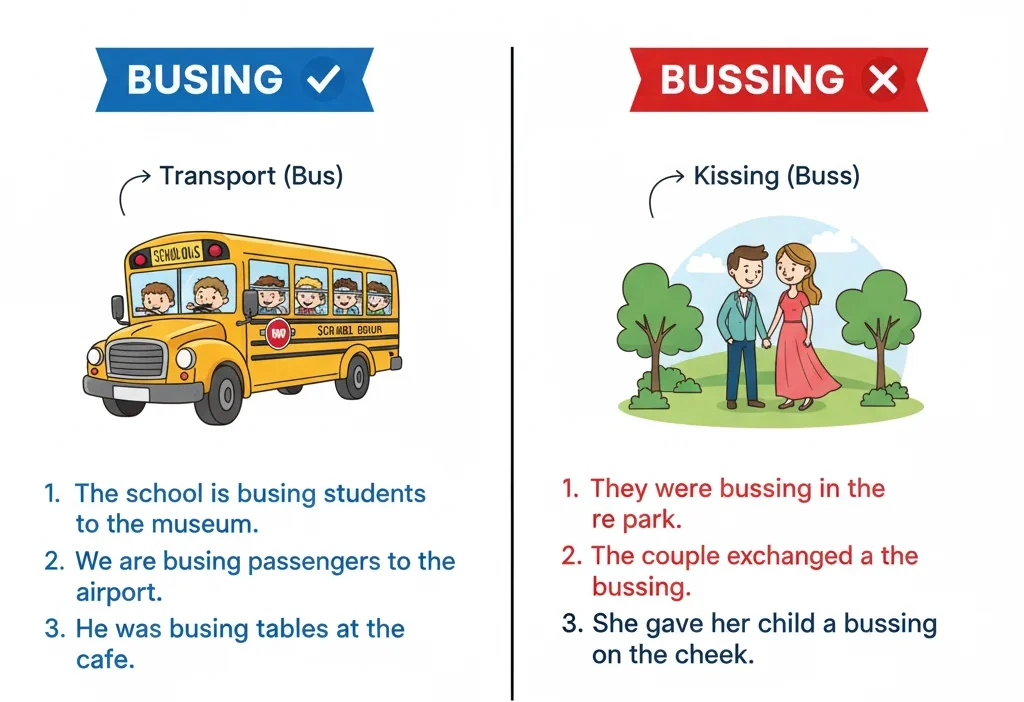
Ever wondered why ‘busing’ and ‘bussing’ look similar but mean totally different things? Here’s the clear difference! Busing refers to the act of transporting people, usually by bus, such as students being taken to school or employees to a conference (“The students are busing to the field trip”, “The company is busing employees to the conference”).
On the other hand, Bussing is the act of kissing, often playfully or romantically (“They were bussing under the mistletoe”, “They were bussing goodbye at the train station”).
Although the words appear similar, their meanings are completely different, and using the wrong one can confuse your reader. If you want to write clearly and choose the right word for your intended meaning, understanding busing vs bussing is essential.
“Busing means transporting people by bus, while bussing means kissing; both are correct words but should be used in the right context.”
🧐 What Does Each Word Mean?
Before we jump into differences, let’s understand what each word means on its own.
🚍 Busing – Meaning and Usage
Busing (also spelled bussing in some regions) is a verb that means transporting people by bus — usually groups of students or workers.
It comes from the base word bus, and when we add “-ing,” it becomes the act of transporting.
✅ Examples of “Busing” in Sentences:
- The school is busing students to the museum for a field trip.
- During the 1970s, the U.S. government began busing children to different schools for integration.
- The company started busing employees to the new office building.
Simple Meaning:
👉 “Busing” = traveling or transporting by bus.
It’s the correct and most common spelling used in American English.
💋 Bussing – Meaning and Usage
Here’s where it gets fun (and a little romantic)!
Bussing (with two s’s) has two meanings depending on context:
- To kiss 💋 (a playful or old-fashioned term)
- To clear tables 🍽️ (in restaurants — as in “busboy”)
So, bussing is not always about buses — sometimes it’s about kisses or cleaning tables!
✅ Examples of “Bussing” in Sentences:
- The couple was bussing each other on the cheek before saying goodbye.
- He spent the evening bussing tables at the diner.
- The waiter was busy bussing the tables after the lunch rush.
Simple Meaning:
👉 “Bussing” = kissing or clearing tables (not riding a bus!).
⚖️ The Key Difference Between “Busing” and “Bussing”
Here’s a quick and clear comparison you can remember easily 👇
| Feature | Busing | Bussing |
|---|---|---|
| Meaning | Transporting people by bus | Kissing OR clearing tables |
| Part of Speech | Verb (present participle of “bus”) | Verb (present participle of “buss”) |
| Common Usage | American English (transportation) | Informal / restaurant / old-fashioned |
| Example Sentence | The school is busing students to camp. | The waiter is bussing tables. |
| Pronunciation | /ˈbʌsɪŋ/ | /ˈbʌsɪŋ/ (same sound!) |
🧠 Quick Tip to Remember:
🚍 One “s” = bus (transport)
💋 Two “s’s” = buss (kiss or clean)
Think of it like this:
Double “s” = double action (kiss or clean)
Single “s” = single ride (bus)
hai article nahi likhna
Busing vs Bussing in American English
Busing is the standard and preferred spelling in American English when referring to transporting people by bus.
Bussing in American English is generally reserved for:
- Kissing (informal/old-fashioned)
- Clearing tables (e.g., “bussing tables”)
📌 Quick Rule:
In the U.S., use busing for buses, bussing for kisses or restaurant work.
300+ Understand Totalled vs Totalling Grammar🧠 2025
❌ Common Mistakes and How to Avoid Them
Let’s look at a few common mix-ups:
Mistake 1:
❌ The school is bussing students to the park.
✅ The school is busing students to the park.
✨ Why it’s wrong: “Bussing” here looks like they’re kissing the students! Always use “busing” for transportation.
Mistake 2:
❌ The waiter is busing tables after dinner.
✅ The waiter is bussing tables after dinner.
✨ Why it’s wrong: “Busing” would mean “driving people by bus,” which doesn’t fit. “Bussing” is correct in restaurant contexts.
Mistake 3:
❌ We enjoyed busing each other goodbye.
✅ We enjoyed bussing each other goodbye.
✨ Why it’s wrong: The “bus” form doesn’t mean kiss! Use “bussing” for affection.
🚌 When to Use “Busing”
Use busing when you’re talking about transportation by bus — especially for groups of people.
This spelling is the standard form in American English, and you’ll see it in schools, news, and travel guides.
✅ Example Sentences:
- The company started busing workers from nearby towns.
- The government introduced busing to help integrate schools.
- Tourists are busing from the hotel to the beach every morning.
- The city plans to stop busing students to faraway schools.
- We’re busing our guests to the wedding venue.
🧠 Memory Hack:
If it’s about buses or travel, use one “s” — busing.
🍽️ When to Use “Bussing”
Use bussing when talking about kissing 💋 or clearing tables 🍽️.
It’s a less common word, but you’ll often hear it in restaurants or old-fashioned writing.
✅ Example Sentences (Kissing Meaning):
- The bride and groom were bussing after the ceremony.
- They were bussing goodbye at the airport.
- The old movie showed couples bussing on New Year’s Eve.
busing in schools history
busing in schools → 1950s–1970s mein America mein racial integration ke liye students ko school tak pahunchane ka system tha, jisse school busing ya desegregation busing kehte hain.
Iska maksad tha Black aur White students ke schools ko mix karna, kyunki neighbourhoods racially divided the.
1971 ke Supreme Court case Swann v. Charlotte-Mecklenburg Board of Education ne isko legally support kiya.
✅ Example Sentences (Clearing Tables Meaning):
- He got a part-time job bussing tables after school.
- The restaurant staff were bussing tables quickly before closing.
- She’s been bussing at the café since last summer.
💡 Memory Trick:
Double “s” = double action — like two people kissing or two hands cleaning!
“Bussing or busing in Canada”
In Canada, both “bussing” and “busing” may be seen in written English, but the preferred spelling for the transport-related term is “busing” (one ‘s’), following American English conventions. However, due to Canada’s British English influence, some publications or contexts might still use “bussing”.
For clarity:
- Use busing for transporting by bus (e.g., school busing).
- Use bussing only if you mean kissing or clearing tables.
🇨🇦 Canadian English Tip:
When in doubt, use busing for bus-related meanings—it’s the safer and more widely accepted choice in modern Canadian writing.
🔁 Quick Recap: “Busing” vs “Bussing”
Here’s a super short summary you can remember easily:
- Busing → transporting by bus 🚌
- Bussing → kissing 💋 or clearing tables 🍽️
- Both sound the same but mean very different things!
- American English prefers busing for transportation.
- Always check your context before writing!
💡 Advanced Tips & Fun Facts
- Origin:
- “Busing” comes from the noun bus (from “omnibus,” Latin for “for all”).
- “Bussing” comes from the old word buss, meaning “a kiss,” used in the 1500s!
- British vs. American Usage:
- In the UK, both spellings sometimes appear, but bussing for buses is rare now.
- In the U.S., busing is the accepted modern form.
- In Modern Writing:
Always use busing for transportation, especially in essays, emails, or news writing.
“Bussing” for “kissing” is now mostly used in literature, jokes, or poetry. - In Texting or Slang:
Some people jokingly use “bussing” (slang: “that’s bussin’!”) to mean something’s really good — but that’s different slang, not grammar! 😄
Bussing Slang Meaning
“Bussing” (also written as “bussin’”) is modern slang that means something is extremely good, tasty, cool, or excellent. It’s often used to describe food, music, fashion, or an exciting situation.
✅ Examples in Sentences:
- “This pizza is bussin’!”
(Meaning: This pizza is delicious.) - “Her new track is bussin’ on TikTok.”
(Meaning: Her song is trending and really good.) - “That outfit is bussin’!”
(Meaning: That outfit looks amazing.)
✏️ Mini Quiz: Test Your Understanding!
Choose the correct word: busing or bussing
- The school is _______ students to the zoo.
- The waiter is _______ tables after dinner.
- They were _______ goodbye before the train left.
- The company began _______ workers to the new site.
- In the 1970s, racial integration often involved _______.
Answers:
- busing
- bussing
- bussing
- busing
- busing
❓ (FAQs)
1. Which is correct: busing or bussing?
✅ Both can be correct, depending on meaning. Use busing for transportation and bussing for kissing or clearing tables.
2. Why are there two spellings?
Because “bussing” can come from two different words: “bus” (the vehicle) or “buss” (a kiss). The double “s” makes the meaning change!
3. Is “busing” British or American English?
“Busing” is mainly American English. British English sometimes uses “bussing,” but it’s becoming rare.
4. Can I use “bussing” in a school essay?
Only if you mean “kissing” or “clearing tables.” For transportation, always write busing.
5. What does “bussin’” mean in slang?
In modern slang, “bussin’” means something is really good — like “this pizza is bussin’!” But that’s informal and unrelated to grammar.
🏁 Conclusion
So now you know the truth about busing vs bussing! 🚍💋
- Use busing when talking about buses or transportation.
- Use bussing for kisses or cleaning tables.
- Remember: double “s” = double action, and you’ll never confuse them again.
Keep practicing by reading and writing sentences with both words. The more you see them in action, the easier it becomes to remember.
English may be full of confusing pairs, but with simple guides like this, you’ll master them all! 🌟

Francis Sufford crafts thoughtful, insightful explanations on language, meaning, and usage, blending clarity with storytelling to guide readers effectively.