Some English words are confusing because they sound similar or appear in similar situations. “Buyback” and “lemon” are two such terms. Many people mix them up, especially when talking about cars, warranties, or consumer rights. Even though both words appear in similar topics, their meanings are completely different.
In this beginner-friendly guide, you will learn the meaning, difference, and correct usage of buyback / lemon with very simple explanations and real-life examples. Every sentence is easy enough for even a class 4 student to understand. You will also get memory tricks, example sentences, a comparison table, and a short quiz to check your understanding.
By the end, you’ll never confuse these two words again — whether you’re reading, writing, or talking about products, cars, or warranties.
What Does Each Word Mean?
1. What Does “Buyback” Mean?
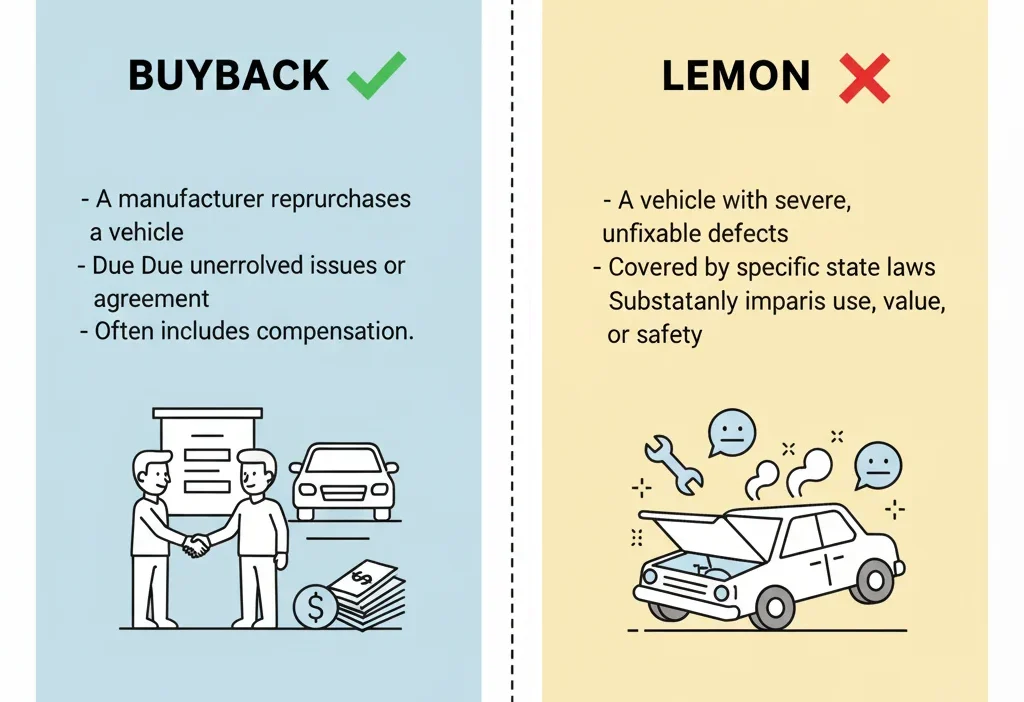
Buyback means something is bought again or returned to the seller, and the seller pays the buyer back.
It is usually used when a company takes back a product because of a problem or as part of a deal.
Part of speech: Noun
Simple Examples of Buyback
- The company offered a buyback for the broken laptop.
- The car dealer agreed to a buyback because the customer was not satisfied.
- She used the phone buyback program to trade in her old phone.
2. What Does “Lemon” Mean?
A lemon, in everyday English, means a product (usually a car) that has many problems or defects.
It does not mean the fruit here. It is a slang word used for bad quality items.
Part of speech: Noun
Simple Examples of Lemon
- The new car was a lemon because it kept breaking down.
- He returned the TV since it turned out to be a lemon.
- A phone that stops working every day feels like a lemon.
The Key Difference Between Buyback and Lemon
Even though both words are used when a product has issues, they mean different things:
- Lemon = A bad product (especially a car).
- Buyback = When the seller takes the product back and refunds or replaces it.
Here is a quick visual comparison:
Comparison Table: Buyback vs Lemon
| Feature | Buyback | Lemon |
|---|---|---|
| Meaning | When the seller takes back the product and pays the customer | A product that has too many problems |
| Part of Speech | Noun | Noun |
| Used For | Refunds, returns, replacement programs | Bad products, faulty cars |
| Example | “The dealer issued a buyback.” | “My car is a lemon.” |
| Easy Tip | Buyback = Buy again / refund | Lemon = Bad product |
Quick Tip to Remember
Think of a lemon fruit — sour and unpleasant.
A lemon product is also unpleasant because it doesn’t work.
A buyback happens after the product turns out to be a lemon.
Common Mistakes and How to Avoid Them
Mistake 1:
❌ “This car is a buyback.”
✔️ Correct: “This car is a lemon.”
Why? Buyback is the action of returning. Lemon is the bad car.
Mistake 2:
❌ “The company gave me a lemon program.”
✔️ Correct: “The company gave me a buyback program.”
Why? Programs and policies are buyback programs, not lemon programs.
Mistake 3:
❌ “My phone was a buyback so I complained.”
✔️ Correct: “My phone was a lemon so I complained.”
When to Use “Buyback”
Use buyback when you are talking about:
- A return
- A refund
- A company taking back a product
- An exchange or replacement
- A special program that involves returning items
Example Sentences
- The store offered a buyback after hearing about the issue.
- The car’s problems were so serious that the dealer approved a buyback.
- Many companies have buyback programs for old phones.
- She received a buyback for her defective washing machine.
- He asked for a buyback after the laptop stopped turning on.
When to Use “Lemon”
Use lemon when talking about:
- A product with too many problems
- A car that breaks often
- Something that doesn’t work well from the start
Example Sentences
- This car is a lemon because the engine keeps failing.
- My new laptop is a lemon; it shuts down every hour.
- They sold him a lemon, so he filed a complaint.
- Her washing machine was such a lemon that she returned it.
- Any product with repeated issues can be called a lemon.
Memory Hack
A lemon fruit tastes sour →
A lemon product makes you feel sour.
So remember: Lemon = Sour product.
Quick Recap: Buyback vs Lemon
- Buyback = Returning + refund or replacement
- Lemon = A bad product with many issues
- A product becomes a lemon first… then it may qualify for a buyback.
- Use buyback for programs, refunds, and returns.
- Use lemon for faulty items and broken cars.
Advanced Tips (For Curious Learners)
- The word “lemon” in this meaning started in American English many years ago to describe something that “looks good outside but is bad inside.”
- A buyback is a formal return process and is used in business, law, and product warranties.
- In writing essays or reports, “lemon” is considered informal, while “buyback” is formal.
- In texting or online posts, people often write “I got a lemon!” which simply means a bad product.
Mini Quiz (Test Yourself!)
Fill in the blanks:
- The company offered a _________ for the damaged TV.
- Her new car was a complete _________ because it broke down daily.
- After finding many problems, he requested a _________.
- A product with repeated issues is called a _________.
- The dealer approved a _________ for the faulty vehicle.
(Answers: 1-buyback, 2-lemon, 3-buyback, 4-lemon, 5-buyback)
5 FAQs
1. What is the difference between a buyback and a lemon?
A lemon is a faulty product; a buyback is when the seller takes the product back and refunds or replaces it.
2. Can a lemon car qualify for a buyback?
Yes. Many companies offer buyback programs for lemon cars.
3. Is “lemon” a formal English word?
It is informal when used to describe a bad product, but very common in everyday English.
4. Is buyback only used for cars?
No. It can be used for phones, laptops, electronics, and many other items.
5. Why do people confuse buyback and lemon?
Because both words are used when a product has problems, but they describe different stages: first lemon → then buyback.
Conclusion
Understanding the difference between buyback and lemon can save you from confusion, especially when dealing with products, cars, warranties, or return policies. A lemon is a problem-filled product, while a buyback is the action taken to return that product and receive a refund or replacement. With the simple examples, comparison table, and memory tricks in this guide, you now know exactly when to use each word correctly. Keep practicing these terms in your daily conversations and writing. Small steps like this help you grow stronger in English every day.

Polly Clark creates clear, insightful guides on language and usage, helping readers understand meanings, differences, and nuances with clarity and confidence.