Have you ever paused while writing and wondered — should I use a colon (:) or a semicolon (;)? You’re not alone! Many English learners, and even native speakers, find colon vs semicolon confusing. Both marks look similar and pause a sentence, but they have very different jobs.
In this simple guide, you’ll learn the difference between a colon and a semicolon, their correct usage, and easy grammar tips to remember which one to use. By the end, you’ll be using both marks like a pro — with examples so clear that even a 4th grader can understand them!
🟡 What Does Each Symbol Mean?
Before learning when to use them, let’s understand what each one means in plain English.
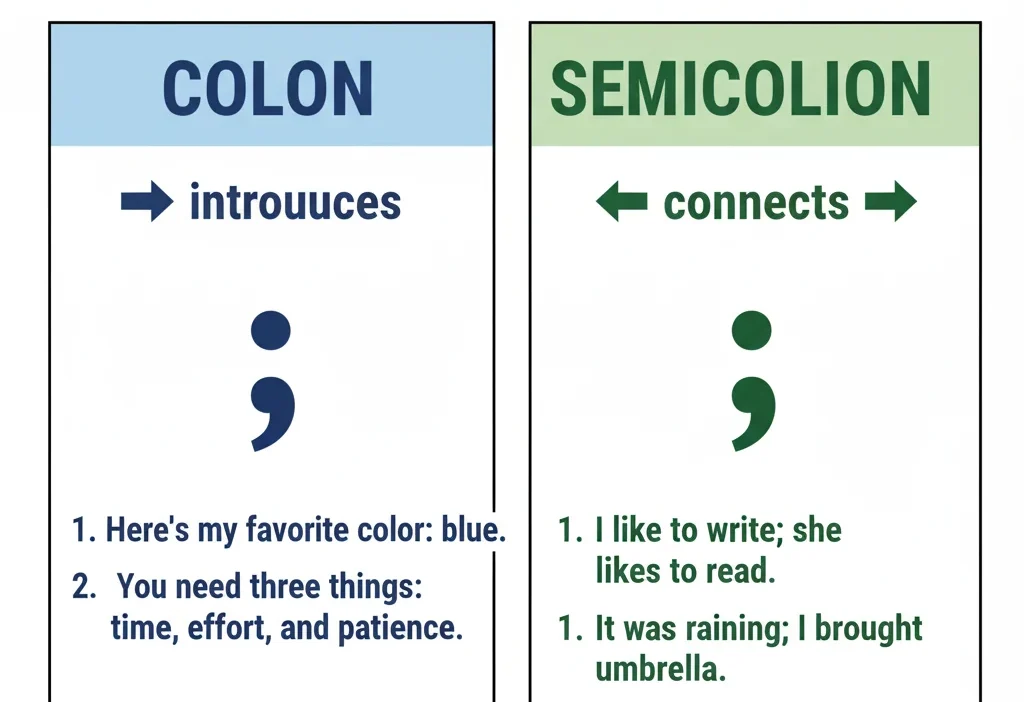
Colon (:) — The “Introducing” Mark
A colon introduces or explains something. Think of it as a “ta-da!” moment before giving more details.
Part of speech: punctuation mark (not a word, but a writing tool).
Use a colon to:
- introduce a list,
- explain something,
- or show emphasis.
Examples:
- I have three pets: a cat, a dog, and a rabbit.
- She finally got what she wanted: peace and quiet.
- The teacher said: “Always check your work.”
Mini story: Imagine the colon as a spotlight — it shines light on what’s coming next!
Semicolon (;) — The “Linking” Mark
A semicolon joins two ideas that are closely related but could stand alone as separate sentences.
Part of speech: punctuation mark.
Use a semicolon to:
- join two complete sentences that are connected,
- or separate long items in a list that already contain commas.
Examples:
- I wanted to go outside; it was raining too hard.
- She loves baking; her cookies are the best in town.
- We visited Paris, France; Rome, Italy; and Madrid, Spain.
Mini story: The semicolon is like a bridge — it connects two complete thoughts without using “and” or “but.”
🔵 The Key Difference Between Colon and Semicolon
| Feature | Colon (:) | Semicolon (;) |
|---|---|---|
| Purpose | Introduces, explains, or gives details | Connects related complete sentences |
| Used Before | A list, explanation, or quotation | Another full sentence or complex list |
| Example | She packed everything: clothes, shoes, and snacks. | She packed everything; she was ready for the trip. |
| Quick Tip | Think colon = introduces | Think semicolon = connects |
Quick Tip to Remember:
👉 A colon points forward (introduces what comes next).
👉 A semicolon holds hands (joins two related ideas).
⚠️ Common Mistakes and How to Avoid Them
Mistake 1:
❌ I love three colors; red, blue, and green.
✅ I love three colors: red, blue, and green.
Why: A colon is used before a list, not a semicolon.
Mistake 2:
❌ I was tired: I went to sleep early.
✅ I was tired; I went to sleep early.
Why: The semicolon joins two complete sentences.
Mistake 3:
❌ Remember: always eat, sleep; and study.
✅ Remember: always eat, sleep, and study.
Why: Don’t mix colons and semicolons in one short list.
Fix tip:
👉 Ask yourself: “Am I about to list or explain something?” Use a colon.
👉 Or: “Am I joining two related sentences?” Use a semicolon.
🟢 When to Use a Colon (:)
You should use a colon in these situations:
- Before a List:
- We bought everything: bread, milk, eggs, and fruit.
- Before an Explanation:
- He stopped running: his shoes had a hole in them.
- Before a Quotation:
- The poster read: “Keep calm and carry on.”
- To Emphasize:
- There’s one thing I can’t live without: coffee.
- In Ratios or Time:
- The score was 3:2.
- The meeting starts at 10:30.
Memory Hack:
🧠 Think of a colon as a drum roll — it builds up to something important!
🟣 When to Use a Semicolon (;)
Use a semicolon when you want to:
- Connect Two Related Sentences:
- She was nervous; the stage lights were bright.
- Replace “and” or “but”:
- I wanted to stay home; it was raining anyway.
- Separate Complex List Items:
- On our trip, we visited Rome, Italy; Paris, France; and Berlin, Germany.
- Join Sentences with Linking Words (like however, therefore):
- She studied hard; however, she forgot her notes.
- Show Contrast or Balance:
- Some people love coffee; others prefer tea.
Memory Hack:
🌉 Imagine the semicolon as a bridge — it connects two strong ideas without breaking the flow.
225+ Comma Before or After So Examples You Must Know 📘 2025
🧭 Quick Recap: Colon vs Semicolon
- Colon (:) → introduces or explains something.
- Example: There’s one rule: always tell the truth.
- Semicolon (;) → joins two related sentences.
- Example: She was tired; she slept early.
In short:
- Use colon = before something new.
- Use semicolon = between two connected ideas.
✨ Advanced Tips for Colon and Semicolon
- In Formal Writing:
- Colons often appear in essays, speeches, and business letters.
Example: Note: All entries must be submitted by Friday. - Semicolons help connect professional thoughts smoothly.
Example: The company expanded rapidly; profits increased by 20%.
- Colons often appear in essays, speeches, and business letters.
- In Academic or Creative Writing:
- Great writers use semicolons to control rhythm:
She smiled; the world seemed brighter. - Colons add dramatic effect:
He had only one dream: to fly.
- Great writers use semicolons to control rhythm:
- In Texting or Online Posts:
- Avoid overusing them. Keep sentences simple for clarity.
Fun Fact:
The colon comes from the Greek word kōlon, meaning “part of a sentence.”
The semicolon was first used in the 1400s to help readers pause naturally.
🧩 Mini Quiz: Test Your Knowledge!
Fill in the blanks with colon (:) or semicolon (;)
- I have one goal ___ to finish my homework on time.
- She was exhausted ___ she had been studying all night.
- Bring these items ___ pencils, paper, and glue.
- We went to London, England ___ Paris, France.
- He had one wish ___ to make his parents proud.
(Answers: 1 – colon, 2 – semicolon, 3 – colon, 4 – semicolon, 5 – colon)
💬 FAQs
Q1. What is the main difference between colon and semicolon?
A colon introduces; a semicolon connects two related sentences.
Q2. Can I use a colon after a verb?
Usually, no. Instead, rephrase your sentence to place the colon after a full clause.
Q3. Can a semicolon replace a comma?
No. Semicolons join full sentences; commas are for shorter pauses.
Q4. Is it wrong to use both in one sentence?
It’s rare but possible in complex lists or formal writing.
Q5. Which is used before a list: colon or semicolon?
Always use a colon before a list.
🌟 Conclusion
Now you know the difference between a colon and a semicolon — one introduces, the other connects. These two marks may look small, but they can make your writing clearer and more powerful. Practice using them in short sentences, emails, or even diary entries. The more you use them, the more natural they’ll feel.
Keep learning, keep writing, and soon punctuation will be your best friend!
Author Note: Written by an English grammar enthusiast passionate about making language simple for everyone.

Jenn Ashworth offers clear, engaging explanations of language and usage, helping readers grasp meanings, nuances, and differences with accuracy and ease.