Have you ever stared at a sentence and wondered — should I put a comma before or after “so”? You’re not alone! Many English learners (and even native speakers) find this tiny word surprisingly tricky. The confusion comes from the fact that “so” can play different roles in a sentence — sometimes joining two ideas, and other times showing a result or purpose.
In this friendly guide, you’ll learn exactly when to use a comma before or after “so,” what it really means, and how to use it correctly with plenty of examples. By the end, you’ll never hesitate about commas and “so” again!
🧩 What Does “So” Mean?
Before we worry about commas, let’s understand what “so” actually means.
“So” can play two main roles in a sentence:
- As a coordinating conjunction – to join two independent ideas (like and, but, or).
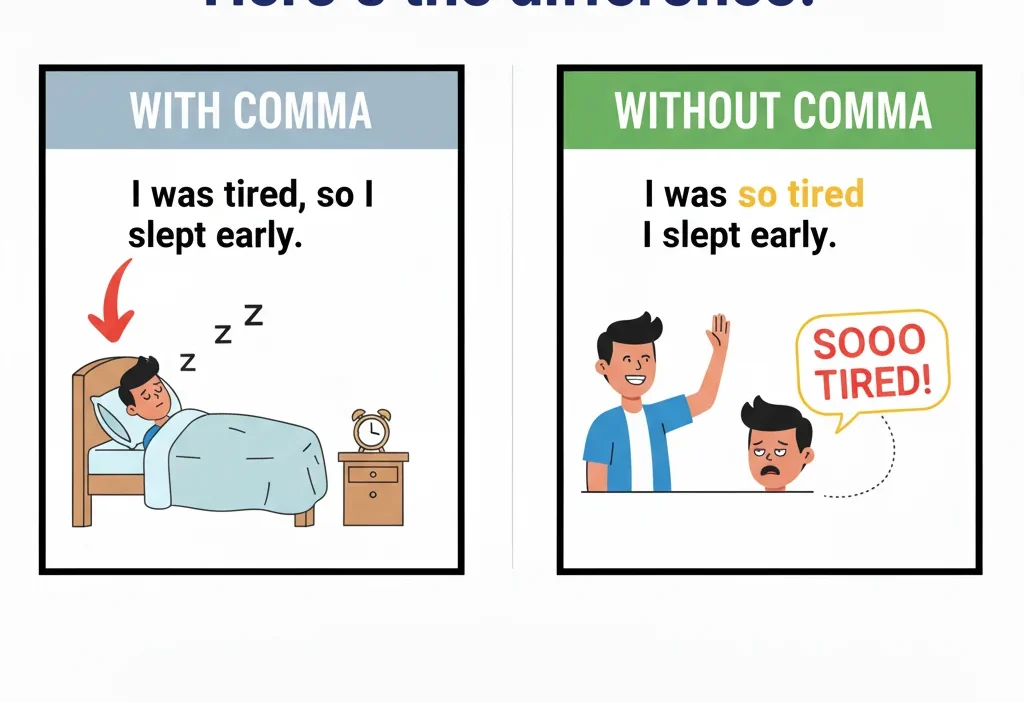
- Example: I was tired, so I went to bed early.
- As an adverb – to show degree or result.
- Example: She was so happy that she cried.
Let’s look at some easy examples:
✅ Examples when “so” joins two ideas:
- It was raining, so we stayed inside.
- He forgot his keys, so he couldn’t open the door.
- She studied hard, so she passed the test.
✅ Examples when “so” means “very” or “as a result”:
- I’m so hungry right now!
- They ran so fast that they won.
- It was so cold that the water froze.
📘 The Key Difference: Comma Before or After “So”
Here’s the rule that makes everything clear:
| Usage | When “so” connects two complete sentences | When “so” shows result or degree |
|---|---|---|
| Comma before “so” | ✅ Yes | ❌ No |
| Comma after “so” | ❌ Never | ❌ Never |
| Example | I was late, so I took a taxi. | She was so tired she fell asleep immediately. |
👉 Quick Tip:
If you can split the sentence into two complete thoughts, use a comma before “so.”
If the second part depends on the first (not a full sentence), no comma.
❌ Common Mistakes and How to Avoid Them
Let’s fix some common errors people make:
🚫 Incorrect: I was hungry so, I ate.
✅ Correct: I was hungry, so I ate.
Why? Both sides are full sentences, so you need a comma before “so.”
🚫 Incorrect: She was, so tired that she slept immediately.
✅ Correct: She was so tired that she slept immediately.
Why? Here “so” describes “tired,” not connecting two sentences—so no comma.
🚫 Incorrect: I forgot my bag, so, I went back.
✅ Correct: I forgot my bag, so I went back.
Why? You never put a comma after “so.”
✏️ When to Use a Comma Before “So”
You should put a comma before “so” when it joins two independent clauses (two complete sentences).
Each side must make sense on its own:
- I wanted ice cream, so I went to the store.
- She missed the bus, so she called a taxi.
- He didn’t study, so he failed the test.
- We were bored, so we watched a movie.
- The sky turned dark, so we went inside.
✅ Memory Trick:
If you can put a period instead of “so” and both parts still work, add a comma before “so.”
(I wanted ice cream. I went to the store. → Works fine. ✅)
🪄 When Not to Use a Comma (No Comma Before or After “So”)
Skip the comma when “so” isn’t joining two full ideas — for example, when it’s part of a result or degree phrase.
- She was so happy she danced.
- It was so cold that my hands hurt.
- He’s so tall that he hits the ceiling.
- The test was so easy that everyone passed.
- I’m so tired I can’t think straight.
💡 Memory Trick:
If “so” means very or as a result, no comma needed.
🔄 Quick Recap: Comma Before or After “So”
✅ Comma before “so” – when joining two full sentences.
✅ No comma – when “so” means “very” or “as a result.”
❌ Never put a comma after “so.”
Examples:
- Correct: It started raining, so we stayed home.
- Correct: It was so hot that we bought ice cream.
- Wrong: It started raining so, we stayed home.
- Wrong: She was, so happy she laughed.
🧠 Advanced Tips and Fun Facts
- Origin: “So” comes from Old English swa, meaning “in this way.”
- Formal Writing: In essays, use commas before “so” carefully. If the sentence is short, the comma can sometimes be optional:
- It’s late so I’ll go home. (Okay in informal writing)
- It’s late, so I’ll go home. (Better for formal writing)
- Texting & Online Writing: People often skip commas in casual text. That’s fine — just remember to use them in essays or emails!
- Bonus Grammar Tip: When “so” starts a sentence, treat it like a transition word and follow it with a comma:
- So, what do we do next?
- So, you think it’s easy?
🧩 Mini Quiz: Test Yourself!
Fill in the blanks with or without commas:
- I was tired ___ so I took a nap.
- She was ___ so happy she cried.
- It’s raining ___ so we’ll stay inside.
- He’s ___ so tall that he hits the door frame.
- We missed the train ___ so we waited for the next one.
✅ Answers:
- , so
- so (no comma)
- , so
- so (no comma)
- , so
💬 5 FAQs About Using a Comma Before or After “So”
1. Do you always need a comma before “so”?
No. Only use it when joining two complete sentences.
2. Can you put a comma after “so”?
Never. It’s grammatically incorrect unless “so” begins the sentence.
3. Is the comma before “so” optional?
Sometimes. If the sentence is very short and clear, you can skip it — but using it is always correct.
4. What’s the difference between “so” and “therefore”?
Both show results, but “therefore” is more formal. You must use a comma before “therefore,” not necessarily before “so.”
5. Can “so” start a sentence?
Yes! It’s common in informal writing: So, let’s get started
🏁 Conclusion
The tiny word “so” can make a big difference in your writing. Now you know exactly when to use a comma before “so” and when to leave it out. Remember: use a comma when connecting two full sentences, and skip it when “so” shows result or degree.
With these simple rules, examples, and tips, you’ll never doubt yourself again. Practice daily, and soon commas will come to you as naturally as conversation.

Francis Sufford crafts thoughtful, insightful explanations on language, meaning, and usage, blending clarity with storytelling to guide readers effectively.