Have you ever been at a party or picnic and heard someone say, “Pass me a koozie” — and another person say “You mean coozie?” 😅
You’re not alone! These two words sound the same and are often used to describe the same thing — that soft sleeve that keeps your drink cold.
But which spelling is actually correct — coozie or koozie?
In this simple guide, you’ll learn:
- What each word means
- The real difference between coozie and koozie
- When and how to use each one correctly
- Common mistakes (and how to avoid them)
By the end, you’ll never be confused again — even if someone argues about it at your next barbecue! 🍹
🧩 What Does Each Word Mean?
What Does “Koozie” Mean?
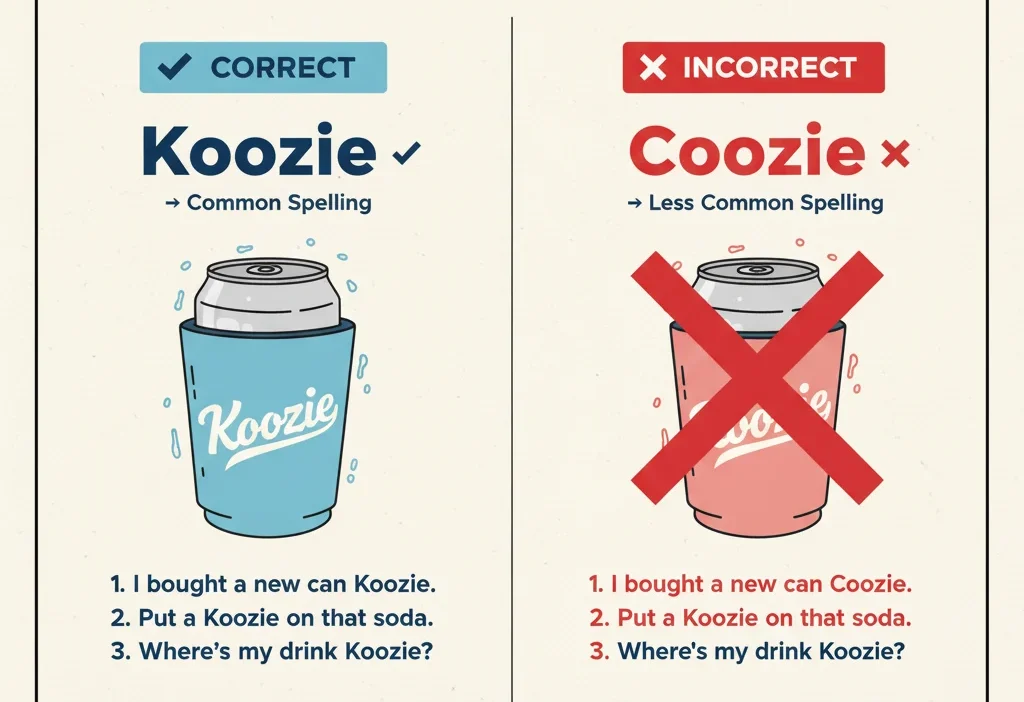
Koozie (noun) refers to an insulated sleeve made of foam, fabric, or neoprene that keeps your beverage can or bottle cool.
It’s a brand name that has become a generic term, like Band-Aid for bandages or Kleenex for tissues.
Examples:
- I slipped my soda into a koozie to keep it cold.
- She gave everyone personalized koozies at her wedding.
- The koozie kept my drink cool all afternoon.
👉 Fun fact: The word “Koozie” is actually trademarked in the U.S. by a company called The Koozie Group.
What Does “Coozie” Mean?
Coozie (noun) is simply an alternative spelling of koozie.
It’s used informally, often by people who don’t know “Koozie” is a brand name.
Examples:
- Can you hand me that blue coozie?
- I ordered a funny coozie online.
- The coozie matches my picnic blanket!
While both words refer to the same object, only Koozie is the official and legally recognized version.
⚖️ The Key Difference Between Coozie and Koozie
Here’s a quick side-by-side comparison:
| Feature | Koozie | Coozie |
|---|---|---|
| ✅ Correct Spelling | Yes (official, trademarked) | No (informal or misspelled) |
| 🏷️ Origin | Brand name (U.S. trademark) | Spelling variation used casually |
| 🧃 Meaning | Insulated sleeve for drinks | Same meaning, but not official |
| 💬 Used in | Branding, stores, advertisements | Casual speech, social media |
| ✍️ Example | I bought a new Koozie for my soda. | My friend made me a funny coozie. |
Quick Tip to Remember:
If you’re writing something formal or professional, use Koozie (with a “K”).
If it’s just casual texting or chatting, Coozie is fine — but it’s not the “correct” form.
❌ Common Mistakes and How to Avoid Them
Mistake 1: Thinking “Coozie” is the Correct Term
❌ Incorrect: I ordered custom coozies for the party.
✅ Correct: I ordered custom Koozies for the party.
Why? Because Koozie is the original brand and recognized spelling.
Mistake 2: Using Both Spellings in One Text
❌ Incorrect: I bought a Koozie, and my friend got a coozie.
✅ Correct: We both bought Koozies for our drinks.
Tip: Stick to one version — preferably Koozie — to keep your writing clear and consistent.
🥤 When to Use “Koozie”
Use Koozie when:
- You’re writing about a product or brand
- You want to be grammatically and legally correct
- You’re writing for websites, blogs, or businesses
Examples:
- Our company sells custom Koozies with funny slogans.
- Keep your beer cold with this new Koozie design.
- The Koozie fits both cans and bottles.
- She collects colorful Koozies from different cities.
- I lost my favorite Koozie at the beach.
Memory Trick:
“K” in Koozie stands for ‘Keep it cool!’ 😎
🍺 When to Use “Coozie”
Use Coozie only in informal settings, like texting friends or writing casually.
It’s not wrong in conversation — just not the official spelling.
Examples:
- Don’t forget to bring your coozie to the party!
- My coozie has my favorite cartoon on it.
- I saw a cute coozie on Etsy.
- Everyone brought different coozies to the picnic.
- He spelled Koozie as Coozie — close enough!
Memory Hack:
Think “C” in Coozie = Casual version. Easy!
🔁 Quick Recap: Coozie vs Koozie
- ✅ Koozie → Correct, trademarked, official spelling
- 🅾️ Coozie → Common but informal misspelling
- 💡 Tip: Use “Koozie” in writing, “Coozie” in chat
- 🧃 Both mean the same — a sleeve that keeps your drink cool!
- 🏷️ “Koozie” is like “Band-Aid”: a brand name used for all similar products
📜 Advanced Tips: Origin, Branding & Formal Use
- Origin: “Koozie” was first trademarked in the 1980s by a U.S. company for beverage insulation products.
- Usage: Over time, the word became so popular that people began using it generically — that’s how “coozie” emerged.
- Formal Writing: Always use Koozie in marketing, online stores, and articles.
- Casual Use: “Coozie” can appear in informal chats or memes, but avoid it in professional contexts.
- Fun Insight: Just like “xerox” means photocopy and “google” means search, “koozie” has turned into a fun, everyday word!
💡 230+ Whit vs Whit out Simple Grammar 2025 ✨
🧠 Mini Quiz: Test Your Understanding!
Fill in the blanks with Coozie or Koozie 👇
- I bought a pink _______ with my name on it.
- The company sells branded _______ for events.
- Can you hand me that _______ for my soda can?
- In professional writing, use the correct spelling — _______.
- I saw funny _______ memes on Instagram.
Answers: 1. coozie 2. Koozie 3. Koozie 4. Koozie 5. coozie
❓ FAQs About “Coozie vs Koozie”
1. Is “Coozie” a real word?
It’s used informally, yes — but the correct and trademarked version is Koozie.
2. Why do people spell it “Coozie”?
Because the sound of the word doesn’t make the “K” obvious. People just spell it phonetically.
3. Can I use “Coozie” in writing?
You can, but it’s better to use Koozie for accuracy, especially in print or online articles.
4. Are “Koozie” and “Coozie” different products?
No — they refer to the same drink sleeve that keeps beverages cold.
5. What’s another name for a “Koozie”?
You can also call it a can cooler, beer sleeve, or drink insulator.
🏁 Conclusion
Now you know the full story behind Coozie vs Koozie!
Both point to that handy drink holder, but only Koozie is the official and correct spelling.
Remember: “Koozie keeps it cool — with a K!”
So next time you’re at a picnic or party, you’ll not only have your drink chilled — you’ll also have your grammar on point. 🥤
Keep learning, keep smiling, and keep your English (and your drinks) cool! 😄

Jenn Ashworth offers clear, engaging explanations of language and usage, helping readers grasp meanings, nuances, and differences with accuracy and ease.