Many English learners get confused between “deal” and “no deal.”
You often hear these phrases in business meetings, games, or negotiation shows like Deal or No Deal. But what do these phrases really mean in English? When should we say deal? And when should we choose no deal?
Even though the words look simple, people often struggle because:
- Both are used to make decisions.
- Both appear in conversations about agreements or choices.
In this guide, you will learn:
- The meaning of deal and no deal
- The difference between the two
- When to use each phrase correctly
- Real examples you can use in daily life
This article is written in easy English. Even a beginner or a 4th-grade student can understand it clearly. By the end, you will never confuse deal or no deal again.
What Does Each Phrase Mean?
✅ 1. Meaning of Deal
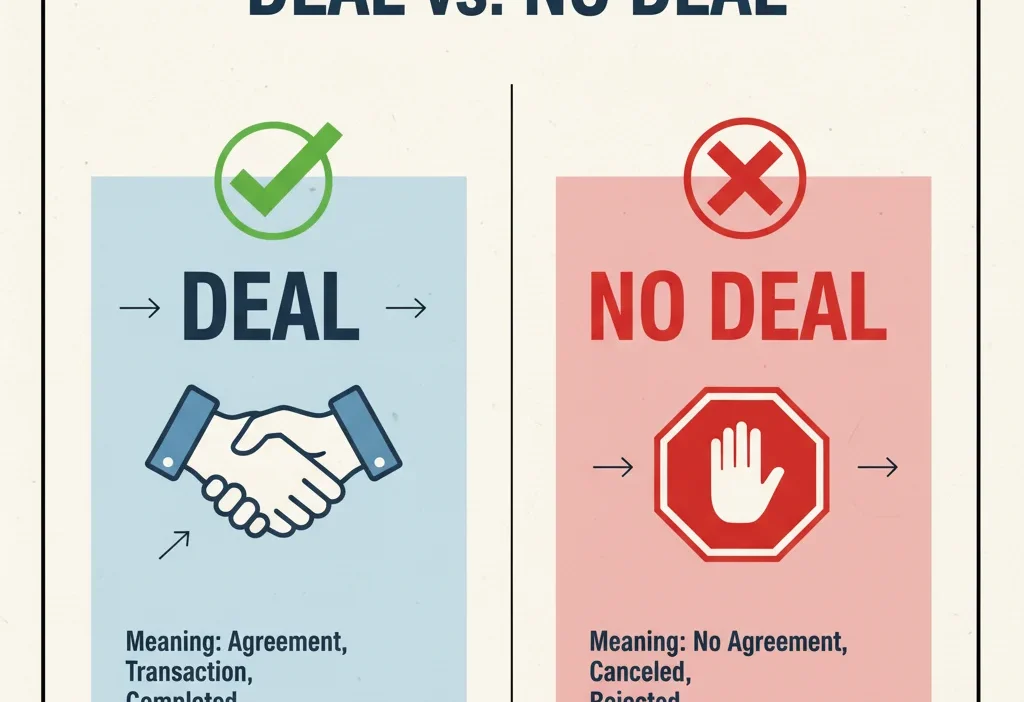
Deal means “I agree.”
It shows acceptance of an offer, suggestion, or decision.
➡️ Deal = Yes, I accept.
It can be a noun (the agreement itself) or a verb (agreeing).
Easy examples of “deal”:
- “If you help me clean, I’ll buy you ice cream.” — “Deal!”
- “We made a deal to finish the project together.”
- “Deal with your homework before playing.”
Think of “deal” like shaking hands and saying Yes!
✅ 2. Meaning of No Deal
No deal means “I do NOT agree.”
➡️ No deal = No, I don’t accept.
It stops the agreement and ends the discussion.
Easy examples of “no deal”:
- “You do my homework, and I pay nothing.” — “No deal!”
- “They offered too little money, so we said no deal.”
- “If it’s not fair, it’s a no deal for me.”
Think of “no deal” like walking away from a bad offer.
✅ The Key Difference Between Deal and No Deal
| Feature | Deal | No Deal |
|---|---|---|
| Meaning | Yes, I accept | No, I don’t accept |
| Used when | Agreement is made | Agreement is rejected |
| Emotion | Positive / Approval | Negative / Disapproval |
| Example sentence | “$10 for the toy? Deal!” | “$50 for that old toy? No deal!” |
⭐ Quick Tip to Remember:
Deal = YES ✅
No Deal = NO ❌
Common Mistakes and How to Avoid Them
| ❌ Wrong | ✅ Correct |
|---|---|
| “Deal or nodeal?” | “Deal or no deal?” |
| “He sayed deal.” | “He said, ‘Deal.’” |
| “I no deal.” | “No deal.” |
Why does the mistake happen?
Because people think “no deal” is one word.
But it’s always two words: no deal.
➡️ Remember: “Deal” is one word. “No deal” is two words.
✅ When to Use Deal (with examples)
Use deal when:
- You agree
- You accept an offer
- You approve a plan
Examples in real life:
- School: “Group project this weekend?” — “Deal.”
- Family: “I’ll wash the dishes if you take out the trash.” — “Deal.”
- Business: “We accept your price. Deal.”
- Friends: “Movie tonight at 8?” — “Deal.”
- Online: “If you subscribe, I’ll gift you a PDF.” — “Deal.”
👉 Memory Hack:
Imagine a handshake 🤝 — that means DEAL.
✅ When to Use No Deal (with examples)
Use no deal when:
- You reject an offer
- The offer is unfair
- You disagree with conditions
Examples in real life:
- School: “Give me your lunch, and I’ll give you one pencil.” — “No deal.”
- Business: “We can’t reduce the price.” — “No deal.”
- Friends: “You do all the work, and I take the credit.” — “No deal.”
- Parents: “No homework, no TV.” — “No deal.”
- Negotiation: “Pay double or leave.” — “No deal.”
👉 Memory Hack:
Imagine a stop sign ⛔ — that means NO DEAL.
✅ Quick Recap: Deal vs No Deal
- Deal = acceptance (YES ✅)
- No deal = rejection (NO ❌)
- Deal is positive
- No deal is negative
Think of it like:
Deal = handshake. No deal = walk away.
Advanced Tips (Optional but Helpful)
| Topic | Deal | No Deal |
|---|---|---|
| Common in… | Negotiations, agreements, business, casual talk | Negotiation, refusing offers |
| Used in writing | To confirm decisions | To show rejection |
| Used in texting/chat | “Deal!” (quick approval) | “No deal.” (stop conversation) |
➡️ In professional emails, you can replace deal with:
- “Confirmed.”
- “Agreed.”
- “Approved.”
➡️ Replace no deal with:
- “I cannot agree to this.”
- “We reject the proposal.”
✅ Mini Quiz (Test Yourself!)
Fill in the blanks with deal or no deal:
- “Buy one, get one free.” — ______!
- “You do my assignment for free.” — ______!
- “We accept your offer.” — It’s a ______.
- “That price is too high.” — ______!
- “You help me study, I help you with math.” — ______.
(Answers: deal, no deal, deal, no deal, deal)
Conclusion
Understanding when to use deal or no deal is simple once you know the basic rule:
➡️ Deal = Yes, I agree.
➡️ No deal = No, I don’t agree.
These phrases help you express decisions clearly in English conversations, business offers, school discussions, and even everyday texting. With the examples and memory tricks in this guide, you’ll be able to use both confidently. Practice them in real-life situations so they become natural.
The more you use them, the better your English communication will become.
✨ Keep learning one phrase at a time — small steps lead to big improvement.
✅ FAQs
1. Is “no deal” one word or two words?
Two words. Always write it as: no deal.
2. Is “deal” formal or informal?
It can be both. In business, people also use “agreement” or “approved.”
3. Can I say “Deal!” alone in a sentence?
Yes. It works as a complete response.
4. Can “deal” be a verb?
Yes. Example: “Deal the cards.”
5. What is the difference between “deal” and “no deal”?
Deal = accept.
No deal = reject.

Francis Sufford crafts thoughtful, insightful explanations on language, meaning, and usage, blending clarity with storytelling to guide readers effectively.