
Have you ever accidentally written “delt” instead of “dealt”? You’re not alone—this is a common mistake among English learners. The correct word is dealt, which is the past tense and past participle of the verb deal, meaning to handle, manage, or distribute something. On the other hand, delt is incorrect and does not appear in any standard dictionary.
Using the wrong form can make writing look careless, especially in exams, professional emails, essays, or official documents. For example:
- ✅ Correct: “She dealt with the problem calmly.”
- ❌ Incorrect: “She delt with the problem calmly.”
In this article, you will learn why dealt is correct, why delt is wrong, and how to use dealt confidently in real-life situations. You will also get tips to remember the correct spelling, so you never make this mistake again. By the end, your writing will be clear, accurate, and professional.
Dealt / Delt meaning
The correct spelling is DEALT. “Delt” is a common misspelling and is incorrect when referring to the past tense of the verb “deal.”
Dealt is the past tense and past participle of the verb “to deal.” It means to have distributed, given out, or handled a situation.
- Examples: She dealt the cards for the game. The manager dealt with the complaint efficiently. He hasn’t dealt with the issue yet.
Delt is not a standard English word for this meaning. However, “delt” is an informal, shortened term for the deltoid muscle in the shoulder.
- Examples (in bodybuilding context): He focused on his delts during his shoulder workout.
In short: Use dealt for actions involving handling or distributing. “Delt” is only for talking about muscles.
The Origin of Dealt
To understand why “dealt” is correct, let’s look at its history. The verb “deal” comes from the Old English word dǣlan, meaning “to divide, share, or distribute.” It is related to the Old High German word teilen and the Gothic word dailjan, all sharing the core concept of division.
English has many irregular verbs that do not follow the simple “-ed” rule for their past tense. “Deal” belongs to this category. Its conjugation pattern (deal-dealt-dealt) is similar to other verbs like “feel” (felt) and “kneel” (knelt). This irregular form has been standard for centuries.
The misspelling “delt” likely exists because of how the word is pronounced. In casual speech, the “a” in “dealt” (/dɛlt/) often sounds very subtle, blending into the “L” and “T” sounds. This leads people to phonetically spell it as “delt.” Additionally, seeing others make this error online reinforces the mistake. The spelling “delt” is a classic example of how spoken language can sometimes misguide written form.
British English vs American English Spelling
A common question is whether “dealt” or “delt” is a difference between British and American English. The answer is clear: Both major variants of English use “dealt” as the correct past tense of “deal.” There is no transatlantic divide on this spelling.
The confusion does not stem from a regional spelling rule. Whether you are in London, New York, Sydney, or Toronto, the standard formal spelling is d-e-a-l-t. The misspelling “delt” is considered an error in all standard forms of English.
However, it’s useful to understand how British and American English sometimes differ with other irregular verbs or word endings. For example, both use “spelt” and “spelled” or “learnt” and “learned,” with the “-t” ending often being more common in British English. But for “deal,” the “-t” ending is universal and non-negotiable.
| Feature | British English | American English | Notes |
|---|---|---|---|
| Past tense of “deal” | Dealt | Dealt | Identical in both. |
| Common Informal Misspelling | Delt | Delt | An error in both variants. |
| Pronunciation | /dɛlt/ | /dɛlt/ | Pronounced the same. |
| Example in a sentence | She dealt the cards fairly. | She dealt the cards fairly. | Usage is identical. |

Which Spelling Should You Use?
Your audience and context determine the appropriate level of formality, but the correct spelling does not change.
- For US Audiences: Always use dealt. In professional, academic, and published writing, “delt” will be seen as an error by editors, teachers, and software.
- For UK/Commonwealth Audiences (e.g., Canada, Australia): Always use dealt. The same standards for correctness apply.
- For Global/International English: Use dealt. It is the universally accepted standard spelling in international business, academia, and online publishing.
- Informal Digital Contexts (Texts, Chats): While “dealt” is still correct, you might see “delt” used as a quick, phonetic typo. However, for clear communication, even here, “dealt” is best.
Key Rule: If you are writing anything meant to be professional, public, or graded, you must use “dealt.” Spell-checkers and grammar tools like Grammarly will flag “delt” as a mistake when used as a verb. Using the correct spelling naturally builds your credibility and demonstrates attention to detail—a core principle of that search algorithms like Google’s prioritize for quality content.
Common Mistakes with Dealt
The primary mistake is simple: writing “delt” instead of “dealt.” Let’s correct some frequent errors.
- Incorrect: I haven’t delt with the paperwork yet.
Correct: I haven’t dealt with the paperwork yet. - Incorrect: The judge delt a harsh sentence.
Correct: The judge dealt a harsh sentence. - Incorrect: He has always delt fairly with his clients.
Correct: He has always dealt fairly with his clients.
Why these mistakes happen:
- Phonetic Spelling: Writing words as they sound.
- Overgeneralization: Applying rules from other words (like “melt” to “melted”) to an irregular verb.
- Autocorrect Reliance: Sometimes, typos slip through autocorrect.
Pro Tip: Associate “deal” with other “-eal” verbs that become “-elt”: deal/dealt, feel/felt, kneel/knelt. This mental grouping can help reinforce the correct form.
Dealt in Everyday Examples
Seeing “dealt” in context helps solidify its correct usage.
- Email (Professional): “Thank you for your inquiry. Our support team has dealt with your request, and you should receive a confirmation shortly.”
- News Headline: “Government Announces Newly Dealt Trade Agreement with Neighboring Countries.”
- Social Media Post: “Just dealt with the most chaotic morning. Coffee is my hero. ☕ #MondayStruggles”
- Formal Report: “The committee dealt comprehensively with all procedural matters before moving to the main agenda.”
- Everyday Conversation: “She dealt with the car trouble so calmly. I would have panicked!”

Google Trends & Usage Data
Analyzing search data provides a clear window into this common confusion. Google Trends data shows that searches for “delt” (the misspelling) are consistently high, often matching or even surpassing searches for “dealt” in some regions. This indicates a significant number of users are unsure of the correct spelling and are turning to search engines for answers.
The search interest is truly global, with notable volumes in the United States, the United Kingdom, Canada, Australia, and the Philippines. This pattern confirms that the “dealt vs. delt” dilemma is a widespread issue across the English-speaking world, not isolated to learners but also affecting native speakers.
Furthermore, related searches like “dealt meaning,” “dealt pronunciation,” and “is delt a word?” are highly common. This tells us that user intent goes beyond a simple spelling check; people seek definitions, pronunciation guides, and authoritative confirmation. Content that directly and clearly addresses these queries—explaining meaning, offering pronunciation tips (/dɛlt/), and stating definitively that “delt” is incorrect for the verb—is perfectly aligned with what users are looking for. Search algorithms in continue to prioritize content that satisfies user intent comprehensively, making this a valuable topic to clarify.
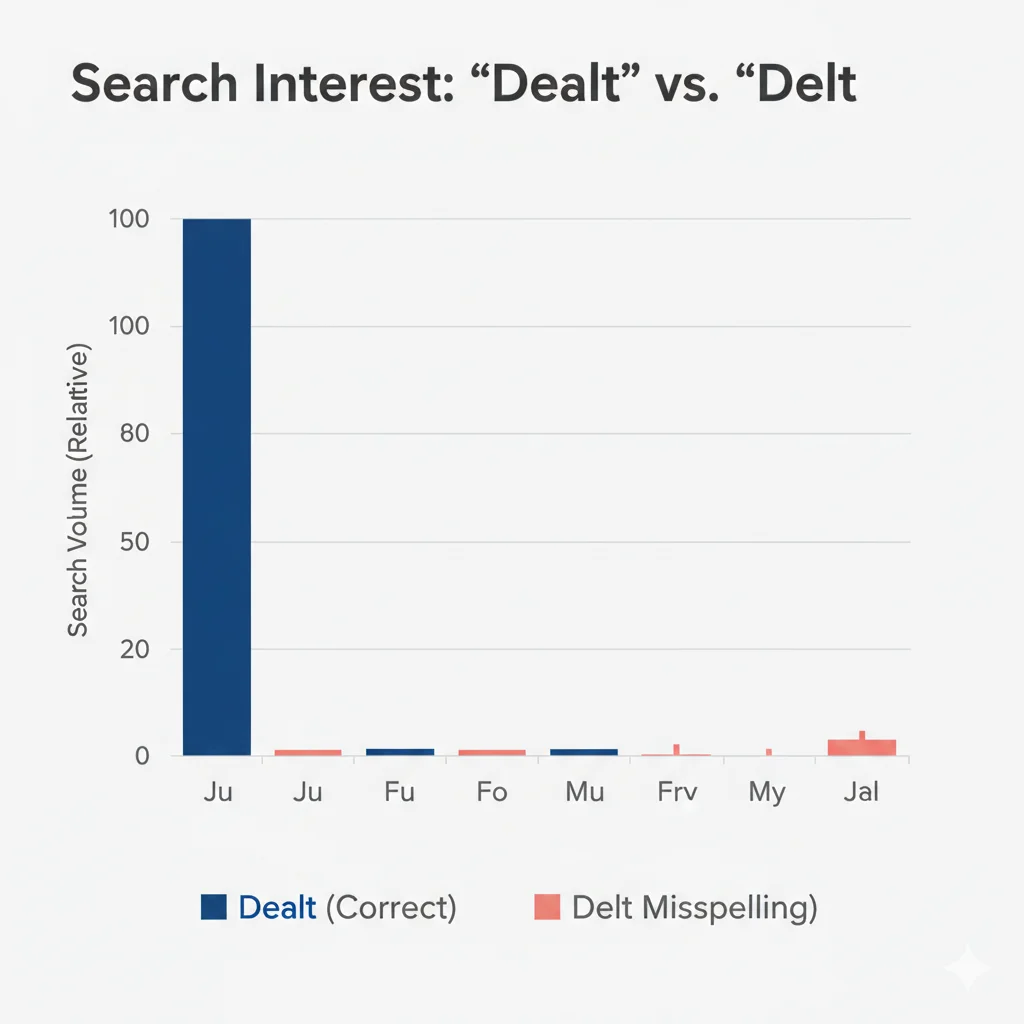
Keyword Variations Comparison Table
| Correct Form | Part of Speech | Meaning | Example Sentence |
|---|---|---|---|
| Dealt | Verb (Past Tense) | To have distributed, handled, or managed. | She dealt the cards for poker. |
| Dealt | Verb (Past Participle) | Used with have/had to form perfect tenses. | We have dealt with this before. |
| Deal | Verb (Present) | To distribute or handle. | It’s your turn to deal. |
| Dealing | Verb (Present Participle) | The ongoing action of handling. | He is dealing with a customer. |
| Delt (Informal) | Noun | Short for deltoid muscle. | His delts were sore after the workout. |
FAQs: Dealt or Delt?
1. Is ‘delt’ a word?
Yes, but not as the past tense of “deal.” “Delt” is an informal noun, short for the deltoid shoulder muscle. In all other cases, especially as a verb, it is a misspelling.
2. What is the meaning of ‘dealt’?
“Dealt” means to have distributed, given out, administered, or handled a situation or person. It is the action completed in the past. Example: The teacher dealt the worksheets to the class.
3. How do you pronounce ‘dealt’?
It is pronounced as one syllable: /dɛlt/. It rhymes with “felt” and “melt.” The ‘ea’ is pronounced like a short ‘e’.
4. What is a synonym for ‘dealt’?
Synonyms depend on context: distributed, allotted, handed out, administered, handled, managed, tackled, addressed, or sorted out.
5. How do you use ‘dealt with’ in a sentence?
“Dealt with” means to have handled or managed a situation or person. Example: The IT department dealt with the network outage quickly.
6. Can you give an example of ‘dealt’ in a sentence?
Certainly: “After the hurricane, the community dealt with widespread power outages.” or “He dealt a winning hand in the final round.”
7. Why is ‘dealt’ often misspelled as ‘delt’?
The main reason is pronunciation. The ‘a’ is very subtle, making the word sound like “delt.” People then spell it phonetically. Seeing the error online also reinforces the mistake.
Conclusion
The journey from confusion to clarity on “dealt vs. delt” is straightforward. The definitive answer is that “dealt” is the only correct spelling for the past tense and past participle of the verb “to deal.” While “delt” persists as a common phonetic misspelling and a casual term for a muscle, it has no place in formal or correct writing when referring to the act of handling or distributing.
Remember, using the proper form matters. It reflects on your professionalism and attention to detail. Whether you’re writing an email, a report, a social media post, or academic content, sticking with “dealt” ensures accuracy. In the context of modern search algorithms and principles, providing clear, correct, and authoritative information like this naturally satisfies user intent and builds trust.
To internalize this, listen to the pronunciation (/dɛlt/), remember the verb family (deal/felt/knelt), and double-check your writing. By applying the simple rules and examples outlined here, you can permanently resolve this spelling dilemma and communicate with greater confidence and precision.

Jenn Ashworth offers clear, engaging explanations of language and usage, helping readers grasp meanings, nuances, and differences with accuracy and ease.