Most people think democracy and republic mean the same thing — but they don’t. One focuses on the power of the people, while the other focuses on the rule of law. In this simple guide, you’ll finally understand the real difference between a democracy and a republic using clear meanings, examples, and easy rules even a child can follow
Many people use the words democracy and republic as if they mean the same thing. But the truth is, these two terms are different, and understanding them is important — especially when we talk about governments, countries, and how leaders are chosen. People often get confused because both systems involve voting, people’s rights, and elected leaders. This guide will make everything simple.
In this article, you will learn the meaning of democracy, the meaning of republic, the difference between democracy and republic, and the correct usage of each term. You will also see easy examples, a comparison table, and memory tips so you never mix them up again.
Whether you’re a student, a beginner, or someone improving English, this explanation will help you understand democracy vs republic in the clearest and simplest way.
What Does Each Word Mean?
What Does “Democracy” Mean?
Democracy is a form of government where people have the power. The people make decisions either directly or by choosing leaders who represent them.
Part of Speech: Noun
Simple meaning: A system where people choose what happens.
Examples:
- In a democracy, all adults can vote.
- A democracy allows people to share their ideas freely.
- The school used a democracy to choose the class captain.
Mini-Story Example:
Imagine your whole class votes on what game to play during break. Everyone raises their hand and the idea with the most votes wins. That’s democracy — people decide together.
What Does “Republic” Mean?
A republic is a government where the country is run by elected leaders who must follow a constitution (a set of rules). The power comes from the people, but the rules protect everyone’s rights.
Part of Speech: Noun
Simple meaning: A system where elected leaders follow laws to run the country.
Examples:
- A republic has a president instead of a king.
- In a republic, leaders must follow the constitution.
- The country became a republic after writing new laws.
Mini-Story Example:
Imagine your class chooses one class monitor. That monitor must follow school rules and cannot break them. That’s a republic — leaders follow rules, not personal wishes.
The Key Difference Between Democracy and Republic
People often ask, “What is the real difference between democracy and republic?”
The simple answer is:
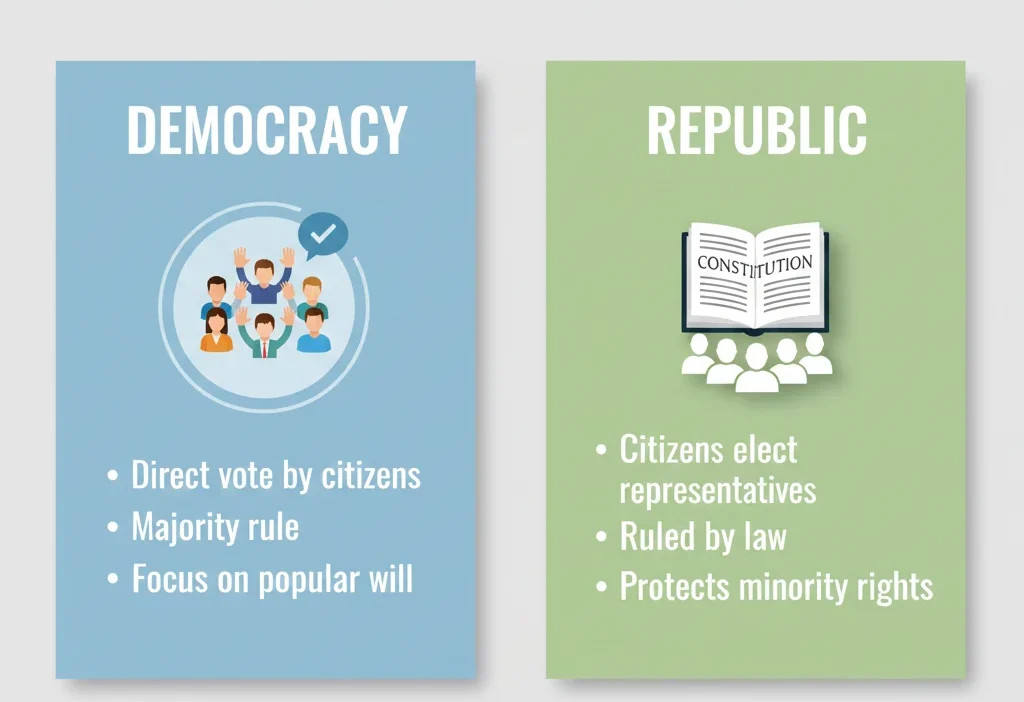
- Democracy = People make decisions directly
- Republic = People choose leaders who follow laws
Both respect the people’s voice, but a republic is guided by a constitution that protects everyone.
Comparison Table: Democracy vs Republic
| Feature | Democracy | Republic |
|---|---|---|
| Power Held By | The people directly | People elect leaders |
| Main Idea | Majority rules | Laws and rights protect everyone |
| Decision Making | Direct voting on issues | Leaders make decisions |
| Example Sentence | “The democracy let everyone vote on changes.” | “The republic elected a president to lead the country.” |
| Easy Meaning | People decide everything | Leaders follow rules |
Quick Tip to Remember
Democracy = Direct decisions
Republic = Rulebook + Elected leaders
If you remember “R = Rules,” you’ll never forget the meaning of republic.
Common Mistakes and How to Avoid Them
❌ Mistake 1: Saying “Every democracy is a republic.”
✔ Correct: Some democracies are republics, but not all.
❌ Mistake 2: Thinking both mean the same thing.
✔ Correct: Democracy focuses on people’s power; republic focuses on leaders + laws.
❌ Mistake 3: Calling a country a “democracy” when it’s actually a republic.
✔ Correct: Many modern countries (like the U.S.) are both — a democratic republic.
Why do these mistakes happen?
Because both systems include voting and public participation. The difference lies in how decisions are made.
When to Use “Democracy”
Use democracy when talking about:
- Voting directly
- Majority decisions
- People choosing policies
- Systems where everyone votes on all issues
Example Sentences
- The village used a democracy to choose the new park design.
- A perfect democracy allows everyone to vote.
- The club works like a democracy; members vote on every rule.
- They debated whether a democracy or republic is better.
- The democracy failed when people were not allowed to vote.
When to Use “Republic”
Use republic when talking about:
- Elected leaders
- A constitution or set of rules
- Presidents instead of kings
- Systems where leaders work for the people
Example Sentences
- The country became a republic after electing a president.
- A republic protects rights even if the majority disagrees.
- In a republic, leaders must follow the law.
- Some nations prefer a republic to avoid kings or queens.
- Students learned the difference between a democracy and a republic.
Memory Hack:
Think of “republic” like “rule-public” — rules for the public!
Quick Recap: Democracy vs Republic
- Democracy = people decide directly
- Republic = leaders follow rules
- Both systems involve voting
- A republic protects rights with a constitution
- Democracy focuses on majority decisions
Simple rule:
Democracy = direct vote
Republic = leaders + laws
Advanced Tips (Optional Section)
- Origin:
- “Democracy” comes from Greek words meaning “people power.”
- “Republic” comes from Latin “res publica,” meaning “public matter.”
- Use in essays:
Use “democracy” when describing direct participation.
Use “republic” when describing constitutional rule. - Online writing mistake:
Many people casually say “democracy” when they really mean “republic.” Using the correct term makes your writing sound more knowledgeable.
Mini Quiz: Test Yourself!
Fill in the blanks:
- In a ________, people vote on every issue.
- A ________ has elected leaders who follow a constitution.
- The class used a ________ to choose a monitor.
- The country became a ________ after removing the king.
- A ________ protects rights through laws.
(Answers: democracy, republic, democracy, republic, republic)
FAQs
1. What is the main difference between democracy and republic?
Democracy is direct rule by the people; a republic is rule by elected leaders under laws.
2. Is the United States a democracy or a republic?
It is both — a democratic republic.
3. Can a democracy exist without a constitution?
Yes, but a republic always has a constitution.
4. Which system protects minority rights better?
A republic protects rights better because laws limit majority power.
5. Why do people confuse democracy and republic?
Because both involve voting and people’s participation, but the decision-making systems differ.
Conclusion
Understanding the difference between democracy and republic helps us talk more clearly about governments and how decisions are made. A democracy focuses on direct voting by the people, while a republic focuses on elected leaders who follow laws. Both systems value the people’s voice, but they work in different ways. Now that you know their meanings, differences, and examples, you can confidently use each word correctly in conversations, essays, and daily life. Keep learning, keep practicing, and you will improve your English every day.

Eley Williams writes clear, engaging guides on confusing words and phrases, helping readers understand meanings, differences, and correct usage with ease.