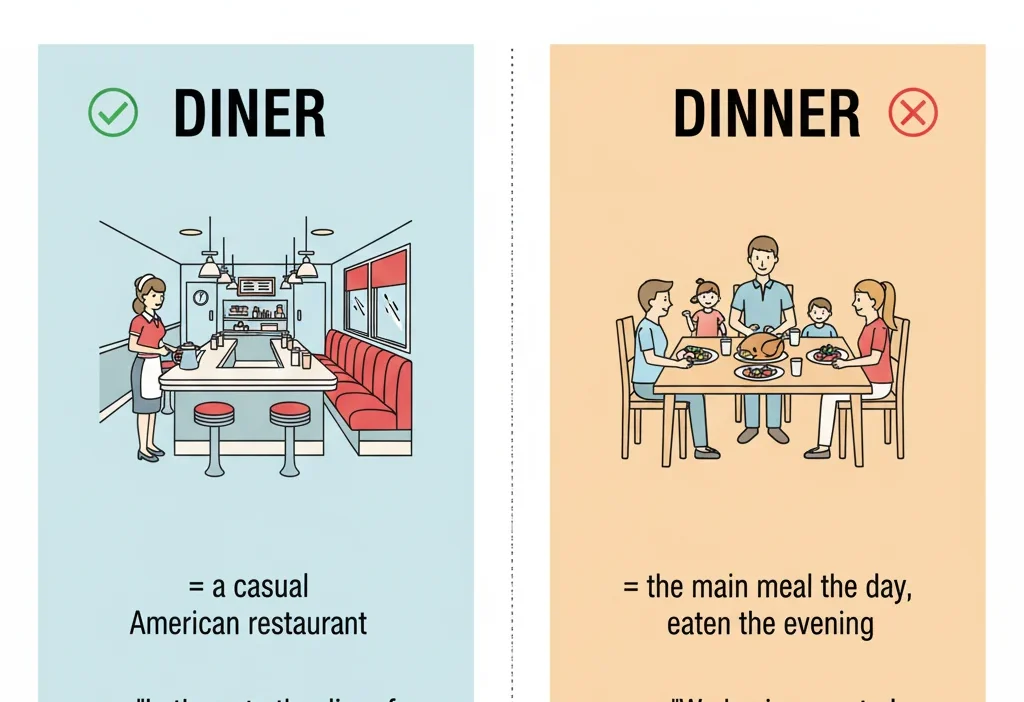
‘Diner’ is a small casual restaurant, while ‘dinner’ is the main meal of the day—knowing the difference avoids confusion.”
Confused about “diner” and “dinner”? You’re not alone. Though they sound similar, these words have completely different meanings. “Diner” refers to a small, casual restaurant, often serving comfort food and open late.
“Dinner”, on the other hand, is the main meal of the day, usually in the evening but sometimes at midday depending on culture. Using the wrong word can confuse readers and reduce the clarity of your writing.
Whether you’re writing essays, menus, social media posts, or casual messages, knowing the difference ensures your sentences make perfect sense. In this article, you’ll find easy-to-understand examples of diner vs dinner, tips to remember which is which, and practical usage guidance for everyday writing.
🥞 What Does Each Word Mean?
Let’s break it down simply.
1. Diner — (Noun)
Meaning: A diner is a small restaurant that serves simple meals, especially in the U.S.
You can also call a person who is eating a meal a diner.
Part of speech: Noun
Simple Examples:
- We stopped at a diner on the highway for breakfast.
- The diners enjoyed their food with smiles.
- My favorite diner serves pancakes all day!
👉 Quick Memory Tip:
Think of “diner” as a place or a person — someone who dines.
2. Dinner — (Noun)
Meaning: Dinner means the main meal of the day — usually eaten in the evening (but in some countries, it can be midday).
Part of speech: Noun
Simple Examples:
- We’re having pasta for dinner tonight.
- Grandma invited us for Christmas dinner.
- I never skip dinner because it’s my favorite meal!
👉 Quick Memory Tip:
Think of “dinner” as the meal itself.
🍽️ The Key Difference Between Diner and Dinner
Here’s a simple way to remember the difference between “diner” and “dinner.”
| Feature | Diner | Dinner |
|---|---|---|
| Part of Speech | Noun | Noun |
| Meaning | A small restaurant or a person eating | The main meal of the day |
| Usage Example | We ate at a small diner downtown. | We had pizza for dinner. |
| Easy Trick | “Diner” ends with one n — it’s a place/person. | “Dinner” has two n’s — it’s the meal itself. |
Quick Tip to Remember:
One “n” = place (diner)
Two “n’s” = meal (dinner)
❌ Common Mistakes and How to Avoid Them
Many learners mix these two words because they look and sound similar. Let’s fix that!
| ❌ Incorrect | ✅ Correct | 💡 Why |
|---|---|---|
| I’m going to have diner with my family. | I’m going to have dinner with my family. | You eat dinner, not diner. |
| We stopped for dinner at a roadside restaurant. | We stopped for diner at a roadside restaurant. | You stop at a diner, not for dinner. |
| There were many dinners at the café. | There were many diners at the café. | People are diners, not dinners! |
✅ Easy Fix:
If it’s a meal, use dinner.
If it’s a place or person, use diner.
Personal Affects / Effects: Tiny Detail That Changes Everything!
🍴 When to Use “Diner”
Use “diner” when you are talking about:
- A restaurant that serves food.
- A person who is eating.
Examples:
- That 1950s-style diner plays old rock music.
- The diners left good tips for the waiter.
- We love going to our favorite diner after school.
- A polite diner always says “thank you” to the staff.
- The movie was set in a cozy diner by the road.
🧠 Memory Hack:
A diner is a place where people dine.
Both words start with “din-” — easy to connect!
🍲 When to Use “Dinner”
Use “dinner” when you are talking about the main meal of the day.
Examples:
- What’s for dinner tonight?
- We usually eat dinner at 8 p.m.
- Our school held a dinner for the teachers.
- Mom cooked a special dinner for my birthday.
- Never skip dinner, it’s important for your health.
💡 Trick:
The word dinner has two “n’s” — imagine two noodles in your meal! 🍜
🔁 Quick Recap: Diner vs Dinner
Let’s keep it short and simple:
- Diner = place or person.
- Dinner = meal.
- One “n” = diner (place).
- Two “n’s” = dinner (food).
- You eat dinner at a diner!
📘 Advanced Tips & Word Origins
- Origin of “Diner”: Comes from the word “dine,” meaning “to eat.” In the 1800s, “diner” described train dining cars in the U.S. that served food.
- Origin of “Dinner”: Comes from the Old French word “disner,” meaning “to break a fast.”
- In Writing or Exams:
- Use “dinner” for meals in essays or formal writing.
- Use “diner” for restaurant names or descriptions in stories.
- In Texting: Many people type “diner” instead of “dinner” by mistake — always double-check your spelling!
🧩 Mini Quiz: Test Yourself!
Fill in the blanks with diner or dinner.
- We had spaghetti for _______.
- Let’s meet at the new _______ near the station.
- The _______ left before paying the bill.
- What’s your favorite _______ meal?
- That _______ is open 24 hours!
- Mom cooked a lovely _______ last night.
- The _______ enjoyed the cozy music.
Answers:
- dinner
- diner
- diner
- dinner
- diner
- dinner
- diner
❓ (FAQs)
1. What is the main difference between diner and dinner?
Diner means a small restaurant or a person eating; dinner means the main meal of the day.
2. Can I say “go to dinner”?
Yes! “Go to dinner” means you’re going somewhere to eat the main meal.
3. Is diner American or British English?
The word “diner” is mostly used in American English to describe a casual restaurant.
4. Why does dinner have two n’s?
The double “n” comes from old spelling patterns in Middle English — it helps separate the meaning from diner.
5. Can I use diner and dinner in the same sentence?
Absolutely! Example: We ate our dinner at a small diner.
Conclusion
Now you know the clear difference between diner and dinner!
Remember — a diner is a place or person, and dinner is the meal.
With simple examples and tricks, you can use both words correctly in everyday English.
Keep practicing, notice these words in books and movies, and soon you’ll use them like a pro!

Gwendoline Riley delivers clear, compelling insights into language and usage, helping readers understand meanings, nuances, and differences with confidence.