If you’ve ever stopped mid-sentence wondering, “Should I use effect or affect?” — you’re not alone. These two tiny words look and sound similar, but their meanings are quite different. People mix them up all the time, even native English speakers!
In this guide, you’ll learn exactly what effect and affect mean, the difference between effect and affect, and how to use each one correctly in your writing and speech. We’ll use simple English, real-life examples, and easy memory tricks so that even a 4th grader can master these words with confidence.
What Does Each Word Mean?
Let’s start by understanding each word separately before comparing them.
Effect – Meaning and Examples
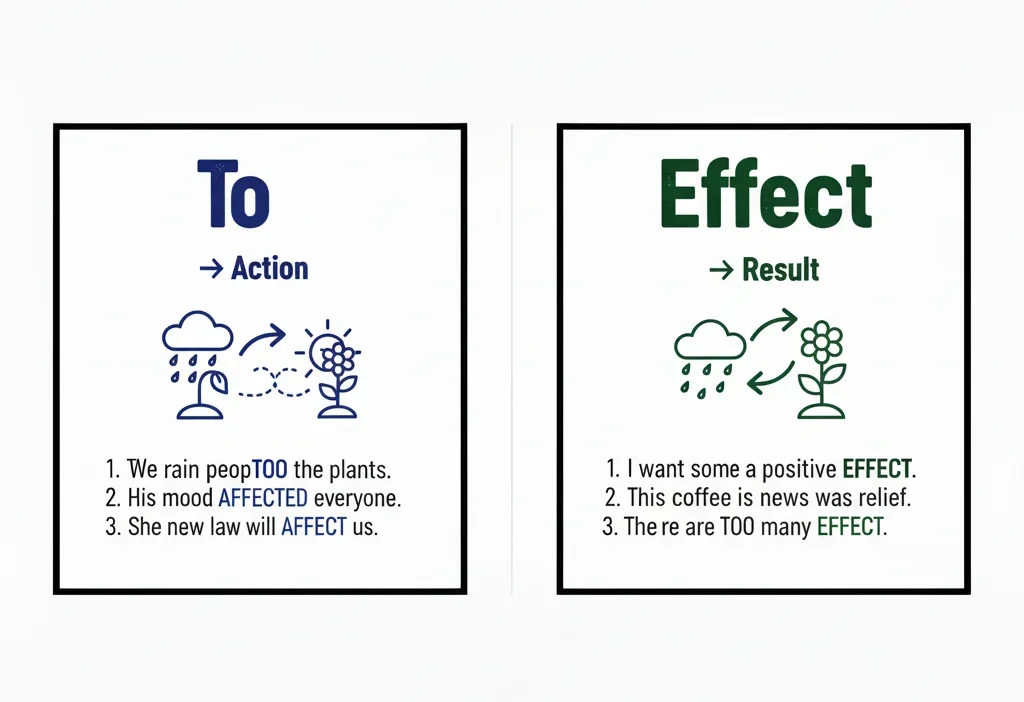
Effect is usually a noun. It means a result or an outcome.
Think of it as “something that happens because of something else.”
✅ Examples:
- The effect of the rain was a beautiful rainbow.
- The movie had a strong effect on me.
- Exercise has a good effect on your health.
👉 Memory tip: Effect = End result (both start with E).
Affect – Meaning and Examples
Affect is usually a verb. It means to change or to influence.
Think of it as “doing something that causes a change.”
✅ Examples:
- The cold weather affected my mood.
- Your words affect how people feel.
- The new rule will affect everyone in the class.
👉 Memory tip: Affect = Action (both start with A).
210+ Then or Than Difference Explained 🔍 2025 Grammar Lesson
The Key Difference Between Effect and Affect
| Feature | Effect | Affect |
|---|---|---|
| Part of Speech | Noun | Verb |
| Meaning | The result or outcome | To influence or change |
| Example | The new law had a big effect on drivers. | The new law will affect all drivers. |
| Quick Tip | If it’s a thing (result), use effect. | If it’s an action (influence), use affect. |
Quick Trick:
👉 If you can replace the word with “result,” use effect.
👉 If you can replace it with “influence,” use affect.
Common Mistakes and How to Avoid Them
❌ Mistake 1:
“The new rule had a big affect on my grades.”
✅ Correct: “The new rule had a big effect on my grades.”
Why? Because we’re talking about a result, not an action.
❌ Mistake 2:
“The rain effected the game.”
✅ Correct: “The rain affected the game.”
Why? Because rain influenced the game—it didn’t cause a result.
❌ Mistake 3:
“His speech really affected me deeply.” (✅ Correct — good example!)
This one is correct because it shows how something changed you emotionally.
👉 Tip to Avoid Confusion:
Ask yourself:
- “Is this about a cause or action?” → use affect.
- “Is this about a result or outcome?” → use effect.
When to Use “Effect”
Use effect when you’re talking about the result of something.
It usually follows words like the, an, or any.
✅ Examples:
- The new medicine had a good effect on the patient.
- Pollution has a bad effect on the environment.
- The teacher’s kindness had a lasting effect on the students.
- The effect of sunlight is to make plants grow.
- The loud noise had no effect on the baby.
🧠 Memory Hack:
Think: Effect = End result.
If something happens because of something else, that’s an effect.
When to Use “Affect”
Use affect when something influences or changes something else.
It shows action — something is happening.
✅ Examples:
- Weather can affect your mood.
- Missing breakfast can affect your focus at school.
- Poor sleep affects your energy levels.
- The speech affected everyone emotionally.
- Stress affects how well you work.
🧠 Memory Hack:
Think: Affect = Action.
If someone or something does something that causes change, use affect.
Quick Recap: Effect vs Affect
✅ Effect (noun) = result or outcome
✅ Affect (verb) = to influence or change
Easy Summary:
- Use affect when describing the action that causes change.
- Use effect when describing the result of that change.
Examples:
- “Lack of sleep can affect your grades.”
- “The effect of sleeping well is better concentration.”
Advanced Tips: Go Beyond the Basics
1. When “Effect” Can Be a Verb
Rarely, effect can also be used as a verb meaning “to cause something to happen.”
Example: “The new manager effected major changes in the company.”
Here, “effected” means “brought about.”
2. When “Affect” Is a Noun
In psychology, affect (noun) means emotion or mood.
Example: “The patient showed a cheerful affect.”
But this is mostly used in professional or medical contexts.
3. Formal Writing and Exams
In essays, use these words carefully. Mixing them up can change your meaning entirely.
Example:
- Wrong: “The policy had a positive affect.”
- Right: “The policy had a positive effect.”
4. In Everyday Texting
In casual messages, people often mix them up, but it’s still good to know the right one! Using them correctly shows attention to detail and improves your writing skills.
Mini Quiz: Test Yourself!
Fill in the blanks with effect or affect.
- The new rule will _______ how students use the library.
- The teacher’s praise had a strong _______ on the child.
- Lack of sleep can _______ your performance.
- The medicine had a calming _______ on the patient.
- The weather can greatly _______ your mood.
✅ Answers: 1) affect 2) effect 3) affect 4) effect 5) affect
FAQs About Effect vs Affect
1. What is the main difference between effect and affect?
Effect is a result (noun), while affect means to influence (verb).
2. How can I remember which to use?
Think: Affect = Action, Effect = End result.
3. Can “effect” ever be a verb?
Yes, in rare cases. “To effect change” means to cause change.
4. Can “affect” be a noun?
Yes, in psychology, it means emotion or mood.
5. Which is more common in daily English?
Affect (verb) and effect (noun) are both common, but their meanings depend on context.
Conclusion
Now you know the real difference between effect and affect!
Remember — affect is about action (something happens), while effect is about the end result (what happens). With practice, you’ll never mix them up again.
Keep reading, writing, and practicing your grammar every day — soon you’ll use these words correctly without even thinking about it! 🌟

Francis Sufford crafts thoughtful, insightful explanations on language, meaning, and usage, blending clarity with storytelling to guide readers effectively.