Have you ever stopped mid-sentence, wondering whether to write every one or everyone? Don’t worry—you’re not alone! These two phrases look almost the same, but their meanings and uses are slightly different. Many English learners and even native speakers get confused by them.
In this easy guide, you’ll learn the difference between “every one” and “everyone,” their correct usage, grammar rules, and simple examples. By the end, you’ll never mix them up again!
What Does Each Word Mean?
Let’s break down both terms and see what they really mean.
Everyone
Part of Speech: Indefinite pronoun
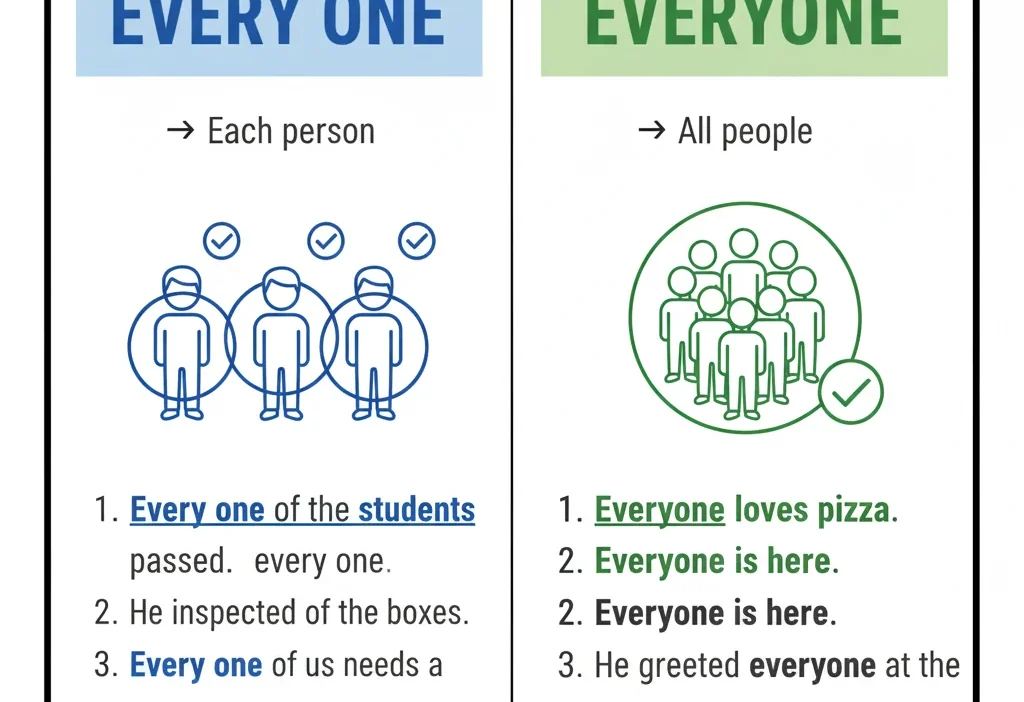
Meaning: Refers to all people in a group. It’s a single word that means “every person.”
✅ Examples:
- Everyone is excited for the school trip.
- The teacher thanked everyone for their help.
- Everyone loves a good story.
You can think of everyone as a short way to say “all people together.”
Every one
Part of Speech: Two words (determiner “every” + noun “one”)
Meaning: Refers to each individual item or person in a group, one by one.
✅ Examples:
- She checked every one of the boxes carefully.
- I called every one of my friends.
- He read every one of the books on the shelf.
To remember: “Every one” = each single one in a group.
The Key Difference Between Every One and Everyone
Here’s a simple way to see how they differ:
| Feature | Every One | Everyone |
|---|---|---|
| Number of Words | Two | One |
| Meaning | Refers to each individual person or thing | Refers to all people as a group |
| Part of Speech | “Every” (determiner) + “one” (noun/pronoun) | Indefinite pronoun |
| Example | She opened every one of the gifts. | Everyone enjoyed the party. |
| Test Tip | Can you replace it with “each one”? Then use every one. | Can you replace it with “all people”? Then use everyone. |
💡 Quick Tip to Remember:
If you can replace the phrase with “each one,” use every one.
If you can replace it with “all people,” use everyone.
Common Mistakes and How to Avoid Them
Mistake #1:
❌ Everyone of the students passed the test.
✅ Every one of the students passed the test.
Why? “Every one” fits because you’re talking about each student individually, not all together.
Mistake #2:
❌ Every one loves pizza.
✅ Everyone loves pizza.
Why? “Everyone” is correct because you mean all people.
Mistake #3:
❌ I called everyone of my friends.
✅ I called every one of my friends.
Why? Each friend was called separately—so use “every one.”
🔹 Tip: If “of” follows the phrase (like “of my friends”), it’s almost always every one, not everyone.
When to Use “Every One”
Use every one when you want to talk about each individual person or thing in a group separately.
✅ Examples:
- I tasted every one of the cupcakes.
- She greeted every one of her guests.
- Every one of the books was signed by the author.
- The coach talked to every one of the players.
- My mom checked every one of my assignments.
👀 Memory Hack:
Think of every one as focusing a spotlight on each person or item—one at a time.
When to Use “Everyone”
Use everyone when you mean all people together—the whole group.
✅ Examples:
- Everyone is invited to the meeting.
- The teacher asked everyone to sit down.
- Everyone knows the answer.
- The new movie made everyone laugh.
- Everyone needs a little kindness.
💡 Memory Hack:
If you can replace it with “all people,” everyone is the right choice.
Quick Recap: Every One vs Everyone
Here’s how to remember the difference quickly:
- Every one = each single person or thing
- Example: “I opened every one of the doors.”
- Everyone = all people as a group
- Example: “Everyone cheered loudly.”
🧠 Shortcut Rules:
- “Every one” is usually followed by of (e.g., every one of them).
- “Everyone” never takes of after it.
- Both start with the same word, but “every one” separates individuals while “everyone” joins people together.
Advanced Tips and Fun Facts
1. Origin and Grammar Note
“Everyone” is a compound word formed by joining “every” and “one.” It became common in the 16th century when English started combining words like “everyone,” “everywhere,” and “everything.”
2. Formal vs. Informal Writing
- In formal writing (essays, reports), both forms are acceptable—just use the correct one for your meaning.
- In informal talk or texting, people often use “everyone” more, even when “every one” might be correct.
3. Similar Pairs to Learn
Once you understand this, you’ll easily learn others like:
- Anyone / any one
- Someone / some one
- Everyone / every one
They follow the same pattern!
4. Common Online Mistakes
On social media, people often type “everyone of you” instead of “every one of you.” Remember: “Everyone” never works with “of.”
Mini Quiz: Test Yourself!
Fill in the blanks with every one or everyone:
- ________ loves ice cream.
- The teacher praised ________ of the students.
- I tried ________ of the games at the fair.
- ________ knows the rules by now.
- She spoke to ________ of her friends individually.
- ________ enjoyed the concert last night.
Answers:
- Everyone
- Every one
- Every one
- Everyone
- Every one
- Everyone
FAQs About Every One vs Everyone
1. What is the difference between “every one” and “everyone”?
“Everyone” means all people together. “Every one” means each person or thing separately.
2. Can I use “everyone of you”?
No. Say “every one of you.”
3. Is “everyone” singular or plural?
“Everyone” is singular, even though it refers to many people. You say, “Everyone is happy,” not “Everyone are happy.”
4. Can “every one” be used without “of”?
Yes, but rarely. For example: “She read every one carefully.”
5. What are other confusing pairs like this?
Similar pairs include “anyone / any one,” “someone / some one,” and “everything / every thing.”
Conclusion
Now you know the clear difference between every one and everyone!
Use everyone when you mean all people together, and every one when talking about each person or thing individually.
Keep practicing these examples in your daily writing, and soon it’ll feel natural. Remember—small details like this make your English sound clear and confident.

Polly Clark creates clear, insightful guides on language and usage, helping readers understand meanings, differences, and nuances with clarity and confidence.