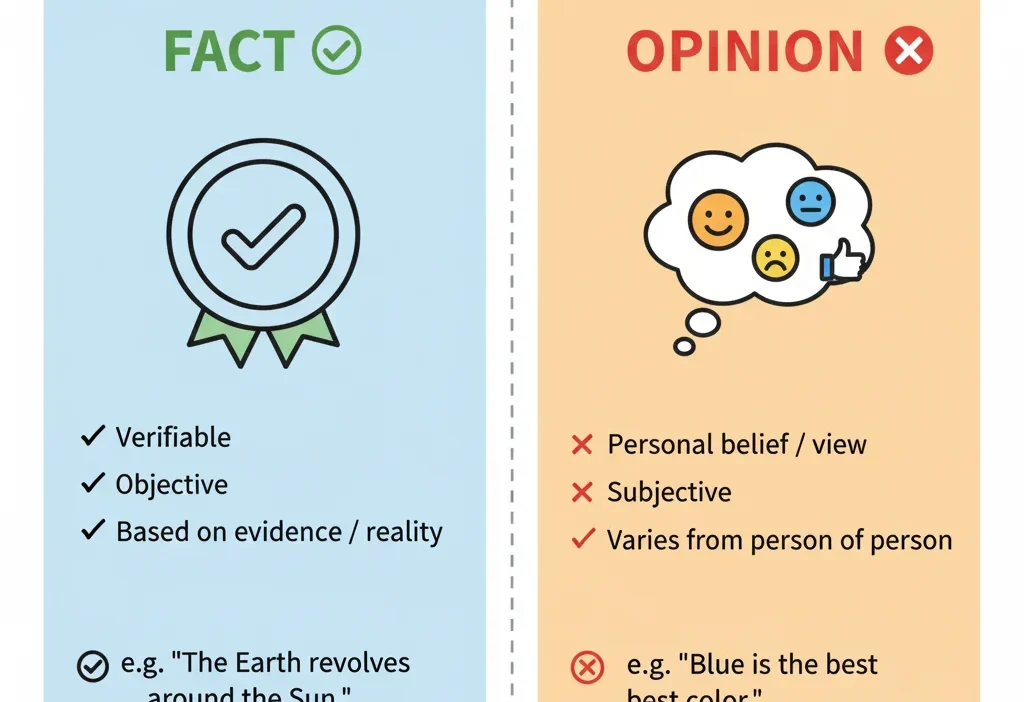
A fact is something that can be proven true or false. An opinion is what someone believes, thinks, or feels, and cannot be proven right or wrong.
Have you ever read a sentence and wondered, “Is this really true or just someone’s idea?” That’s exactly why fact / opinion often confuses people. Many mix them up because both appear in everyday life — in school, news, social media, or even casual conversations.
In this guide, you will learn:
- The simple meanings of fact and opinion
- How to tell them apart with easy examples
- Common mistakes and how to avoid them
- Practical tips to use both words correctly in writing and speaking
By the end, you’ll easily spot facts from opinions, even if English isn’t your first language. Let’s make it simple and fun!
What Does Each Word Mean?
Fact
A fact is something that is true and can be proven. Facts do not depend on feelings or beliefs.
- Part of speech: Noun
- Examples:
- Water boils at 100°C.
- The Earth revolves around the Sun.
- Cats are mammals.
Mini Story Example:
Imagine you say, “The sky is blue.” Anyone can look outside and see it — that’s a fact.
Opinion
An opinion is what someone thinks or feels. Opinions cannot be proven because they are personal beliefs.
- Part of speech: Noun
- Examples:
- Chocolate ice cream is the best flavor.
- Summer is more fun than winter.
- Math is the hardest subject.
Mini Story Example:
If your friend says, “Dogs are cuter than cats,” it’s an opinion — other people might disagree, and that’s okay!
The Key Difference Between Fact and Opinion
| Feature | Fact | Opinion |
|---|---|---|
| Definition | Something true and provable | A personal belief or feeling |
| Can be proven? | Yes | No |
| Example Sentence | The Pacific Ocean is the largest ocean. | I think the Pacific Ocean is beautiful. |
| Memory Tip | Facts are “checkable.” | Opinions are “thinkable.” |
Quick Tip: If you can check it in a book, website, or experiment — it’s a fact. If it’s based on taste, preference, or belief — it’s an opinion.
Common Mistakes and How to Avoid Them
Mistake 1: Treating opinions as facts
- ❌ “Chocolate is the healthiest food.”
- ✅ “Some people think chocolate is healthy.”
Mistake 2: Confusing facts with personal beliefs in essays
- ❌ “I believe the Earth is flat.”
- ✅ “The Earth is round.”
Mistake 3: Using emotional words to describe facts
- ❌ “The movie was amazingly good, and it is the best ever.”
- ✅ “The movie won three Oscars last year.”
Tip: Ask yourself: Can this be proven with evidence? If yes → fact. If no → opinion.
When to Use Fact
Use fact when sharing truths, evidence, or real information. Facts are used in:
- School projects
- News reports
- Scientific studies
- Research papers
Examples:
- The Amazon River is the second-longest river in the world.
- There are 12 months in a year.
- Humans have 206 bones in their bodies.
- The Great Wall of China is in China.
Memory Hack: Facts are your “proof cards.” Show them to others, and they can verify.
When to Use Opinion
Use opinion when sharing personal thoughts or preferences. Opinions are used in:
- Blogs and reviews
- Social media posts
- Discussions with friends
- Essays with personal reflection
Examples:
- I think summer is better than winter.
- Pizza tastes better with extra cheese.
- Reading books is more fun than watching TV.
- Soccer is the most exciting sport.
Memory Hack: Opinions are “your personal stamp.” Only you can say them, and others may disagree.
Quick Recap: Fact vs Opinion
- Fact: True, provable, objective. Example: The sky is blue.
- Opinion: Personal belief, not provable, subjective. Example: Blue is the prettiest color.
- Quick Tip: Check it → Fact. Think it → Opinion.
Advanced Tips
- Origin: “Fact” comes from Latin factum meaning “done or made.” “Opinion” comes from Latin opinio, meaning “belief or judgment.”
- Formal Writing: Facts are preferred in research papers; opinions should be clearly stated as such.
- Online Writing: Mislabeling opinions as facts can confuse readers or spread misinformation.
Mini Quiz: Test Your Knowledge
Fill in the blanks with fact or opinion:
- Chocolate is the tastiest ice cream flavor. → ______
- The Earth revolves around the Sun. → ______
- Dogs are friendlier than cats. → ______
- Water freezes at 0°C. → ______
- I believe math is boring. → ______
- There are 24 hours in a day. → ______
- Summer is the best season. → ______
Conclusion
Now you know the difference between fact / opinion. Facts are provable truths, while opinions are personal beliefs. By practicing these rules and using examples from everyday life, you can confidently separate facts from opinions. Keep reading, observing, and writing — your English will improve every day!
FAQs
1. Can opinions ever be facts?
No. Opinions are personal beliefs and cannot be proven, while facts are always verifiable.
2. How do I check if something is a fact?
Look for evidence in books, trusted websites, or experiments. If it can be proven, it’s a fact.
3. Can facts be wrong?
Yes, if new evidence proves otherwise. Facts depend on current verified knowledge.
4. Are statements like “I think” always opinions?
Yes. Phrases like “I think” or “I believe” signal personal opinions.
5. How can I teach kids the difference?
Use real-life examples like favorite foods (opinion) vs planet shapes (fact) and create simple checklists.

Eley Williams writes clear, engaging guides on confusing words and phrases, helping readers understand meanings, differences, and correct usage with ease.