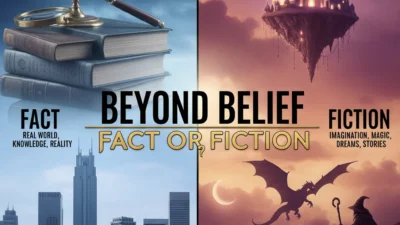
Every day, we read news, watch videos, scroll social media, and enjoy fact or fiction streaming content. But sometimes we get confused — Is this real? Or just a story?
That’s where two important English words come in:
- Fact
- Fiction
These two words may look simple, but they are used incorrectly more often than you think. Many students and even adults mix them up while writing essays, reports, or reviews of movies and streaming shows.
This guide will explain:
- The meaning of fact and fiction
- The difference between them in clear, easy language
- How to use them correctly with real examples
By the end, you’ll always know whether something is fact (real) or fiction (imaginary).
🔎 What Does Each Word Mean?
✅ FACT — Something real or true
A fact is information that can be proved.
👉 If you can test it, check it in a book, or verify it, then it is a fact.
Examples of Facts:
| Fact Example | Reason |
|---|---|
| The sun rises in the East. | Can be scientifically proved. |
| Water freezes at 0°C. | Can be tested. |
| 2 + 2 = 4 | Can be verified. |
Easy Sentences:
- It is a fact that birds can fly.
- Pakistan is in Asia — this is a fact.
- The Eiffel Tower is in Paris.
✅ FICTION — Something imaginary or made-up
Fiction means something that is not real.
It comes from someone’s imagination — like stories, movies, cartoons, or legends.
Examples of Fiction:
| Fiction Example | Reason |
|---|---|
| A superhero flies to space without a rocket. | Not real. |
| Dragons breathe fire. | Imaginary creature. |
| Time travel using a magic door. | Only in stories. |
Easy Sentences:
- Harry Potter is a fiction story.
- Unicorns are fiction.
- Most superhero movies are fiction.
🎬 Fun Example (Streaming Context)
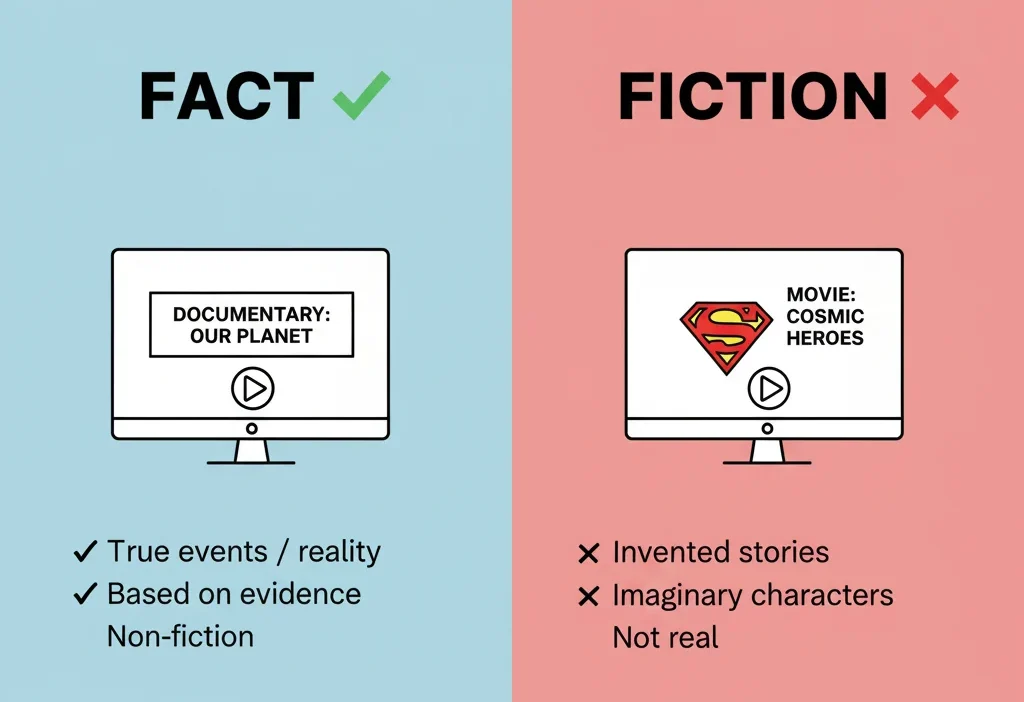
- A documentary on Netflix = usually FACT
- A superhero movie on Netflix = FICTION
So when someone searches for fact or fiction streaming, they usually want to know:
“Is this show based on true events or imagination?”
🆚 The Key Difference Between Fact and Fiction
| Feature | FACT ✅ | FICTION ❌ |
|---|---|---|
| Meaning | Real, true information | Imaginary or invented story |
| Can be proved? | ✅ Yes | ❌ No |
| Based on reality? | ✅ Yes | ❌ No |
| Used in | News, documentaries, school reports, science | Movies, novels, fairy tales |
| Example sentence | “The Earth moves around the Sun.” | “A man can become invisible.” |
⭐ Quick Tip to Remember
👉 FACT = F for F Real & Proven Facts
👉 FICTION = F for *Fake Stories
⚠️ Common Mistakes and How to Avoid Them
| Incorrect Sentence ❌ | Why it’s wrong | Correct Sentence ✅ |
|---|---|---|
| The movie Avatar is based on facts. | Avatar is 100% fictional. | Avatar is a fictional movie. |
| Dragons are facts. | Dragons don’t exist. | Dragons are fiction. |
| Social media posts are always facts. | Not everything online is true. | Not every post online is a fact. |
✏️ When to Use FACT
Use fact when:
- The information can be measured or verified
- It is real and true
- It is supported by evidence
Example Sentences:
- It is a fact that water is made of hydrogen and oxygen.
- The Amazon River is the largest river in the world — this is fact.
- History books are full of facts.
- The height of Mount Everest is a fact, not a guess.
- Climate change is a scientific fact.
🎯 Memory Hack:
If it can go in a science book, it is a FACT.
✏️ When to Use FICTION
Use fiction when:
- Something is made up
- It is part of a creative story
- Characters or events are imaginary
Example Sentences:
- Cinderella is a fiction story.
- Most cartoons are fiction.
- Novels usually contain fiction.
- Fiction helps us escape reality.
- Harry Potter is a world of magic and fiction.
🎯 Memory Hack:
If it could be in a storybook, it is FICTION.
🚀 Quick Recap: Fact vs Fiction
- FACT = Real
- FICTION = Not real / imaginary
- Fact can be proved. Fiction cannot.
- Use fact for research, news, and reports.
- Use fiction for entertainment, stories, and movies.
✅ Advanced Tips (optional but useful)
| Area | Fact | Fiction |
|---|---|---|
| School essays | Used to present real information | Used in creative writing |
| Streaming platforms | Documentaries, real crime stories | Movies, cartoons, fantasy shows |
| Writing exams | Requires evidence and proof | Requires imagination and creativity |
Misusing these words can confuse readers and make your writing unclear.
✏️ Mini Quiz (Test Yourself!)
Fill in the blanks with fact or fiction:
- Dragons are ______.
- Water boils at 100°C. This is a ______.
- The show claims to be based on true events, but it is actually ______.
- Scientists use ______ in their research.
- Harry Potter movies are ______.
(Answers: 1. fiction, 2. fact, 3. fiction, 4. facts, 5. fiction)
📝 Conclusio
Understanding the difference between fact and fiction helps you think more clearly, write better, and avoid believing incorrect information — especially when watching fact or fiction streaming content online.
Facts are real, true, and proven. Fiction is imaginary, creative, and entertaining.
Whenever you read or watch something, ask yourself:
“Can this be proved?”
If yes, it’s a fact.
If not, it’s fiction.
With practice, you will quickly recognize the correct usage in writing, school assignments, and daily conversations.
Keep learning. Keep questioning. Keep improving your English every day.

Polly Clark creates clear, insightful guides on language and usage, helping readers understand meanings, differences, and nuances with clarity and confidence.