Ever wondered why some statements sound true but aren’t actually facts? Or why people argue about opinions as if they’re facts? Understanding fact or opinion is the secret to reading, writing, and speaking English correctly — and we’ll make it super simple for you.
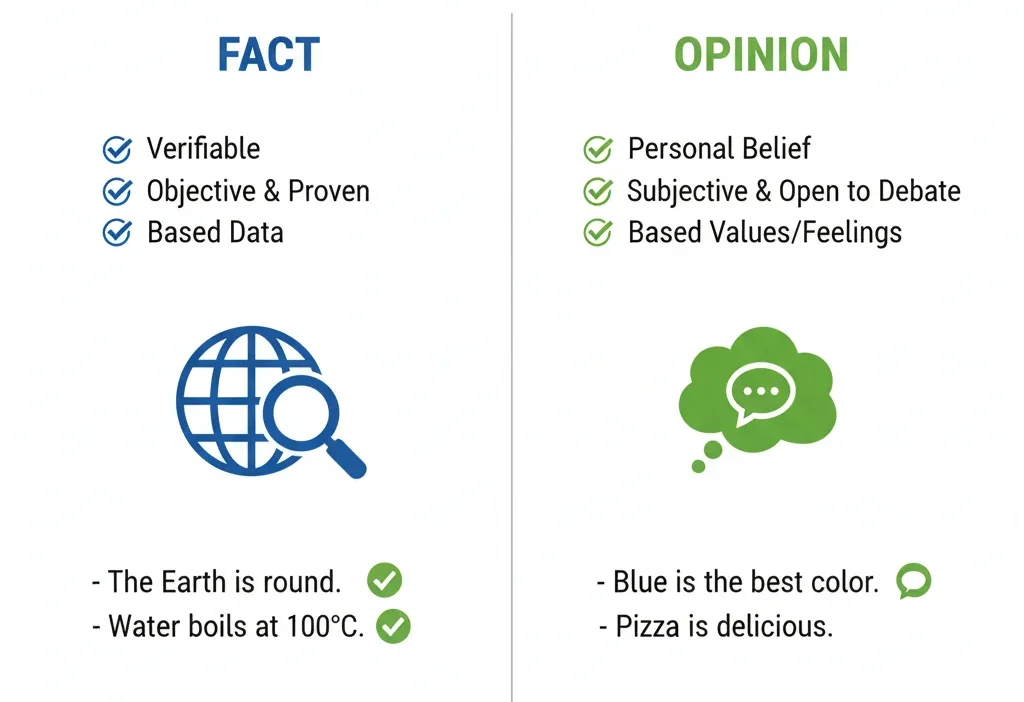
Many people confuse fact or opinion because they often look similar at first glance. A fact is something that can be proven true or false, while an opinion is a personal belief or feeling. Mixing them up can lead to misunderstandings in school, work, or even casual conversations.
In this guide, you’ll learn:
- The clear meaning of fact and opinion
- How to identify each in sentences
- Common mistakes and how to avoid them
- Practical examples for daily use
By the end, you’ll be able to spot facts and opinions instantly and use them correctly every time — even if you’re a beginner in English.
What Does Each Word Mean?
Fact
A fact is something that can be proven true or false. It doesn’t depend on personal feelings.
Part of speech: noun
Examples:
- Water boils at 100°C.
- The Earth revolves around the Sun.
- Dogs are mammals.
Think of facts as “reality statements.” They exist whether you believe them or not.
Opinion
An opinion is what someone thinks, feels, or believes. It cannot be proven true or false.
Part of speech: noun
Examples:
- Chocolate ice cream is the best flavor.
- Summer is better than winter.
- Reading books is more fun than watching TV.
Opinions are personal. Different people can have different opinions about the same thing.
The Key Difference Between Fact and Opinion
| Feature | Fact | Opinion |
|---|---|---|
| Meaning | Can be proven true or false | Personal belief or feeling |
| Proof | Requires evidence | Cannot be proven |
| Example | “The Moon orbits the Earth.” | “The Moon looks beautiful tonight.” |
| Usage Tip | Use in reports, science, news | Use in reviews, personal stories |
Quick Tip:
If you can check it in a book, website, or experiment — it’s a fact. If it’s what you like, think, or feel — it’s an opinion.
Common Mistakes and How to Avoid Them
Mistake 1: Treating opinions as facts
- Incorrect: “Summer is the best season because everyone loves it.”
- Correct: “Many people think summer is the best season.”
Mistake 2: Claiming facts without evidence
- Incorrect: “Dinosaurs still live today.”
- Correct: “Dinosaurs lived millions of years ago, but they are now extinct.”
Mistake 3: Mixing both in one sentence
- Incorrect: “Chocolate is the healthiest food because it tastes good.”
- Correct: “Chocolate tastes good, but it is not the healthiest food.”
Tip: Always separate feelings (opinions) from provable information (facts).
When to Use Fact
Facts are useful when you need to be correct, accurate, or persuasive. Use facts in:
- School assignments
- News reports
- Scientific writing
- Research projects
Examples:
- “The Pacific Ocean is the largest ocean on Earth.”
- “Mount Everest is 8,848 meters tall.”
- “Humans need oxygen to survive.”
- “Penguins live in the Southern Hemisphere.”
Memory Hack: Facts = checkable reality. Think “Fact = True or False.”
When to Use Opinion
Opinions are useful when sharing personal thoughts, preferences, or beliefs. Use opinions in:
- Reviews (movies, food, books)
- Conversations with friends and family
- Essays or blogs expressing your point of view
- Personal reflections
Examples:
- “I love pizza more than burgers.”
- “Math is my favorite subject.”
- “Watching the sunset is relaxing.”
- “Cats are better pets than dogs.”
Trick: Opinions are like speech bubbles over someone’s head — personal and unique.
Quick Recap: Fact vs Opinion
- Fact: Can be proven, true or false, reality-based.
- Opinion: Personal belief, feeling, or preference.
- Tip: Ask yourself — “Can I prove this?” If yes → Fact. If no → Opinion.
Advanced Tips (Optional)
- History: The word “fact” comes from Latin factum, meaning “something done or performed.” “Opinion” comes from Latin opinio, meaning “belief.”
- Formal Writing: Facts strengthen essays, research papers, and articles. Opinions add personal voice in blogs, reviews, or narratives.
- Online Writing: Misusing facts and opinions online can mislead readers. Always clarify what is proven and what is personal.
Mini Quiz
Fill in the blanks with fact or opinion:
- “The sun rises in the east.” → _______
- “Chocolate is the yummiest dessert.” → _______
- “Elephants are the largest land animals.” → _______
- “I think summer is better than winter.” → _______
- “Water freezes at 0°C.” → _______
(Answers: 1-Fact, 2-Opinion, 3-Fact, 4-Opinion, 5-Fact)
FAQs
1. How do I quickly tell fact from opinion?
Check if it can be proven. If yes, it’s a fact; if not, it’s an opinion.
2. Can a sentence have both fact and opinion?
Yes. Separate the fact (provable) from the opinion (personal).
3. Are opinions always wrong?
No. Opinions are personal beliefs and can’t be “wrong,” but facts can be checked for truth.
4. Why is it important to know the difference?
It helps in writing, reading comprehension, and avoiding misunderstandings.
5. Can facts change?
Facts are based on evidence, but new discoveries can update our understanding of some facts.
Conclusion
Understanding fact or opinion is essential for clear thinking and communication. Facts provide proof, while opinions show personal views. By learning to separate the two, you can write better, argue less, and read more effectively.
Practice spotting facts and opinions in your daily life — from books to conversations — and your English skills will improve step by step. Remember, every expert started by learning the basics!

Jenn Ashworth offers clear, engaging explanations of language and usage, helping readers grasp meanings, nuances, and differences with accuracy and ease.