English is full of confusing words — especially when they sound the same but have very different meanings. One pair that confuses many people in texting, online messages, and even song lyrics is feening vs feigning.
People often say:
“I’m feening for chocolate.”
“He’s feigning sickness to skip school.”
At first glance, these two words look similar. When spoken quickly, they even sound alike. But they do not mean the same thing.
The goal of this guide is simple:
- Understand what feening means
- Understand what feigning means
- Learn the difference between feening and feigning
- Learn how to use them in correct sentences
By the end of this article, even a 4th-grade student will be able to tell the difference and use both words confidently.
Let’s make English easy. ✨
What Does Each Word Mean? (Simple Definitions + Examples)
✅ Word 1: Feening (slang)
Meaning:
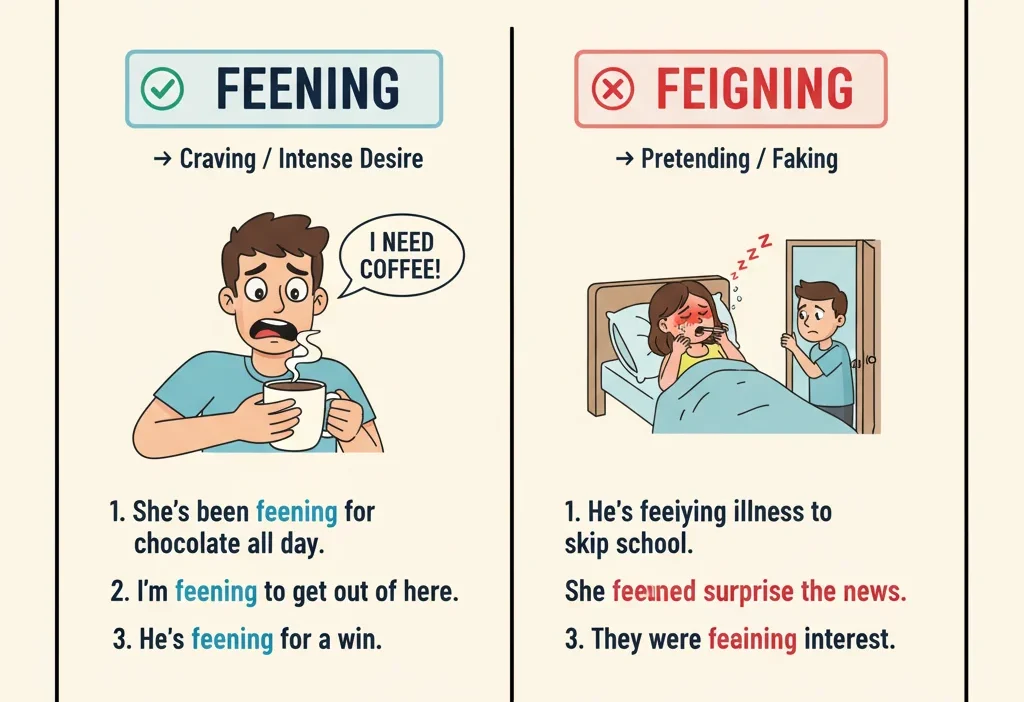
“Feening” is slang. It means craving something very strongly — wanting something so badly that you can’t stop thinking about it.
It comes from the word “fiending” (like someone acting desperate for something).
Popular in music, texting, and casual conversation.
Part of speech:
➡️ Verb (action word)
Simple definition:
To want something very, very badly.
Examples:
| Sentence | Explanation |
|---|---|
| “I’m feening for pizza.” | I want pizza a lot. |
| “She’s feening to buy the new phone.” | She really wants that phone. |
| “They were feening to see the new movie.” | They couldn’t wait to watch it. |
Think of “feening” as strong desire.
✅ Word 2: Feigning (correct formal English word)
Meaning:
“Feigning” means pretending.
When someone acts like something is true, but it is not.
Part of speech:
➡️ Verb (action word)
Simple definition:
To fake something, or pretend something is real.
Examples:
| Sentence | Explanation |
|---|---|
| “He was feigning sleep.” | He pretended to be asleep. |
| “She was feigning confidence.” | She acted confident but wasn’t. |
| “The student was feigning sickness to avoid school.” | Pretended to be sick. |
Think of “feigning” as acting or pretending.
⭐ The Key Difference Between Feening vs Feigning
| Word | Meaning | Type of Word | Use in Sentence |
|---|---|---|---|
| Feening | Craving or wanting something strongly (slang) | Verb (informal) | “I’m feening for chocolate.” |
| Feigning | Pretending or faking something (formal) | Verb (formal) | “He is feigning sickness.” |
🧠 Quick Tip to Remember:
Feening = Feeling a strong desire.
Feigning = Faking something.
Just remember:
➡️ Feening = craving
➡️ Feigning = pretending
❌ Common Mistakes and How to Avoid Them
🔥 Mistake 1:
❌ “I’m feigning for ice cream.”
✅ Correct: “I’m feening for ice cream.”
❓ Why?
Because you aren’t pretending to want ice cream — you really want it.
🔥 Mistake 2:
❌ “He’s feening interest in the project.”
✅ Correct: “He’s feigning interest in the project.”
❓ Why?
He doesn’t really care — he is pretending to care.
🟦 When to Use Feening
Use feening when you:
- Want something strongly
- Can’t stop thinking about it
- Have a craving (food, games, attention, etc.)
✅ Examples:
- “I’m feening for some cold soda right now.”
- “She’s feening to finish the new book.”
- “We were feening to play outside.”
- “He was feening for attention at the party.”
- “They’re feening to try the new restaurant.”
👉 Memory Hack:
Feening looks like feeling — both are about emotions or desire.
🟩 When to Use Feigning
Use feigning when you:
- Are pretending
- Are faking something
- Want others to believe something that is not true
✅ Examples:
- “The child was feigning a cough to skip school.”
- “She was feigning interest to be polite.”
- “He is feigning tiredness to avoid helping.”
- “The actor was feigning sadness for the scene.”
- “He was feigning surprise, but he already knew.”
👉 Memory Hack:
Feigning looks like fake — both start with “F-E.”
🔄 Quick Recap: Feening vs Feigning
- Feening = craving something (slang/casual)
- Feigning = pretending something (formal/correct spelling)
➡️ If you want something → feening
➡️ If you pretend something → feigning
🧠 Advanced Tips (Bonus)
| Usage Level | Feening | Feigning |
|---|---|---|
| Formal writing (essays, emails, school work) | ❌ Not recommended (slang) | ✅ Correct and accepted |
| Texting, chatting, songs, social media | ✅ Common | ✅ Also used |
| Academic or official grammar | ❌ | ✅ |
- “Feening” became widely used from hip-hop and R&B music lyrics (e.g., “I’m feenin’ for you”).
- “Feigning” has been used in English since the 1300s.
🧪 Mini Quiz: Test Yourself!
Fill the blanks with feening or feigning:
- She is _______ sickness to avoid homework.
- I’m _______ for a cup of coffee.
- He was _______ confidence at the meeting.
- We were _______ to try the new burger place.
- The actor was _______ sadness for the role.
(Answers: 1–Feigning, 2–Feening, 3–Feigning, 4–Feening, 5–Feigning)
✅ Frequently Asked Questions (FAQ)
1. Is “feening” a real word?
It is slang, not a formal dictionary word.
2. Which word should I use in school essays?
Use feigning — it is formal and correct.
3. Why do people mix up feening and feigning?
They sound similar when spoken quickly.
4. Can feening and feigning be used in the same sentence?
Yes: “He was feigning interest, but we were feening to leave.”
5. Which one appears in song lyrics?
Feening — especially in R&B/hip-hop music.
✨ Conclusion
Words can be confusing, especially when they sound the same. But now you know the difference between feening vs feigning — one is slang for strong desire, and the other means pretending.
- Use feening when you want something badly.
- Use feigning when you are faking something.
Whether texting friends or writing an academic essay, choosing the correct word shows confidence and clarity. The more you practice, the more natural it becomes. Keep improving, keep learning, and soon English will feel easy.

Polly Clark creates clear, insightful guides on language and usage, helping readers understand meanings, differences, and nuances with clarity and confidence.