Primary Keywords: fewer or less, fewer vs less, difference between fewer and less, fewer and less grammar rule
Secondary Keywords: correct usage, grammar tips, common mistake, examples in English, how to use fewer or less, English grammar difference
Semantic Keywords: what’s the difference between fewer and less, simple explanation, easy grammar rule, when to use fewer, when to use
Do you ever pause and wonder — should I say fewer or less?
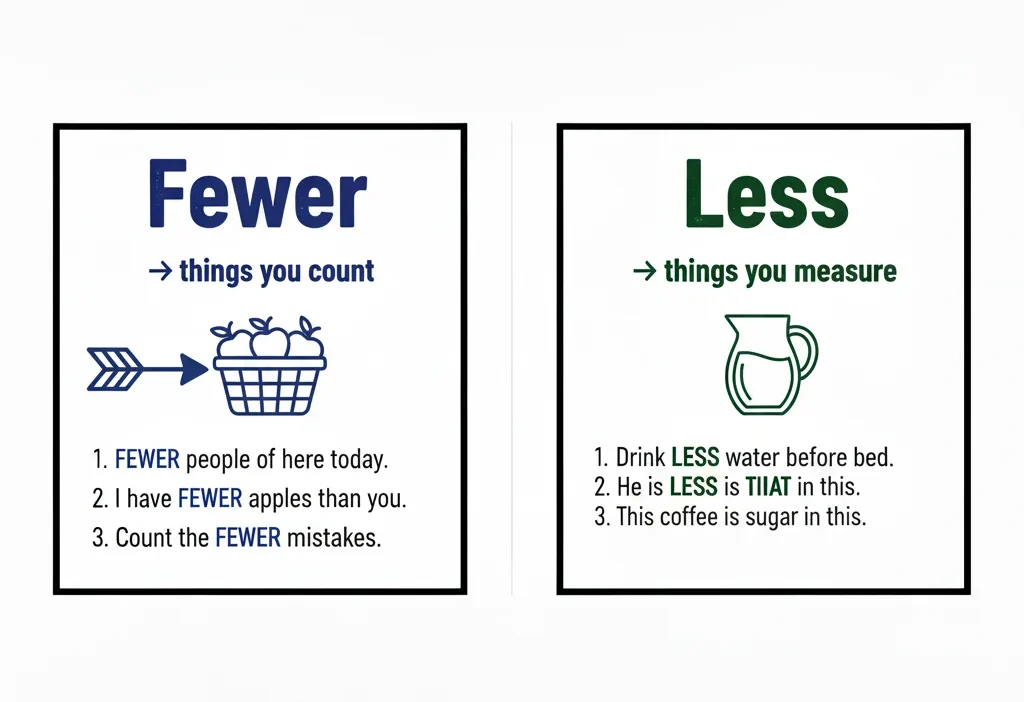
You’re not alone! These two small words confuse even native English speakers. Both talk about quantity or amount, but they are not interchangeable. The difference lies in what you’re counting — things you can count vs things you can’t.
In this simple guide, you’ll learn exactly when to use fewer and when to use less, with easy examples, comparison tables, and helpful memory tricks. By the end, you’ll never mix them up again. Whether you’re writing an essay, speaking in class, or chatting online, this article will make fewer vs less crystal clear.
🧠 What Does Each Word Mean?
Let’s start by understanding what each word actually means in plain English.
1. What Does “Fewer” Mean?
- Part of speech: adjective
- Used for: things you can count one by one (countable nouns)
Think of fewer as used with individual items — things that can be counted with numbers.
Examples:
- I have fewer apples than you. 🍎
- There were fewer students in class today.
- She made fewer mistakes this time.
💡 Simple trick: If you can add a number (like 3 apples, 5 books), use fewer.
210+ Who vs Whom Difference Explained 🗣️ 2025 English Lesson
2. What Does “Less” Mean?
- Part of speech: adjective/adverb
- Used for: things you cannot count individually (uncountable nouns)
Use less for mass nouns — things that come in amounts, not separate pieces.
Examples:
- I have less water in my glass. 💧
- He spends less time on video games.
- We have less money this month.
💡 Simple trick: If you can’t count it one by one (like sugar, time, water), use less.
⚖️ The Key Difference Between Fewer and Less
Here’s a quick comparison to make it even clearer:
| Feature | Fewer | Less |
|---|---|---|
| Used for | Countable nouns | Uncountable nouns |
| Meaning | A smaller number of items | A smaller amount or quantity |
| Examples | Fewer books, fewer people, fewer problems | Less water, less sugar, less time |
| Can we count it? | ✅ Yes | ❌ No |
💡 Quick Tip to Remember:
👉 If you can count it → use fewer.
👉 If you can’t count it → use less.
210+ Then or Than Difference Explained 🔍 2025 Grammar Lesson
❌ Common Mistakes and How to Avoid Them
Even fluent speakers make these common grammar mistakes. Let’s fix them!
Mistake 1:
❌ There were less people at the concert.
✅ There were fewer people at the concert.
🧩 Why? You can count people, so “fewer” is correct.
Mistake 2:
❌ I drank fewer water after running.
✅ I drank less water after running.
🧩 Why? You can’t count water — it’s an amount, not individual items.
Mistake 3:
❌ We need less chairs for the event.
✅ We need fewer chairs for the event.
🧩 Why? Chairs can be counted, so “fewer” is the right word.
🗂️ When to Use “Fewer”
Use fewer for things you can count. Here are some easy examples and real-life situations:
- Fewer students came to school today.
- I made fewer mistakes on my test.
- We have fewer cars on the road this Sunday.
- Please bring fewer bags next time.
- There are fewer hours left before the deadline.
💡 Memory Hack:
If you can count it with your fingers, use fewer!
⏳ When to Use “Less”
Use less for uncountable things — things that come in a total amount, not as separate pieces.
Examples:
- We have less milk in the fridge.
- I need less stress in my life.
- Try to spend less time on your phone.
- He has less money than before.
- There’s less traffic today.
💡 Visual Trick:
Picture a big container of something (like milk or sand). You can’t count each drop or grain — that’s when you use less.
🔄 Quick Recap: Fewer vs Less
Here’s an easy summary you can remember:
- ✅ Fewer → for countable nouns (apples, people, mistakes)
- ✅ Less → for uncountable nouns (water, time, sugar)
- ⚡ Rule: If you can count it → use fewer. If you measure it → use less.
Examples:
- Fewer students, less noise
- Fewer cars, less traffic
- Fewer words, less talk
📘 Advanced Tips and Fun Facts
- Origin:
Both words come from Old English — “fewer” (from feawe) and “less” (from laes). Over centuries, people began mixing them up. - Exceptions:
There are a few cases where less is still used with countable things — usually in time, money, or distance.
Examples:- It takes less than five minutes.
- The shirt costs less than ten dollars.
- We walked less than two miles.
- In Formal Writing:
Use “fewer” for countable nouns in essays, emails, and academic writing. Using the correct form makes your English sound precise and professional.
🧩 Mini Quiz: Test Yourself!
Fill in the blanks with fewer or less.
- There are _______ cookies left in the jar.
- I have _______ homework today.
- She made _______ mistakes on her spelling test.
- We need _______ sugar for this recipe.
- He spent _______ money than I did.
- _______ people attended the meeting.
- I feel _______ tired after my nap.
(Answers: 1. fewer, 2. less, 3. fewer, 4. less, 5. less, 6. fewer, 7. less)
❓ FAQs
1. What’s the difference between fewer and less?
“Fewer” is for countable things (like books), while “less” is for uncountable things (like water).
2. Can I say “less people”?
Technically no. It should be “fewer people,” because people can be counted.
3. Why do stores say “10 items or less”?
It’s an accepted phrase, though “10 items or fewer” is grammatically correct.
4. Is “less” only used for quantities?
Mostly yes, but it can also mean “to a smaller degree,” like “less interested.”
5. How can I remember the rule easily?
If you can count it → use fewer.
If you measure it → use less.
🌈 Conclusion
Now you know the clear and simple difference between fewer and less.
Use fewer when counting separate items and less when talking about amounts or quantities. Remember: if it’s countable, it’s fewer; if it’s not, it’s less.
Practice using both in your daily life — when speaking, writing, or texting. The more you notice them, the easier it gets. Soon, you’ll confidently pick the right one every time. Keep learning and improving — one small grammar rule at a time makes a big difference!

Francis Sufford crafts thoughtful, insightful explanations on language, meaning, and usage, blending clarity with storytelling to guide readers effectively.