
Do you find yourself hesitating between “fiery” and “firey”? You’re not alone. This simple, five-letter word sparks a surprising amount of confusion for writers, students, and professionals worldwide. Every day, countless people search for the correct spelling, driven by the need for accuracy in emails, academic papers, creative writing, and professional communication.
The mix-up is understandable—the word relates to “fire,” so why wouldn’t it be spelled “firey”? This common logic trap is precisely why the mistake persists. This article aims to douse the flames of confusion once and for all.
We’ll explore the correct spelling, its fascinating origin, the rules that govern it, and provide clear, practical guidance so you can use “fiery” with unwavering confidence. Whether you’re crafting a novel’s passionate scene, describing a spicy meal, or writing a critical business report, knowing the correct form is key to clear and authoritative communication.
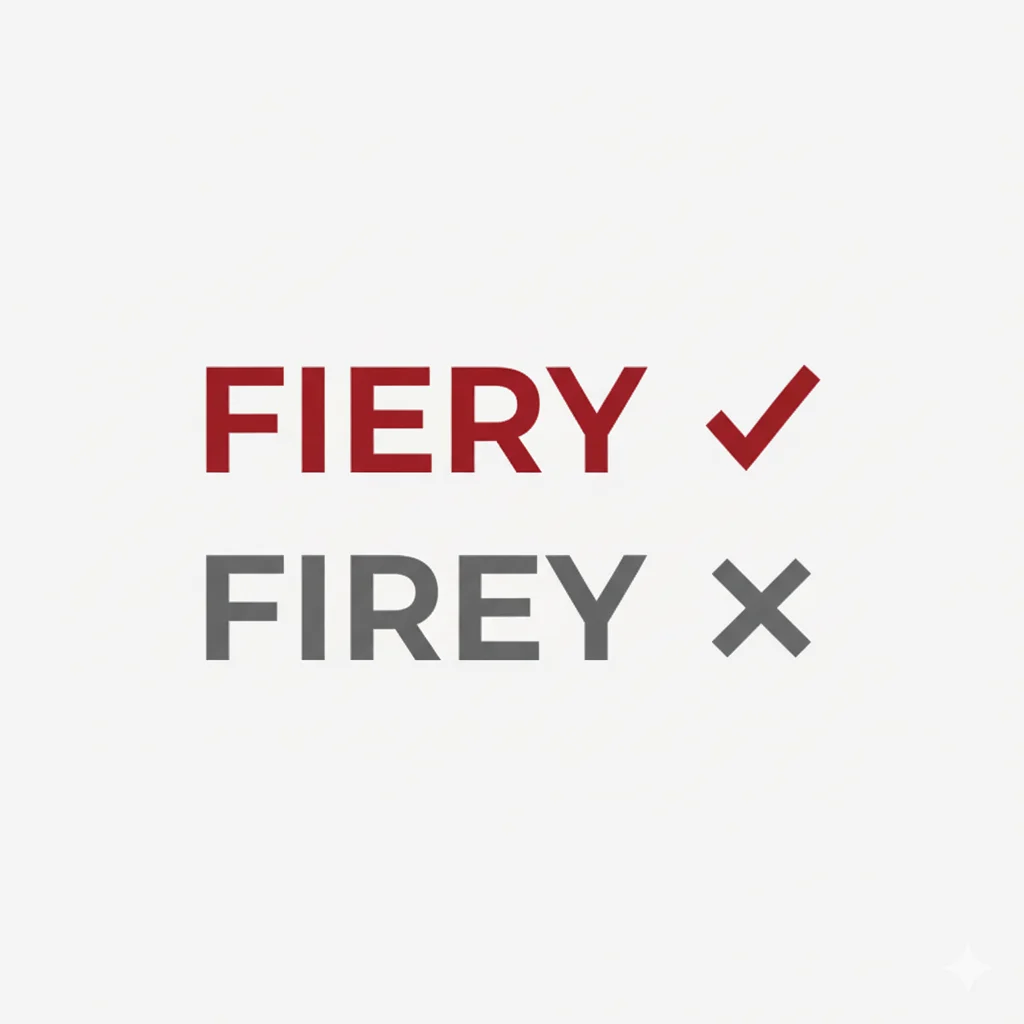
Fiery / Firey
The correct spelling is fiery. “Firey” is always a spelling error. This rule holds true for all forms of English—American, British, Australian, and others.
The word “fiery” is an adjective. It describes something that resembles or contains fire, is intensely hot, or has a passionate, spirited quality.
Examples of Correct Usage:
- “The politician gave a fiery speech that energized the crowd.”
- “Be careful—these peppers have a fiery taste.”
- “The sky turned a fiery orange at sunset.”
A quick tip: Remember the base word is “fire,” but when forming the adjective, the “e” is dropped and replaced with a “y,” resulting in fiery.
The Origin of Fiery
To understand why “fiery” is correct and “firey” is not, we must look to its history. The word “fiery” comes from the Middle English word firy, which itself evolved from the Old English fȳr (meaning fire) combined with the suffix *-y*, used to form adjectives.
The core of the confusion lies in a standard English spelling rule. When adding a suffix (like *-y*) to a word ending in “e,” the general rule is to drop the silent “e.” For example:
- Ice + y = Icy (not “icey”)
- Noise + y = Noisy (not “noisey”)
- Smoke + y = Smoky (not “smokey”)
- Fire + y = Fiery (not “firey”)
This rule creates consistency. The misspelling “firey” likely emerges because people visually and mentally connect the word directly to “fire” and intuitively add the “y” without dropping the “e.” While this seems logical, it contradicts the established spelling convention that has been in place for centuries.
British English vs. American English Spelling
One of the most common sources of spelling confusion is the difference between British and American English. Words like “colour/color,” “centre/center,” and “organise/organize” have accepted variations depending on the dialect.
However, “fiery” is a rare case of perfect agreement. Both British English and American English accept only “fiery” as the correct spelling. The non-standard “firey” is considered incorrect in all major standardized forms of English.
The table below clarifies the spelling landscape for similar adjective formations, showing where variations do and do not exist.
Table: Spelling Comparison of “-y” Adjective Forms
| Base Word | Correct Adjective (US & UK) | Common Incorrect Spelling |
|---|---|---|
| Fire | Fiery | Firey |
| Ice | Icy | Icey |
| Smoke | Smoky | Smokey |
| Noise | Noisy | Noisey |
| Stone | Stony | Stoney |
| Home | Homey (US) / Homy (UK) | – |
As shown, “fiery” follows the same pattern as “icy” and “smoky,” not the exceptional pattern of “homey/homy.”
Which Spelling Should You Use?
The guidance here is unequivocal: you should always use “fiery.”
- For a US Audience: Use fiery. American English dictionaries and style guides (like AP or Chicago) list only “fiery.”
- For a UK/Commonwealth Audience: Use fiery. Oxford English Dictionary and other UK references confirm “fiery” as the standard.
- For Global or International English: Use fiery. It is the globally recognized and accepted spelling in formal writing, academia, and publishing.
Using “firey” will be flagged as an error by spell-checkers (like those in Microsoft Word or Google Docs) and may undermine your credibility with educated readers. For clear, professional, and correct communication, “fiery” is the only choice.
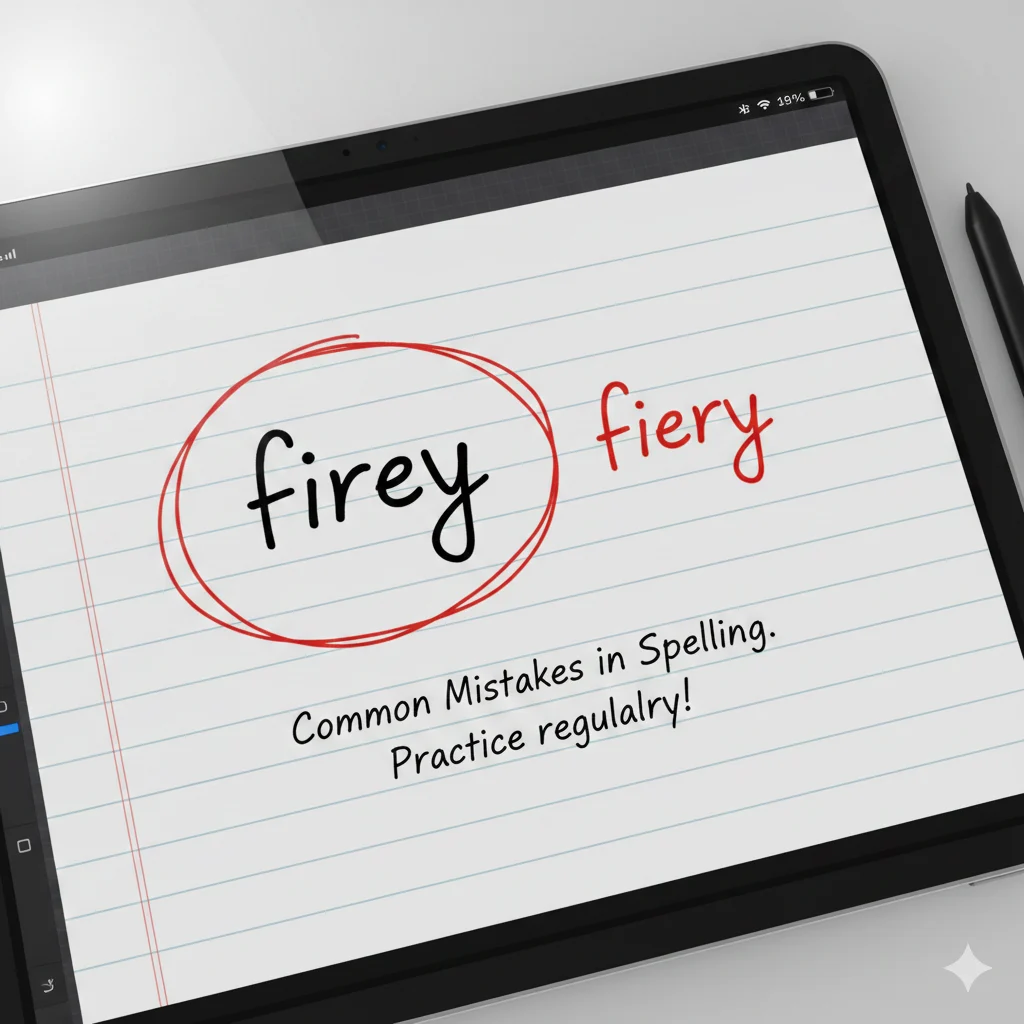
Common Mistakes with Fiery
Beyond the primary “firey” error, a few other common mistakes occur with this word.
- The Primary Error: Adding an Extra ‘e’
- Mistake: “Her temper was very firey.”
- Correction: “Her temper was very fiery.”
- Incorrect Pronunciation Leading to Spelling Errors: Some pronounce it as “fye-ree,” which can lead to misspellings like “firy.”
- Mistake: “He has a firy personality.”
- Correction: “He has a fiery personality.” (Correct pronunciation: FYE-uh-ree or FYE-ree).
- Confusion with Plurals or Other Forms: Remember, “fiery” is only an adjective.
- Mistake: “The fierys of hell.” (Using it as a noun).
- Correction: “The fires of hell.” or “The fiery pits of hell.”
Fiery in Everyday Examples
Seeing “fiery” used correctly in context helps cement its spelling and meaning.
- Email/Professional Context: “We need to address the client’s fiery feedback with a calm and detailed response.”
- News Headline: “Debate Erupts into Fiery Exchange Between Candidates.”
- Social Media Post: “Just tried the new ‘Dragon’s Breath’ wings – talk about a fiery flavor! 🔥”
- Creative Writing: “She met his gaze with fiery determination, refusing to back down.”
- Product Description: “This salsa delivers a fiery kick made with authentic habanero peppers.”

Fiery – Google Trends & Usage Data
Data from Google Trends reveals a telling story. Searches for the incorrect term “firey” show a consistent, low-volume pattern, almost exclusively representing people questioning the spelling (e.g., “how to spell firey”).
In contrast, the correct term “fiery” sees higher and more stable search volume, often spiking in relation to real-world events—such as during political debates, major sports controversies, or news about wildfires. Geographically, searches for both terms follow English-speaking populations, with no significant regional variation that would suggest an accepted alternative spelling. This data confirms that “fiery” is the dominant, accepted form used in actual content and discourse, while “firey” searches primarily reflect uncertainty.
FAQs
Which is correct, firey or fiery?
Fiery is correct. Firey is an incorrect spelling.
What is the meaning of Fiery?
“Fiery” is an adjective with three main meanings: 1) Consisting of or resembling fire (fiery sparks), 2) Very hot or spicy (fiery chili), 3) Having a passionate, quick-tempered, or spirited nature (a fiery personality).
What is the superlative of fiery?
The comparative form is fierier, and the superlative form is fieriest. Example: “Of all the sauces, this is the fieriest.”
Who is Fiery?
“Fiery” is not typically a proper name for a person. It is an adjective. However, it can be used as a descriptive nickname (e.g., “Fiery” Fred, a passionate sports coach) or appear in fictional character names for those with fiery traits.
How to pronounce fiery?
The most common pronunciation is FYE-uh-ree (three syllables). A common alternate, two-syllable pronunciation is FYE-ree.
Why is it fiery and not firey?
It follows the standard English spelling rule where the silent “e” at the end of a base word (fire) is dropped before adding a suffix that starts with a vowel or ‘y’ (like -y). Similar examples are “icy” (from ice) and “smoky” (from smoke).
What are synonyms for fiery?
Synonyms depend on context: For temperature/intensity: blazing, burning, flaming, hot. For personality/spirit: passionate, fervent, ardent, spirited, tempestuous. For flavor: spicy, pungent, piquant, hot.
Conclusion
The journey from confusion to clarity with fiery is straightforward. Despite the intuitive pull to spell it as “firey,” the established, historical, and globally accepted spelling is unequivocally fiery. This adjective, describing everything from literal flames to metaphorical passion, follows a consistent English spelling rule: drop the silent “e” from “fire” before adding the “-y.” This places it in the same family as “icy” and “smoky.”
Whether you’re writing for an American, British, or international audience, “fiery” is the only correct choice. Using it accurately strengthens your writing, avoids distracting errors, and ensures your message is received with the authority you intend. Let this be the final word: embrace the correct form, and write with fiery confidence.

Jenn Ashworth offers clear, engaging explanations of language and usage, helping readers grasp meanings, nuances, and differences with accuracy and ease.