Have you ever seen the words “flakey” and “flaky” and wondered which one is correct? 🤔
You’re not alone! Many English learners (and even native speakers) get confused because both versions look right — and they even sound the same!
In this guide, you’ll learn:
✅ What each word means
✅ The difference between flakey and flaky
✅ How to use each word correctly in sentences
✅ Common mistakes to avoid
✅ Fun tips and examples to help you remember easily
By the end, you’ll never mix up flakey and flaky again — promise!
🧩 What Does Each Word Mean?
Let’s start by understanding what each version means and how it’s used.
Flaky — the Standard and Correct Spelling
Part of speech: Adjective
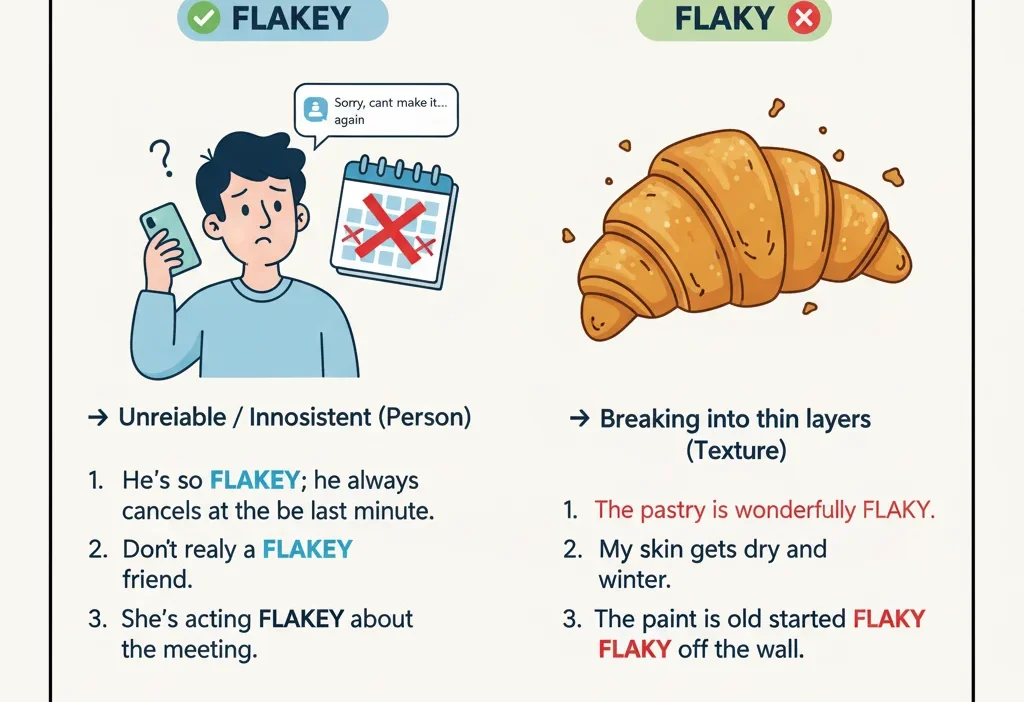
Meaning: Something that easily breaks into thin, small pieces — or a person who is unreliable or forgetful.
Examples:
- The flaky pastry crumbled as soon as I touched it. 🥐
- My internet connection is flaky today — it keeps dropping!
- Sarah is a bit flaky; she always cancels plans at the last minute.
So, “flaky” can describe texture (like food or paint) or behavior (like being unreliable).
Flakey — the Common Misspelling
Part of speech: Adjective (nonstandard)
Meaning: Technically the same as flaky, but not recognized as correct in formal English.
Examples (common but incorrect):
- ❌ The paint is starting to look flakey.
✅ The paint is starting to look flaky. - ❌ My computer is acting flakey again.
✅ My computer is acting flaky again. - ❌ Don’t be so flakey!
✅ Don’t be so flaky!
👉 Quick Note:
“Flakey” appears sometimes in informal writing (especially in old texts or online), but “flaky” is the correct and preferred spelling in both American and British English.
⚖️ The Key Difference Between Flakey and Flaky
| Feature | Flaky | Flakey |
|---|---|---|
| ✅ Correctness | ✔️ Standard spelling (correct) | ❌ Nonstandard (incorrect in formal English) |
| 📖 Dictionary Use | Found in major dictionaries (Merriam-Webster, Oxford) | Rarely listed; marked as “variant” or “misspelling” |
| 🌍 Common in | Formal writing, schools, books, and media | Informal texting or social media |
| 💬 Example | “The croissant was flaky and buttery.” | “The croissant was flakey and buttery.” (❌) |
Quick Tip to Remember:
✅ “Flaky” is like “snowflake” — both have “flake” in them!
❌ “Flakey” just adds extra letters you don’t need.
🚫 Common Mistakes and How to Avoid Them
Here are some mistakes people make when using flakey or flaky:
❌ Mistake 1: Thinking both spellings are acceptable
Wrong: “Either spelling is fine.”
Right: Only “flaky” is correct in formal English.
❌ Mistake 2: Using “flakey” in professional or academic writing
Wrong: “He was acting flakey during the meeting.”
Right: “He was acting flaky during the meeting.”
❌ Mistake 3: Confusing the meaning with “fake”
“Flaky” doesn’t mean “fake.” It means unreliable or easily broken apart.
✅ Correct: “This paint is flaky.”
❌ Wrong: “This paint is fake-y.”
✏️ When to Use Flaky
Use flaky when describing something that:
- Breaks apart easily (texture meaning)
- Is unreliable or inconsistent (personality meaning)
- Doesn’t work properly (technology or systems)
Examples:
- The snow was flaky and light. ❄️
- I don’t trust that flaky app — it crashes too often.
- Our teacher says my handwriting is flaky when I rush.
- Don’t depend on Mark; he’s too flaky.
- The old paint is flaky and peeling off.
💡 Memory Hack:
Think of flakes — small pieces that fall apart easily.
So, “flaky” means “breaking apart” or “not steady.”
✏️ When to Use Flakey
Simply put: Don’t.
While you may see “flakey” used casually on the internet, it’s not correct in formal or academic English.
However, if you’re quoting someone or writing informal dialogue, it’s okay for effect:
“He’s such a flakey dude,” she laughed.
But for everything else — spelling tests, essays, emails, or blog posts — always use “flaky.”
🔁 Quick Recap: Flakey vs Flaky
Here’s a simple way to remember the rule:
- ✅ Flaky = Correct spelling
- ❌ Flakey = Common misspelling
- 💬 Meaning: Describes something that’s unreliable, unstable, or breaks easily
- 🧠 Tip: “Flaky” looks like “flake” — the root word!
📚 Advanced Tips (Bonus Section)
🕰️ Word Origin
“Flaky” comes from the noun flake, which means a thin piece of something (like snowflake or cornflake).
It first appeared in the 19th century to describe things that easily broke into pieces. Later, it began to describe people’s personalities — unreliable or “all over the place.”
🏫 In Formal Writing
Always use flaky in essays, work reports, and professional documents.
Example:
“The project’s failure was due to a flaky system update.”
💬 In Texting or Slang
People often say, “He’s so flakey” — but even in casual chats, try to use the right spelling. It helps build good habits!
🧠 Mini Quiz — Test Your Understanding!
Fill in the blanks with flaky or flakey 👇
- My phone signal is really ______ today.
- Don’t rely on John; he’s too ______.
- The pastry was delicious and ______.
- That website is acting ______ — it won’t load!
- The old paint looks ______ and dry.
✅ Answers: 1. flaky 2. flaky 3. flaky 4. flaky 5. flaky
(Yes, all “flaky” — because it’s always the correct choice!)
🙋♀️ FAQs About Flakey vs Flaky
1. Is “flakey” a real word?
Technically no — it’s a misspelling of “flaky.” Some people use it informally, but it’s not correct in standard English.
2. Which spelling do dictionaries accept?
Major dictionaries like Oxford, Cambridge, and Merriam-Webster only list “flaky” as the standard form.
3. Can I use “flakey” in creative writing?
Yes, but only if you’re showing casual speech or dialogue — never in formal contexts.
4. What does “flaky person” mean?
It means someone who is unreliable, forgetful, or doesn’t follow through with plans.
5. Is “flaky” the same as “fake”?
No! “Flaky” means inconsistent or unreliable. “Fake” means not real or genuine
🏁 Conclusion
Now you know the truth — “flaky” is the correct and standard spelling, while “flakey” is just a common misspelling.
Remember: when in doubt, think of “flakes” — because “flaky” has the same root!
Keep practicing, notice the word in real sentences, and soon you’ll always spell it right without even thinking.
Learning small differences like this makes your English smoother, clearer, and more confident every day. 🌟

Eley Williams writes clear, engaging guides on confusing words and phrases, helping readers understand meanings, differences, and correct usage with ease.