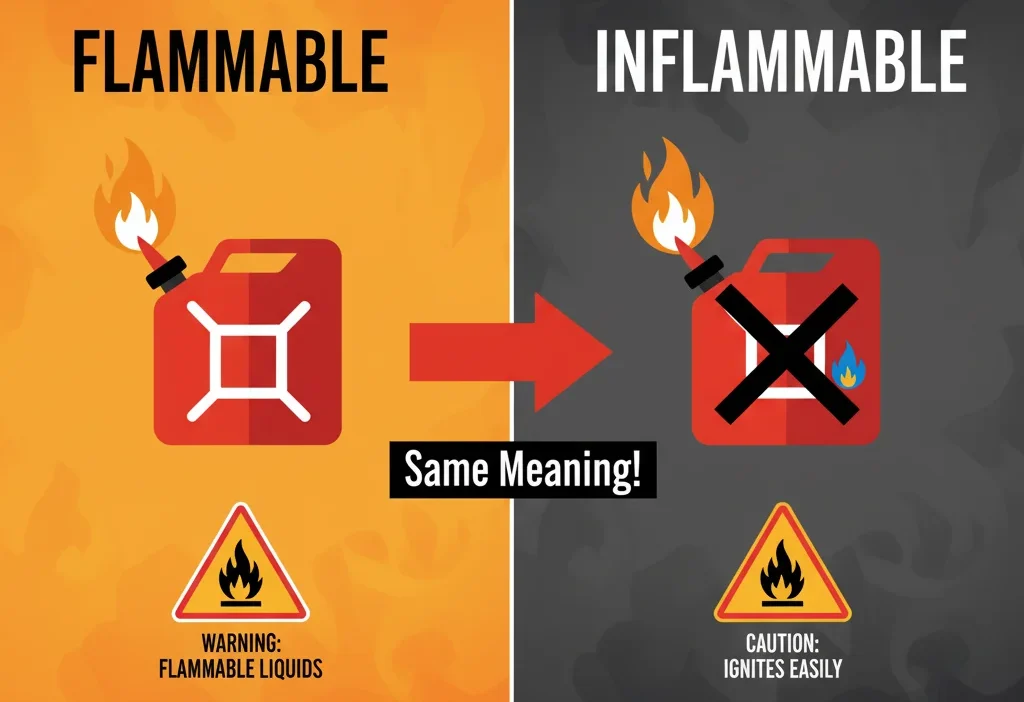
Have you ever seen a warning sign that says “Flammable” and another that says “Inflammable” — and wondered if they mean the same thing or the opposite? 🤔
You’re not alone! Many people think “inflammable” means not flammable (like “invisible” means not visible), but that’s a common English mistake.
In this guide, you’ll learn:
- What flammable and inflammable actually mean
- The key difference between them
- How to use each one correctly with examples
- Common mistakes and easy memory tricks
By the end, even a 4th-grade student will clearly understand when to use flammable or inflammable — and never get confused again!
🧯 What Does Each Word Mean?
1. Flammable
Meaning: Something that can easily catch fire.
Part of Speech: Adjective
Simple Definition:
If something is flammable, it burns quickly when near fire, heat, or sparks.
Examples:
- Paper is flammable, so keep it away from candles.
- Petrol is a flammable liquid.
- The warning label said, “Flammable — Keep away from flames!”
Mini Story:
Imagine you’re camping. You put dry leaves near your campfire. 🔥 Those leaves catch fire fast — that means they’re flammable.
2. Inflammable
Meaning: It also means something can easily catch fire! (Yes, the same as flammable.)
Part of Speech: Adjective
Simple Definition:
Inflammable = Flammable. Both mean “able to burn easily.”
Examples:
- Alcohol is inflammable — store it carefully.
- The old cloths were highly inflammable.
- The label read, “Danger: Inflammable gas.”
Why So Confusing?
The prefix “in-” in “inflammable” does not mean “not.”
It comes from the Latin word “inflammare,” which means “to set on fire.”
So “inflammable” actually means “able to catch fire,” not “fireproof.”
🔥 The Key Difference Between Flammable and Inflammable
Even though both mean the same thing, the word “flammable” is now more commonly used — especially for safety signs and product labels — to avoid confusion.
| Feature | Flammable | Inflammable |
|---|---|---|
| Meaning | Can easily catch fire | Can easily catch fire |
| Prefix Meaning | “Flam” = fire | “In” = Latin for “into,” not “not” |
| Usage | Modern and simple | Older, less common |
| Example Sentence | “Petrol is flammable.” | “Alcohol is inflammable.” |
| Common in | Everyday English, labels | Older books, scientific terms |
✅ Quick Tip to Remember:
Both flammable and inflammable mean the same — but use “flammable” in daily life to stay safe and clear.
⚠️ Common Mistakes and How to Avoid Them
| ❌ Wrong | ✅ Correct | 🧩 Why |
|---|---|---|
| This chemical is not inflammable. | This chemical is non-flammable. | “Inflammable” means flammable, so saying “not inflammable” confuses people. |
| The sign said inflammable — safe to use near heat. | The sign said flammable — keep away from heat. | “Inflammable” means dangerous, not safe! |
Tip:
If you mean “cannot burn,” always use non-flammable, fireproof, or flame-resistant, not “inflammable.”
🧴 When to Use Flammable
Use flammable when you’re describing anything that can catch fire easily — like liquids, fabrics, gases, or materials.
Examples:
- Paint thinner is flammable.
- Always store flammable liquids away from stoves.
- Gasoline is highly flammable.
- The box had a flammable materials warning.
- Aerosol sprays contain flammable propellants.
Real-Life Situation:
When you see a warning label or safety sign, it will almost always say “Flammable” — not “Inflammable.”
🍶 When to Use Inflammable
Use inflammable only if you’re reading or writing older texts or scientific material — but not in daily use.
Examples:
- Old books may say “inflammable liquids” for alcohol or gasoline.
- The scientist handled inflammable gases carefully.
- This antique label reads “Danger: Inflammable.”
🧠 Memory Hack:
Think of “inflammable” as “ignite-flammable” — both start with “in-” (ignite), meaning “able to catch fire.”
🧩 Quick Recap: Flammable vs Inflammable
- ✅ Both mean “able to catch fire.”
- 🚫 Do not use “inflammable” if you mean “not flammable.”
- 🔤 Use “non-flammable” for things that don’t burn.
- 🧯 Prefer “flammable” in writing and labels — it’s clearer and modern.
- 🏷️ Always check safety signs and follow warnings carefully.
🧠 Advanced Tips
- Word Origin:
- “Flammable” comes from the Latin flamma = flame.
- “Inflammable” comes from inflammare = to set on fire.
- Modern Usage:
- “Flammable” is the preferred modern word in American and British English.
- Most safety organizations (like OSHA and ISO) use only flammable to prevent confusion.
- In Writing and Exams:
- Always use “flammable” for clarity.
- Use “non-flammable” for things that cannot burn.
- Online Tip:
- Avoid saying “inflammable” in posts, labels, or instructions — people might misread it as “safe from fire,” which can be dangerous.
✏️ Mini Quiz: Test Yourself!
Fill in the blanks with flammable, inflammable, or non-flammable:
- Petrol is a __________ liquid.
- Water is __________ because it cannot burn.
- Alcohol is highly __________.
- The sign warned of __________ gases.
- Wool is less __________ than paper.
- Plastic bottles are sometimes __________ under heat.
- The scientist handled __________ materials carefully.
(Answers: 1. flammable, 2. non-flammable, 3. flammable, 4. flammable/inflammable, 5. flammable, 6. flammable, 7. inflammable)
🧭 Conclusion
Now you know the truth — flammable and inflammable mean the same thing! Both describe things that can easily catch fire.
But to avoid confusion, always use flammable in modern English and safety writing.
Keep practicing, stay curious, and remember:
Learning small differences makes your English stronger — and your life safer!
FAQs
1. Do flammable and inflammable mean the same thing?
Yes! Both mean “able to catch fire easily.”
2. Why do we use flammable instead of inflammable now?
Because “inflammable” confuses people — they think “in-” means “not.”
3. What’s the opposite of flammable?
Non-flammable or fire-resistant.
4. Is alcohol flammable or inflammable?
Both — alcohol can burn easily, so it’s flammable/inflammable.
5. Can I say “inflammable gas” in modern writing?
You can, but it’s safer and clearer to say “flammable gas.”

Cynan Jones loves diving into the world of words and uncovering what makes each one unique. Through Meandiff.com, he brings clarity, curiosity, and creativity to the art of language learning.