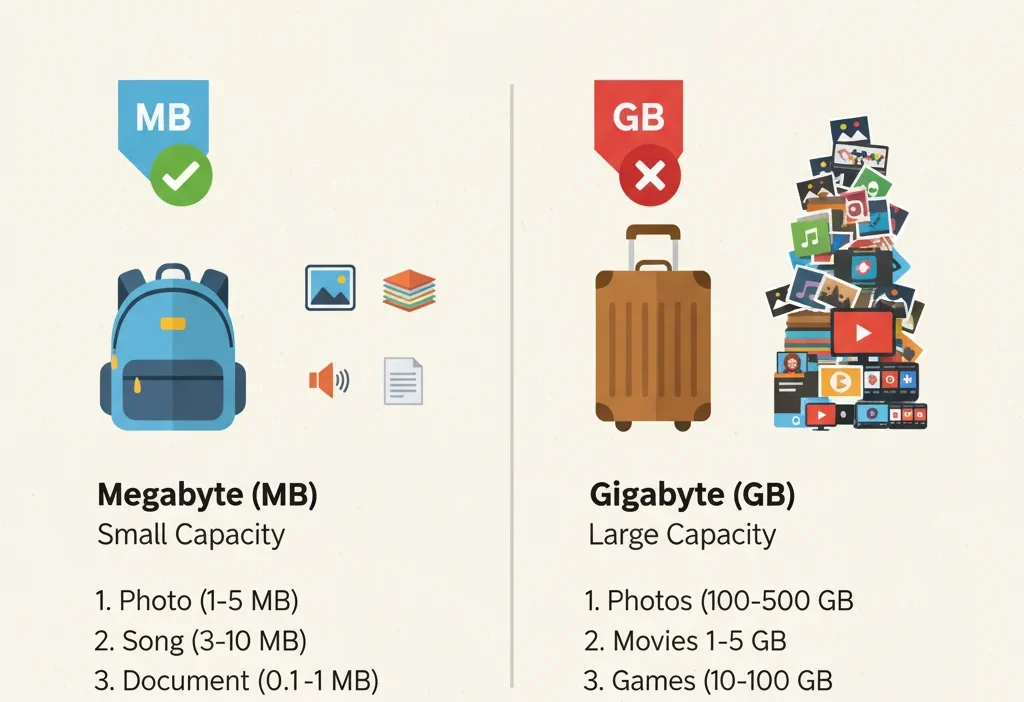
GB and MB are units of digital storage. 1 GB = 1024 MB, so GB is bigger than MB. Use MB for smaller files and GB for larger storage like laptops, phones, or cloud drives
Do you ever see your phone or computer showing storage as GB or MB and wonder, what’s the difference? You are not alone! Many beginners get confused because both terms measure digital storage, but they are not the same. Understanding the difference is important when downloading apps, saving photos, or buying devices.
In this guide, you will learn:
- What GB and MB really mean
- How to use each one correctly
- Simple examples from daily life
- Tricks to remember which is bigger
By the end of this article, even if you are a beginner, you’ll confidently know when to use GB or MB.
What Does Each Word Mean?
GB (Gigabyte)
Meaning: GB stands for Gigabyte, a unit used to measure digital data. It is bigger than MB and is commonly used for large files, hard drives, and cloud storage.
Part of Speech: Noun
Examples:
- My new phone has 128 GB of storage.
- The movie file is 2 GB large.
- You need at least 4 GB of RAM to run this game.
Mini Story: Think of GB as a big suitcase. You can pack many clothes in it, just like storing many files.
MB (Megabyte)
Meaning: MB stands for Megabyte, a smaller unit of digital storage. It’s used for smaller files like photos, documents, or songs.
Part of Speech: Noun
Examples:
- This photo is 5 MB in size.
- The PDF file is only 2 MB.
- You can download this song, which is about 8 MB.
Mini Story: MB is like a small backpack. It can carry a few items, but not as much as the suitcase (GB).
The Key Difference Between GB and MB
| Feature | GB (Gigabyte) | MB (Megabyte) |
|---|---|---|
| Size | 1 GB = 1024 MB | 1 MB = 1/1024 GB |
| Usage | Large files, phones, computers | Small files, documents, songs |
| Example Sentence | “My laptop has 500 GB of storage.” | “This photo is only 3 MB.” |
Quick Tip: Remember G > M. Gigabyte is bigger than Megabyte.
Common Mistakes and How to Avoid Them
Mistake 1
Wrong: My phone has 2 MB of storage.
Correct: My phone has 2 GB of storage.
Why: Phones usually have storage in GB, not MB.
Mistake 2
Wrong: This video is 200 GB.
Correct: This video is 200 MB.
Why: Small videos usually measure in MB, not GB.
Pro Tip: Always check the file type — large games or HD videos are GB, small documents or images are MB.
When to Use GB
GB is used for:
- Smartphones and tablets: Most devices have storage in GB.
- Computers and laptops: Hard drive size is in GB.
- Cloud storage: Google Drive or Dropbox shows GB usage.
- HD movies and games: Large files are measured in GB.
Examples:
- My new tablet has 64 GB of space.
- I downloaded a game that is 3 GB.
- This HD movie takes up 2 GB of space.
- You need 8 GB of free space to update the software.
Memory Hack: Think “GB = Giant Box” — big enough to hold lots of data.
When to Use MB
MB is used for:
- Photos and images: Small files like PNG, JPG.
- Documents and PDFs: Office files, ebooks.
- Songs and audio files: Music tracks are often a few MB each.
- Small apps: Lightweight applications.
Examples:
- This PDF file is 2 MB.
- The photo I sent is only 4 MB.
- My song downloads are about 5 MB each.
- The app size is 12 MB, so it’s quick to download.
Visual Trick: MB = “Mini Bag” — small and easy to carry.
Quick Recap: GB vs MB
- GB = Gigabyte = Bigger storage
- MB = Megabyte = Smaller storage
- 1 GB = 1024 MB
- Use GB for large files and MB for small files
- Remember: G > M (Gigabyte bigger than Megabyte)
Advanced Tips
- Origin: Both GB and MB come from computer science and digital storage measurement.
- Formal writing: In essays or tech guides, always capitalize GB and MB.
- Online texting: Saying “my phone has 128 mb” instead of MB can confuse readers. Always use proper units.
Mini Quiz
Fill in the blanks with GB or MB:
- My new laptop has _______ of storage.
- This photo is 7 _______ in size.
- You need at least 8 _______ of RAM to run the game.
- The PDF file is only 3 _______.
- That HD movie takes 2 _______ of space.
Conclusion
Now you know the difference between GB and MB! GB is for big files like movies and games, while MB is for small files like photos and documents. Remember the simple rule: G > M, and check your file type before deciding which unit to use. With practice, using GB and MB correctly will become second nature. Keep practicing, and soon digital storage will make perfect sense
FAQs
Q1: What is bigger, GB or MB?
A: GB is bigger than MB. 1 GB = 1024 MB.
Q2: When should I use MB?
A: Use MB for small files like photos, songs, and documents.
Q3: When should I use GB?
A: Use GB for large files like movies, apps, or computer storage.
Q4: Can I convert MB to GB?
A: Yes, divide the number of MB by 1024 to get GB.
Q5: Is GB used for RAM too?
A: Yes, computer and phone RAM are often measured in GB.

Eley Williams writes clear, engaging guides on confusing words and phrases, helping readers understand meanings, differences, and correct usage with ease.