Have you ever seen both “gluing” and “glueing” and wondered which one is correct? 🤔
You’re not alone! Many English learners — and even native speakers — get confused between these two spellings.
Both words look right, sound right, and mean the same thing. So why do some people say gluing while others write glueing?
In this simple grammar guide, you’ll learn the meaning, difference, and correct usage of gluing vs glueing — with easy examples, comparison tables, and memory tricks anyone can remember.
By the end, you’ll know which spelling to use (and why) every time. Let’s begin!
🧩 What Does Each Word Mean?
Let’s start by understanding what both words mean.
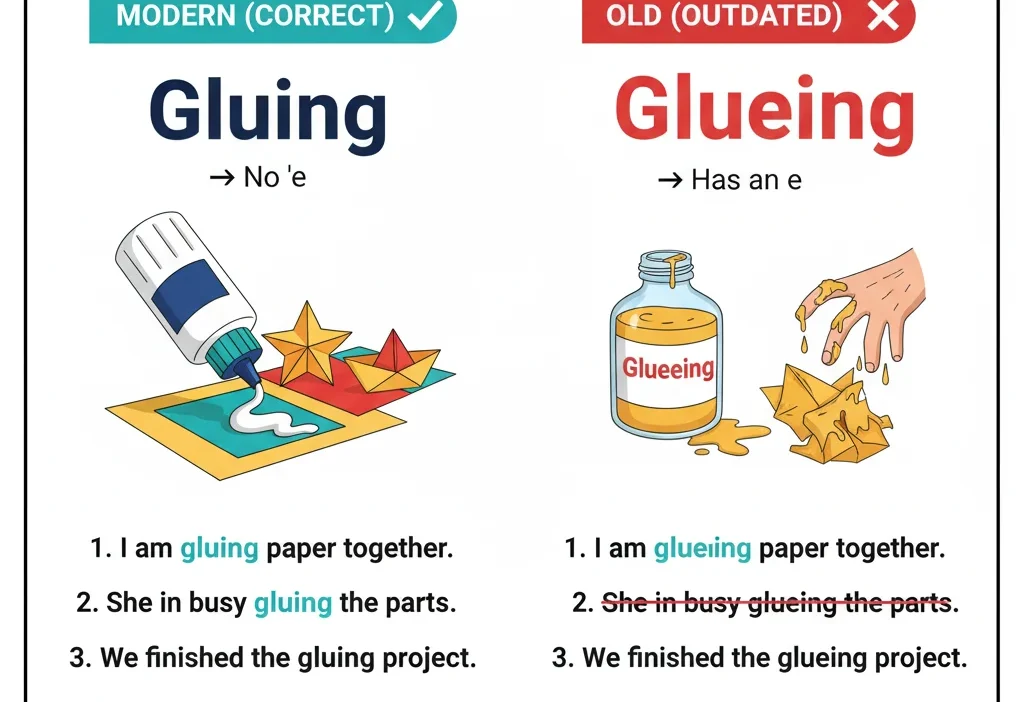
1. Gluing (✅ Correct & Modern Form)
“Gluing” is the present participle of the verb “glue.”
It means joining or sticking things together using glue.
Examples:
- She is gluing the paper pieces for her art project.
- I’m gluing the broken toy back together.
- The teacher watched the students gluing their crafts.
👉 “Gluing” is the correct and standard spelling in American and British English today.
2. Glueing (❌ Older or Less Common Form)
“Glueing” is an older spelling of the same word.
It has the same meaning — joining or sticking with glue — but it’s rarely used today.
Examples:
- In old textbooks, you might see “glueing” instead of “gluing.”
- He was glueing the tiles carefully.
- “Glueing” appears in some historical British writings.
👉 “Glueing” is considered outdated or nonstandard in modern English, though you may still see it in older British texts.
🔍 The Key Difference Between Gluing and Glueing
Here’s a simple comparison to make it crystal clear 👇
| Feature | Gluing | Glueing |
|---|---|---|
| Part of Speech | Verb (present participle of “glue”) | Verb (archaic spelling) |
| Meaning | Joining or sticking with glue | Same meaning (old spelling) |
| Usage | Modern, correct English | Rare, old-fashioned |
| Example Sentence | She is gluing a label on the box. | She was glueing the paper (old usage). |
| Used In | Both British and American English | Mostly old British English |
| Spelling Rule | Drop the ‘e’ before adding “-ing.” | Keeps the ‘e,’ which is unnecessary. |
✅ Quick Tip to Remember:
If a verb ends in silent “e,” like glue, you usually drop the ‘e’ before adding “-ing.”
So it becomes:
Glue → Gluing (not Glueing)
👉 Just like:
- Make → Making
- Use → Using
- Bake → Baking
🚫 Common Mistakes and How to Avoid Them
Many learners write “glueing” because they think removing the “e” might change the sound. Let’s see how to fix this.
❌ Incorrect:
- She is glueing the photos in her scrapbook.
- He kept glueing the pieces, but they fell apart.
✅ Correct:
- She is gluing the photos in her scrapbook.
- He kept gluing the pieces, but they fell apart.
Why the mistake happens:
Students think that removing the “e” makes it sound like “gluh-ing,” but it doesn’t.
The sound stays the same — “gloo-ing.”
👉 Fix: Remember that adding -ing after a verb ending in “e” almost always means you drop the “e.”
🧠 When to Use “Gluing”
Use gluing in all modern writing and speech.
It’s the correct spelling in both American and British English.
✅ Examples:
- I am gluing my science project together.
- The artist is gluing tiny beads on the fabric.
- Be careful while gluing the edges — they might stick to your hands!
- She spent hours gluing pictures into her scrapbook.
- The worker is gluing wallpaper on the wall.
📌 Memory Hack:
Think of “glue + ing” like “true + ing.” You drop the “e” — easy as that!
📜 When to Use “Glueing”
You’ll almost never need to use “glueing” today.
It’s found mostly in old British writings or historical documents.
✅ Examples (Old Usage):
- The manual from 1910 mentioned “glueing” wooden parts.
- The craftsman was “glueing” leather covers on books.
📘 Fun Fact:
In older English, writers sometimes kept the “e” in verbs ending with “ue” to preserve the long “oo” sound. But modern spelling rules dropped it because it wasn’t necessary.
🧾 Quick Recap: Gluing vs Glueing
Here’s a short summary you can remember easily:
- “Gluing” = Correct and modern spelling.
- “Glueing” = Old-fashioned and rare.
- Both mean “joining things using glue.”
- Drop the silent “e” before adding “-ing.”
- Always use “gluing” in your writing and schoolwork.
✅ Quick Rule:
If a word ends with silent “e,” drop it before adding “-ing.”
Example: make → making, glue → gluing.
💡 Advanced Tips: Grammar, Origin & Writing Use
1. Grammar Note:
- “Gluing” is a present participle or gerund.
It can act as part of a verb (“She is gluing”) or as a noun (“Gluing things is fun!”).
2. Word Origin:
- The verb “glue” comes from the Latin gluten, meaning “sticky substance.”
Over time, English adopted “glue” (noun) and later turned it into the verb “to glue.”
3. Formal Writing:
Always use “gluing” in essays, exams, and business writing.
Using “glueing” might be marked as a spelling mistake.
4. Texting and Social Media:
Even online, people only use “gluing.” The shorter spelling fits better and looks cleaner.
5. In Exams:
If you see a question like:
Choose the correct spelling:
a) Glueing
b) Gluing
✅ Pick Gluing every time.
🧩 Mini Quiz: Test Yourself!
Fill in the blanks with gluing or glueing (Hint: only one is correct! 😉)
- She is ______ the paper hearts for Valentine’s Day.
- I love ______ colorful buttons on my jacket.
- The teacher helped the kids while they were ______ their crafts.
- My brother is ______ stickers on his notebook.
- They spent the evening ______ tiles to the floor.
Answers:
- gluing
- gluing
- gluing
- gluing
- gluing
🎉 Perfect! You’re officially a gluing expert!
📚 5 Common FAQs About “Gluing” vs “Glueing”
1. Is “glueing” a word?
Yes, but it’s an old or outdated spelling. The correct modern form is “gluing.”
2. Which is correct in British English — “gluing” or “glueing”?
Both appear in history, but modern British English uses “gluing.”
3. Why is “glueing” sometimes seen in old books?
Writers used to keep the “e” to preserve pronunciation. Modern English dropped it.
4. How do I remember the spelling rule?
If a verb ends with “e,” just drop the ‘e’ before adding -ing.
Example: bake → baking, glue → gluing.
5. Does “gluing” mean the same as “pasting”?
Almost! “Pasting” usually uses paste, while “gluing” uses glue.
Both mean sticking things together — but with different materials.
🏁 Conclusion
Now you know the truth about gluing vs glueing!
Both mean the same thing — to stick things together — but only “gluing” is correct in modern English.
Remember the golden rule:
If the word ends in “e,” drop it before adding “-ing.”
So, next time you’re writing about crafts, repairs, or projects, you’ll know exactly which spelling to use. Keep practicing, stay curious, and you’ll see your English improving every day! 🌟

Gwendoline Riley delivers clear, compelling insights into language and usage, helping readers understand meanings, nuances, and differences with confidence.