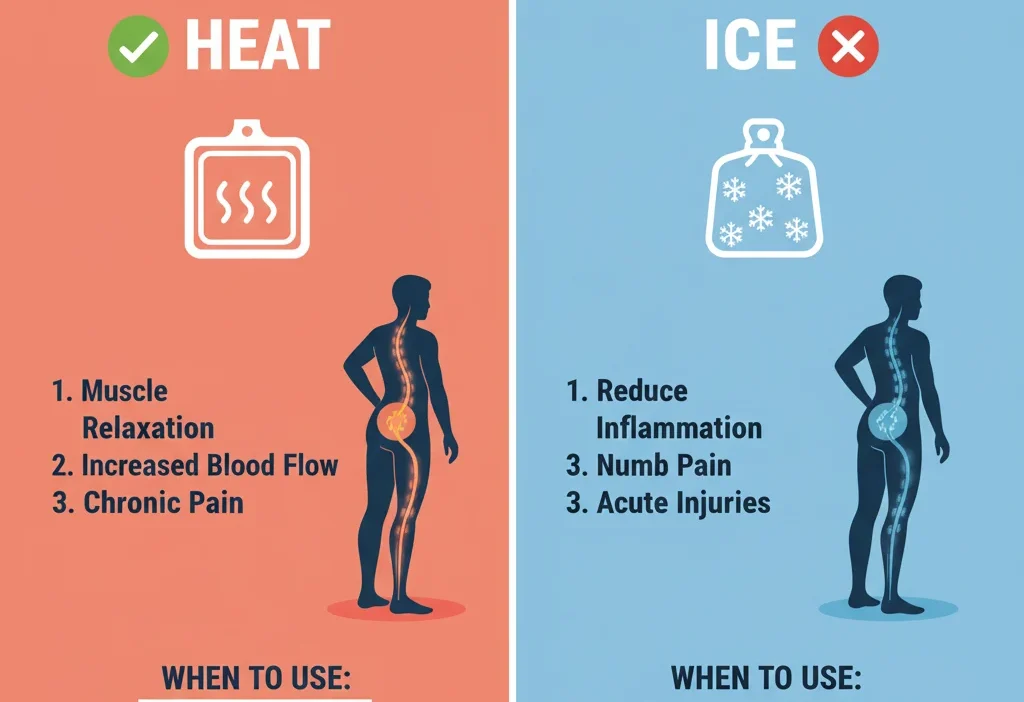
Use ice first to reduce sharp sciatica pain and swelling. Use heat later to relax tight muscles and improve blood flo
If you’ve ever felt a sharp, shooting pain running down your lower back, hip, or leg, you may have wondered: Should I use heat or ice for sciatica? Many people mix the two methods up, and using the wrong one at the wrong time can make the pain worse. That’s why the phrase “heat or ice for sciatica” often confuses learners and patients alike.
In this guide, you’ll learn the meaning, difference, and correct usage of heat vs. ice for sciatica, explained in the simplest way possible—easy enough for even a 4th-grade student to understand. We’ll explore when to use each one, common mistakes, example situations, quick memory tricks, and a full recap.
By the end, you’ll feel confident choosing the right method whenever sciatica pain strikes.
What Does Each Treatment Mean?
What Is Ice Therapy? (Cold Treatment)
Ice therapy means using something cold—like an ice pack—to reduce swelling and numb sharp pain.
Ice = cold pack to calm pain.
Part of Treatment:
Used for fresh, sharp, or recent sciatica pain.
3 Simple Examples:
- “I used ice after my pain started suddenly.”
- “The doctor told me to put ice for 15 minutes.”
- “I used a cold pack to numb the sciatica pain.”
What Is Heat Therapy? (Warm Treatment)
Heat therapy means using something warm—like a heating pad—to relax tight muscles and improve blood flow.
Heat = warm pad to relax muscles.
Part of Treatment:
Used for stiff, tight, or chronic pain.
3 Simple Examples:
- “I used heat to relax the tight muscles in my back.”
- “Warm therapy helped my leg feel less stiff.”
- “The heating pad soothed my sore lower back.”
The Key Difference Between Heat and Ice for Sciatica
| Feature | Ice for Sciatica | Heat for Sciatica |
|---|---|---|
| Best For | Sharp, sudden pain | Muscle tightness, stiffness |
| Main Purpose | Reduce swelling & numb pain | Relax muscles & improve blood flow |
| When to Use | First 24–72 hours after pain starts | After swelling goes down |
| Feels Like | Cold, numbing | Warm, soothing |
| Example Sentence | “Use ice when the pain is new.” | “Use heat when your back feels tight.” |
Quick Tip to Remember
Ice = Injury (both start with “I”)
Heat = Healing (both start with “H”)
Common Mistakes and How to Avoid Them
❌ Mistake 1: Using Heat During Sharp New Pain
Why it’s wrong: Heat increases blood flow and can make swelling worse.
Corrected:
Use ice for new or severe pain.
❌ Mistake 2: Keeping Ice on for Too Long
Why it happens: People think longer = better.
Corrected:
Use ice only 15–20 minutes at a time.
❌ Mistake 3: Only Using One Method
Why it’s wrong: Sciatica needs both at different stages.
Corrected:
Use ice first, then heat later.
When to Use Ice for Sciatica
Use ice when:
- The pain is new
- You had an injury
- The area is swollen
- The pain is sharp or burning
- You just finished physical activity
Easy Real-Life Examples:
- “My pain started today, so I used ice.”
- “After lifting something heavy, I felt a sharp pain and used ice.”
- “My lower back felt swollen, so I applied ice for 15 minutes.”
- “The cold pack helped numb the burning sensation.”
- “The doctor said to use ice for 48 hours.”
When to Use Heat for Sciatica
Use heat when:
- The pain is older than 2–3 days
- Your muscles feel stiff
- You have long-term sciatica
- You want to relax or stretch
- The cold therapy already reduced swelling
Easy Real-Life Examples:
- “My back felt stiff, so I used heat.”
- “The warm pad helped my muscles relax before stretching.”
- “After two days of ice, I switched to heat.”
- “Heat therapy made sitting more comfortable.”
- “The warmth helped improve blood flow.”
Memory Hack:
Think: Heat = Hug
A warm hug relaxes your body—just like heat does.
Quick Recap: Heat vs Ice for Sciatica
- Ice = for new pain, swelling, sharp pain
- Heat = for stiffness, tight muscles, long-lasting pain
- Use ice first, then heat later
- Ice numbs. Heat relaxes.
- Heat is not for fresh injuries.
- Ice is not for tight muscles.
Advanced Tips (Optional)
- Heat therapy goes back to ancient Greek and Chinese medicine.
- Ice became popular in modern sports and injury treatment.
- In formal medical writing, “cold therapy” is known as cryotherapy, and “heat therapy” is called thermotherapy.
- Misusing heat or ice in online advice can spread confusion—always rely on trusted sources.
Medicine, Health Routines, and Physical Conditions: Hidden Truths
Mini Quiz (Test Yourself!)
Fill in the blanks:
- Use ______ when the pain is new.
- Use ______ when your muscles feel tight.
- Ice should be used for only _____ minutes at a time.
- Heat helps improve ______ flow.
- Ice helps reduce ______.
- Use ice first and heat ______.
- Heat is like a warm ______ for your muscles.
Conclusion
Now you know exactly when to use heat or ice for sciatica. Ice works best for new and sharp pain, while heat helps relax stiff, tight muscles. By understanding the difference, you can manage your pain safely and quickly. Remember: start with ice, switch to heat later, and use both correctly for maximum relief.
Keep learning, keep practicing, and keep making smart choices for your health.
You’ve got this!
FAQs
1. Should I use heat or ice first for sciatica?
Always use ice first to reduce swelling and numb fresh pain.
2. When should I switch from ice to heat?
Switch after 48–72 hours, once swelling and sharp pain calm down.
3. Can I use both heat and ice on the same day?
Yes, but use them at different times—never back-to-back.
4. Is heat bad for sciatica?
Heat is not bad, but using it too early can worsen swelling.
5. How long should I apply heat or ice?
Apply for 15–20 minutes per session, not longe.

Jenn Ashworth offers clear, engaging explanations of language and usage, helping readers grasp meanings, nuances, and differences with accuracy and ease.