People often get confused when they see the terms “Hinduism ethnic or universalizing”—especially in geography, world religion studies, and English essays. Are we talking about religion? Grammar? Cultural identity?
This guide makes everything super easy, clear, and beginner-friendly. Let’s finally settle the confusion!
The phrase “Hinduism ethnic or universalizing” is a common point of confusion for students, writers, and anyone learning about world religions or human geography. The problem is simple: people wonder whether Hinduism is an ethnic religion or a universalizing religion—and how to correctly use these terms in writing and exams.
In this complete, SEO-optimized guide, you will learn what each term means, how they differ, how to use them, and easy examples that even a 4th-grade student can understand. By the end, you’ll confidently know how to explain the difference between ethnic vs universalizing religions, especially when talking about Hinduism.
Let’s break it down step by step in simple English.
⭐ What Does Each Word Mean?
To understand “Hinduism ethnic or universalizing”, we must first understand the meaning of ethnic religion and universalizing religion.
🟫 What Is an Ethnic Religion? (Simple Meaning)
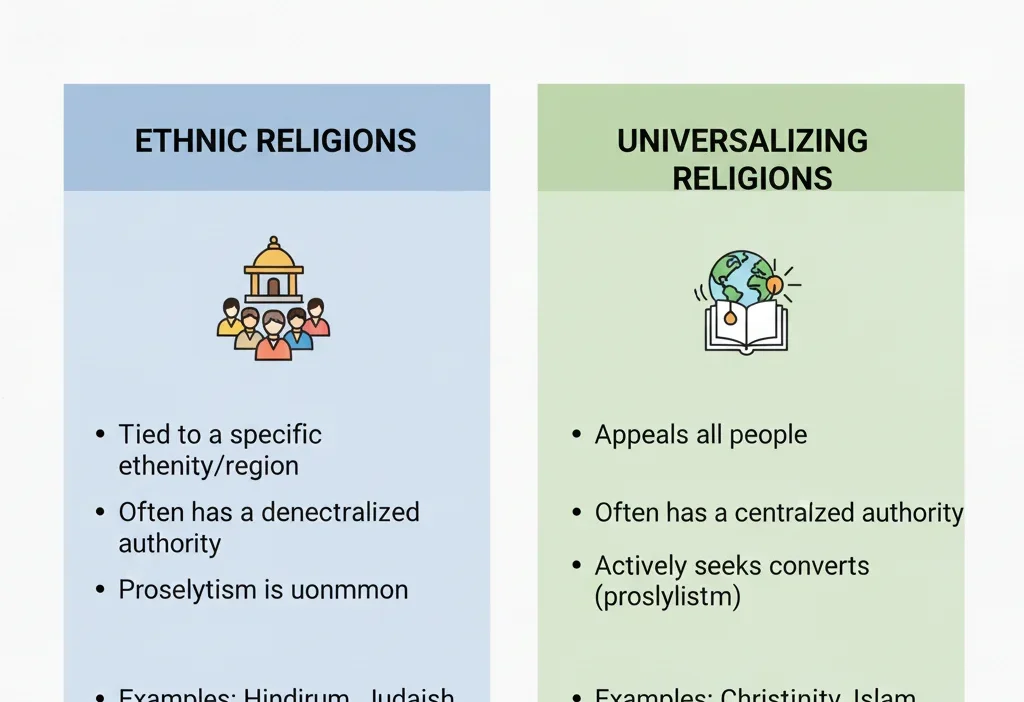
An ethnic religion is a religion that is strongly connected to a specific place, culture, or group of people.
It usually does not try to convert others.
Easy Examples
- Hinduism (mostly practiced in India and Nepal)
- Judaism
- Traditional Chinese religions
In simple words:
Ethnic religions stay with one group, one culture, or one homeland.
🌍 What Is a Universalizing Religion? (Simple Meaning)
A universalizing religion tries to spread across the world and welcomes people from any culture, country, or background.
Easy Examples
- Christianity
- Islam
- Buddhism
In simple words:
Universalizing religions want to reach everyone worldwide.
🔑 The Key Difference Between Hinduism Ethnic or Universalizing
To classify Hinduism, ask a simple question:
👉 Does Hinduism try to spread worldwide through missionaries?
No.
👉 Is it tied to a specific culture and region (India)?
Yes.
Therefore:
⭐ Hinduism is an ethnic religion, not a universalizing one.
Here’s a clear comparison table:
Comparison Table: Ethnic vs Universalizing (with Hinduism Example)
| Feature | Ethnic Religion | Universalizing Religion |
|---|---|---|
| Main Goal | Stay within one culture | Spread worldwide |
| Converts Others? | Rarely | Actively |
| Based On | Culture, heritage, birthplace | Shared beliefs for all |
| Examples | Hinduism, Judaism | Christianity, Islam |
| Hinduism Fits? | ✔ Yes | ✖ No |
🌟 Quick Tip to Remember
If a religion is strongly linked to one place and doesn’t send missionaries, it’s ethnic.
Hinduism fits this perfectly.
❗ Common Mistakes and How to Avoid Them
❌ Mistake 1:
Calling Hinduism a universalizing religion.
👉 Correction:
Hinduism is an ethnic religion because it is tied to Indian culture and does not aim to convert globally.
❌ Mistake 2:
Using the phrase incorrectly in essays, like:
“Hinduism is universalizing because it is popular.”
👉 Correction:
Popularity does not decide the type.
Conversion and cultural ties do.
❌ Mistake 3:
Mixing up the grammar:
“Is Hinduism ethnic or are universalizing religion?”
👉 Correct:
“Is Hinduism an ethnic or a universalizing religion?”
🧭 When to Use “Ethnic Religion” (with Examples)
Use ethnic religion when talking about beliefs tied to one cultural group.
Examples:
- “Hinduism is an ethnic religion based in India.”
- “Most ethnic religions do not encourage conversion.”
- “Ethnic religions often follow ancestral traditions.”
- “Hindu festivals show the cultural nature of this ethnic religion.”
🌎 When to Use “Universalizing Religion” (with Examples)
Use universalizing religion when describing a religion that spreads to people anywhere.
Examples:
- “Christianity is a universalizing religion.”
- “Universalizing religions use missionaries.”
- “Islam reached many continents over time.”
- “Universalizing religions grow quickly across regions.”
🧠 Memory Hack
Ethnic = Attached to Ethnicity
Universalizing = For the Universe (Everyone!)
🔁 Quick Recap: Hinduism Ethnic or Universalizing?
- Hinduism = Ethnic religion
- Tied to Indian culture
- No active global conversion
- Not universalizing
- Clear difference between the two terms
📘 Advanced Tips (Optional)
- In AP Human Geography, Hinduism is always classified as an ethnic religion.
- In essays, mention cultural roots, traditions, and lack of missionary activity.
- Online discussions often mix the terms—always check definitions.
- Though Hinduism welcomes new followers, it does not actively seek them, keeping its ethnic status.
📝 Mini Quiz (Check Your Understanding)
Fill in the blanks:
- Hinduism is an ______ religion.
- Christianity is a ______ religion.
- Ethnic religions are tied to one ______.
- Universalizing religions want to reach ______.
- Hinduism does not actively try to ______ others.
❓ 5 FAQs
1. Is Hinduism ethnic or universalizing?
Hinduism is an ethnic religion because it is rooted in Indian culture and does not seek global conversion.
2. Why is Hinduism considered an ethnic religion?
Because it is tied to one culture, one region, and has no missionary tradition.
3. Can Hinduism accept converts?
Yes, but it does not actively encourage conversion.
4. What is the difference between ethnic and universalizing religions?
Ethnic religions stay within a cultural group, while universalizing religions try to spread globally.
5. Is Buddhism ethnic or universalizing?
Buddhism is a universalizing religion because it spreads across cultures.
🏁 Conclusion
Understanding whether Hinduism is ethnic or universalizing becomes simple when you look at culture, location, and conversion. Hinduism stays deeply connected to Indian heritage, which makes it an ethnic religion. Now you can confidently explain the difference, use the terms correctly, and avoid common mistakes. Keep practicing, keep learning, and your English—and world knowledge—will get stronger every day.

Gwendoline Riley delivers clear, compelling insights into language and usage, helping readers understand meanings, nuances, and differences with confidence.