Have you ever seen both “honor” and “honour” and wondered which one is correct? 🤔
You’re not alone! Many English learners (and even native speakers) get confused between these two words. They look almost the same and mean the same thing — but the spelling depends on where you are in the world.
In this simple guide, you’ll learn:
- The meaning of honor and honour
- The difference between them
- How to use each one correctly
- Common mistakes and easy memory tricks
By the end, you’ll never mix them up again — even if you’re just starting to learn English!
🧩 What Does Each Word Mean?
Both “honor” and “honour” come from the same root and share the same meaning — respect, high moral standards, or a special recognition for someone’s achievements. The only difference lies in spelling, not meaning.
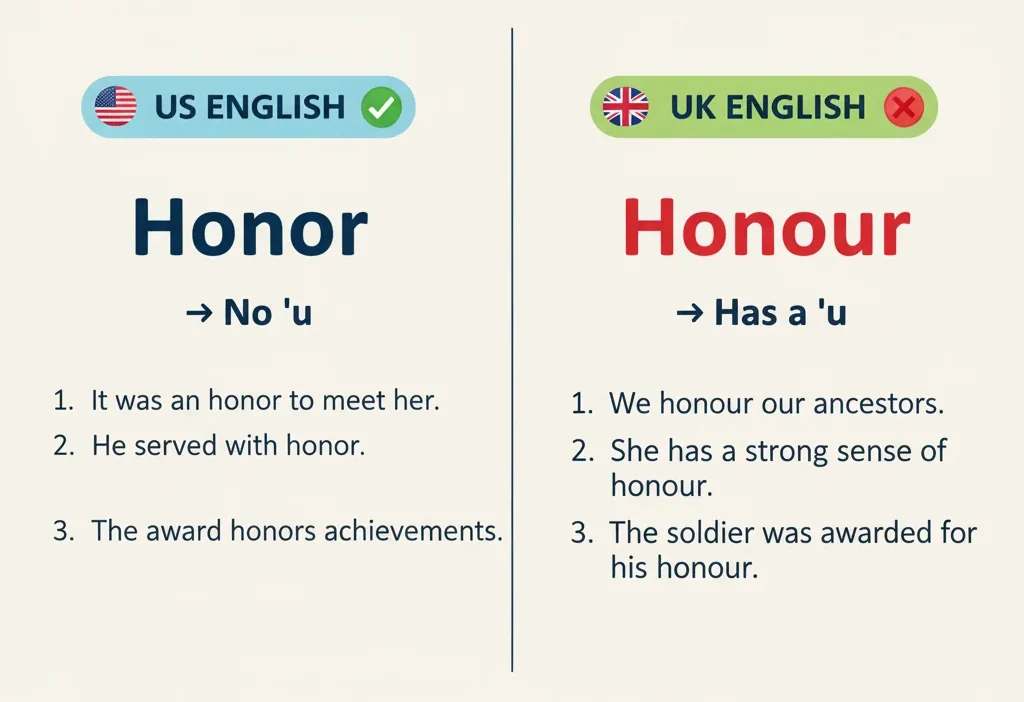
🟦 “Honor” (American English 🇺🇸)
Part of Speech: Noun or verb
Meaning: To show great respect or give special recognition to someone or something.
Used In: The United States and other countries that follow American English spelling.
Examples:
- It is an honor to meet you.
- The soldier received a medal of honor.
- We should always honor our parents.
🟥 “Honour” (British English 🇬🇧)
Part of Speech: Noun or verb
Meaning: The same as “honor” — showing respect, pride, or recognition.
Used In: The United Kingdom, Canada, Australia, and other countries using British English.
Examples:
- It is an honour to be your friend.
- The Queen awarded him an honour for his bravery.
- We must honour our promises.
🧠 Simple Tip:
👉 “Honor” = American spelling (shorter word, no “u”)
👉 “Honour” = British spelling (longer word, with “u”)
⚖️ The Key Difference Between Honor and Honour
| Feature | Honor | Honour |
|---|---|---|
| Language Style | American English | British English |
| Meaning | Respect, recognition, or moral integrity | Same meaning |
| Usage Example | “He received an honor from the president.” | “He received an honour from the Queen.” |
| Spelling Rule | Drops the ‘u’ | Keeps the ‘u’ |
| Common Regions | USA, Philippines | UK, Canada, Australia, India |
✅ Quick Tip to Remember:
“If you’re in the USA — drop the ‘U’. If you’re in the UK — keep the ‘U’!”
❌ Common Mistakes and How to Avoid Them
Even advanced learners make these small spelling mistakes when switching between American and British English. Let’s fix them:
| ❌ Incorrect | ✅ Correct | 💡 Why |
|---|---|---|
| It was an honour to meet you. (In U.S. writing) | It was an honor to meet you. | Use honor in American English. |
| The soldier received a medal of honor. (In British text) | The soldier received a medal of honour. | Use honour in British English. |
| We must always honour our country. (In U.S. essay) | We must always honor our country. | Keep spelling consistent with American English. |
💬 Grammar Tip:
Always match your spelling style with your audience or region.
If you’re writing for a U.S. website — use honor.
If you’re writing for a U.K. audience — use honour.
🇺🇸 When to Use “Honor”
Use “honor” when you’re writing in American English, especially in:
- U.S. schools and essays
- American websites or articles
- Formal letters or awards in the United States
Examples:
- It’s a great honor to receive this award.
- The student was on the honor roll this semester.
- We will honor the heroes of our nation.
- Please honor your commitments.
- The ceremony paid honor to brave firefighters.
🧠 Memory Hack:
👉 “Honor” without a “u” = “U.S.” spelling (Both have the letter U missing!).
🇬🇧 When to Use “Honour”
Use “honour” when you’re writing in British English, such as:
- In the U.K., Canada, or Australia
- British exams or essays (like IELTS or GCSEs)
- British news, books, or literature
Examples:
- It was an honour to serve under your leadership.
- The Prime Minister received an honour from the King.
- Let’s honour the traditions of our ancestors.
- She graduated with honours from Oxford University.
- He swore to honour his word.
🧠 Visual Trick:
👉 “Honour” looks fancier — like traditional British English.
If it feels more “formal” or “royal,” it’s probably British!
🧾 Quick Recap: Honor vs Honour
- Same meaning, different spelling.
- Honor = American English 🇺🇸
- Honour = British English 🇬🇧
- Keep your writing consistent — don’t mix both in one text.
- Remember: “If you’re in the U.S., drop the U!”
💡 Advanced Tips: Origin, Style, and Usage
The word comes from the Latin “honos”, meaning respect or dignity.
When English evolved differently in the U.S. and the U.K., American spelling simplified words by removing unnecessary letters like “u” in colour → color, favour → favor, and honour → honor.
📚 Formal Writing:
- In academic essays, always match your spelling style with your audience.
- IELTS (British English) → “Honour”
- TOEFL (American English) → “Honor”
💬 Online Writing:
In global writing (like blogs or emails), pick one version and stay consistent. Mixing both looks unprofessional.
🧠 Mini Quiz: Test Yourself!
Choose the correct word (honor or honour) for each blank.
- It was an ________ to meet the President.
- The award is given in ________ of brave citizens.
- He promised to ________ his parents’ wishes.
- She received an ________ from the Queen.
- Our school celebrates Academic ________ Day every year.
(Answers: 1. honor, 2. honour, 3. honor/honour, 4. honour, 5. Honor)
❓FAQs About Honor vs Honour
1. Is honour British or American?
👉 “Honour” is British English. “Honor” is the American version.
2. Do they mean the same thing?
Yes! Both mean respect, pride, or special recognition — only the spelling changes.
3. Which one should I use in IELTS?
Use honour, since IELTS follows British English rules.
4. Why does American English drop the “u”?
Because American spelling was simplified by Noah Webster to make English easier and more consistent.
5. Can I use both in one essay?
No, always stay consistent. Pick one style (U.S. or U.K.) and use it throughout.
🏁 Conclusion
Now you know — there’s no real difference in meaning between honor and honour — only where and how you use them.
Use honor in American English, and honour in British English.
Practice writing them correctly, and soon it will feel completely natural.
Keep learning little grammar differences like this — each one helps you write more clearly and confidently. 🌟

Jenn Ashworth offers clear, engaging explanations of language and usage, helping readers grasp meanings, nuances, and differences with accuracy and ease.