

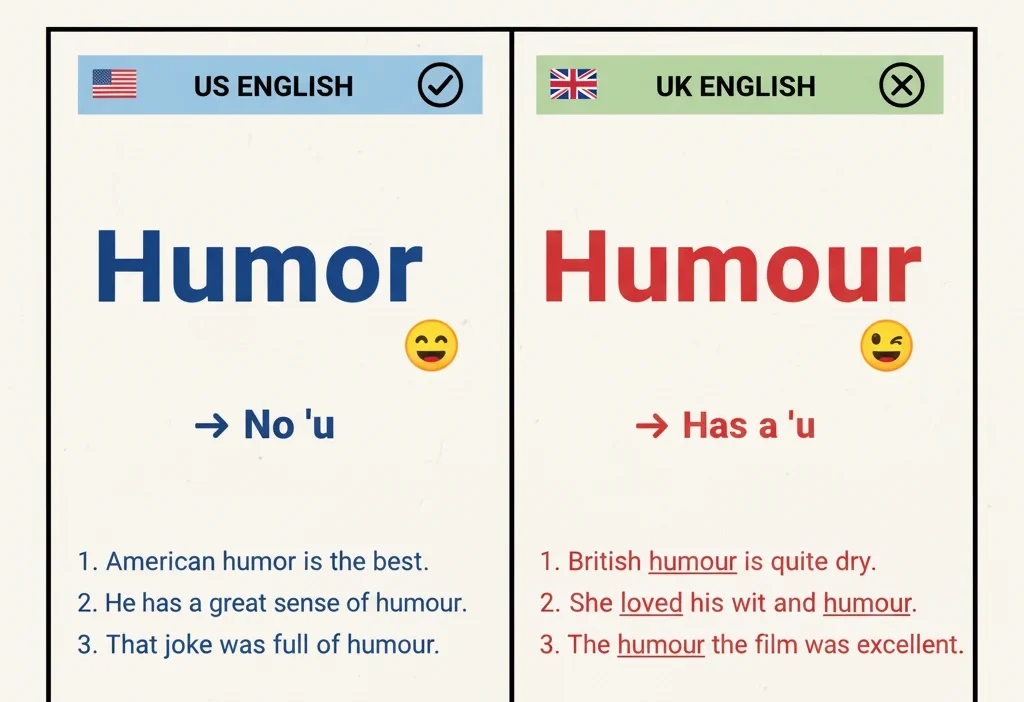
Have you ever noticed that sometimes people write “humor” and other times “humour”? Both look almost the same — just one has an extra “u.” So, which one is correct? 🤔
The short answer: both are correct, but their usage depends on where you live! Many English learners get confused between humor and humour, especially when reading books, watching shows, or writing essays.
In this guide, we’ll explain:
✅ The meaning of both words
✅ The difference between humor and humour
✅ When to use each one (with examples!)
✅ Common mistakes and quick memory hacks
By the end, you’ll never mix them up again — even a 4th-grader will find it easy to understand!
🧩 What Does Each Word Mean?
Let’s break down both words simply 👇
📘 What Does Humor Mean?
Humor (noun) means the quality of being funny or making people laugh. It’s used in American English (USA 🇺🇸).
✅ Examples:
- His humor always makes everyone smile.
- That TV show is full of smart humor.
- She has a great sense of humor.
Part of speech: Noun
Used in: American English
📗 What Does Humour Mean?
Humour (noun) means the same thing — the ability to make people laugh — but it’s the British English spelling (UK 🇬🇧, Canada 🇨🇦, Australia 🇦🇺).
✅ Examples:
- British humour is often dry and clever.
- I love the humour in classic English comedies.
- He has a weird sense of humour, but it’s fun!
Part of speech: Noun
Used in: British English
⚖️ The Key Difference Between Humor and Humour
| Feature | Humor | Humour |
|---|---|---|
| Meaning | Quality of being funny | Same meaning — quality of being funny |
| Spelling Style | American English | British English |
| Used In | USA, Philippines | UK, Canada, Australia, India |
| Examples | “She loves American humor.” | “She loves British humour.” |
| Pronunciation | /ˈhjuːmər/ | /ˈhjuːmə/ (almost identical) |
💡 Quick Tip to Remember:
👉 If you write color, favor, or neighbor (without “u”), use humor.
👉 If you write colour, favour, or neighbour (with “u”), use humour.
🚫 Common Mistakes and How to Avoid Them
Let’s look at a few common mix-ups:
❌ Incorrect: I love British humor shows.
✅ Correct: I love British humour shows.
❌ Incorrect: American humour is simple.
✅ Correct: American humor is simple.
🧠 Why This Happens:
English spelling changes between regions. Many learners mix them because both sound the same — but spelling depends on which version of English you’re following.
✅ How to Fix It:
Always match your spelling style.
- If you’re writing for a U.S. audience ➡️ use humor.
- If you’re writing for the U.K. or Commonwealth ➡️ use humour.
🇺🇸 When to Use “Humor”
Use humor when you’re writing or speaking American English.
It’s commonly seen in U.S. schools, movies, and websites.
📝 Examples:
- His humor makes the classroom fun.
- The movie had a lot of clever humor.
- She’s known for her dark humor.
- That comedian’s humor is very modern.
- Americans appreciate light humor in daily life.
🧠 Memory Hack:
If your computer’s spell-check suggests “color” instead of “colour,” it will also prefer humor — both are American spellings!
🇬🇧 When to Use “Humour”
Use humour when writing or speaking British English (or in countries influenced by it, like Canada, Australia, and India).
📝 Examples:
- British humour often includes irony and wit.
- He doesn’t understand my humour sometimes.
- The play was filled with great humour.
- I enjoy reading books with dry humour.
- Her humour brightens everyone’s day.
🧠 Memory Trick:
The “u” in humour reminds you of the UK — U for UK, U for Humour! 🇬🇧
🔁 Quick Recap: Humor vs Humour
✅ Humor → American English (no “u”)
✅ Humour → British English (with “u”)
✅ Both mean: funny, amusing, or entertaining
✅ Same pronunciation, different spelling
✅ Use according to your region or target audience
💡 Advanced Tips: History and Extra Insights
The word “humor” comes from the Old French word “umour” and the Latin “umor”, meaning “fluid” or “moisture.”
In ancient medicine, people believed our mood was affected by body fluids or “humours.” Later, the word came to mean “mood” or “wit.”
📚 In Writing & Exams:
- In academic essays, match your English style to your teacher or exam board (e.g., British spelling for IELTS).
- In online writing, choose one style and stay consistent.
📱 In Texting or Online Posts:
Mixing the two spellings doesn’t change the meaning — but consistency makes your writing look more professional.
280+ Cancelled vs Canceled Grammar 🖋️ 2025
🧠 Mini Quiz: Test Your Understanding!
Fill in the blanks with humor or humour 👇
- I love American ________.
- British ________ can be quite sarcastic.
- Her ________ made everyone laugh.
- We all appreciate a good sense of ________.
- The comedian’s ________ was very sharp.
- Canadian ________ is similar to British style.
- He lacks a sense of ________, unfortunately.
(Answers: 1. humor, 2. humour, 3. humor/humour, 4. humor/humour, 5. humor/humour, 6. humour, 7. humor/humour)
❓ 5 Frequently Asked Questions (FAQs)
Q1: Is humor or humour correct in English?
Both are correct — humor is American English, humour is British English.
Q2: Which is used in Canada?
Canada mostly follows British English, so “humour” is preferred.
Q3: Is there any difference in meaning?
No. The meaning is identical — only the spelling changes.
Q4: Can I use humor in a formal essay?
Yes, but use the correct form depending on your region or audience.
Q5: What’s a good way to remember the difference?
Think: “U” for UK = Humour. No “U” = USA = Humor.
🌈 Conclusion
Now you know the truth about humor vs humour — they’re two spellings of the same cheerful word! 🇺🇸✨🇬🇧
Whether you prefer humor without the “u” or humour with it, both bring laughter and joy to language. The key is to be consistent and confident in your choice.
Keep smiling, keep laughing, and keep improving your English every day! 😄

Polly Clark creates clear, insightful guides on language and usage, helping readers understand meanings, differences, and nuances with clarity and confidence.


