Have you ever paused while writing and wondered:
“Should I write indexes or indices?”
If yes, you’re not alone.
These two words confuse students, writers, and even professionals. They look similar, sound almost the same, and both are plural forms of the word index. But here’s the twist:
👉 Indexes is correct in many situations,
👉 Indices is also correct—but used differently.
In this simple guide, you’ll learn:
- What indexes means and when to use it
- What indices means and where it is used
- The difference between indexes and indices
- Easy memory hacks to remember them
- Example sentences anyone can understand
- A mini quiz at the end to test your learning
By the end of this article, you will never confuse indexes and indices again. Even a 4th-grade student will get it. 😊
What Does Each Word Mean?
⭐ Word #1: Indexes
Part of speech: Plural noun (more than one index)
Meaning:
Indexes refers to lists used for organizing information — such as in books, computer databases, or websites.
📌 Think of it as:
A list that helps you find something quickly.
Easy Examples:
| Example Sentence | Meaning |
|---|---|
| The book has two indexes at the end. | Two lists to help readers find topics. |
| Google uses indexes to show search results. | Organized lists of web pages. |
| The librarian updated the indexes of all books. | Lists used to find books faster. |
Mini Story
Imagine you’re reading a long science book. At the end of the book, you see an index—a list of topics and page numbers. If the book had many index sections, they would be indexes.
⭐ Word #2: Indices
Part of speech: Plural noun
Meaning:
Indices is the plural of index used in math, statistics, and finance.
📌 Think of it as:
Numbers or symbols that measure or show a value.
Easy Examples:
| Example Sentence | Meaning |
|---|---|
| In math, we use indices to show powers (like 3²). | Shows exponents. |
| Stock market indices show economic growth. | Shows financial value. |
| Scientists compare climate indices to track weather change. | Shows measurement values. |
Mini Story
Your teacher writes 5³ on the board. The little ³ (3) is called an exponent. In British English, it is part of indices.
The Key Difference Between Indexes and Indices
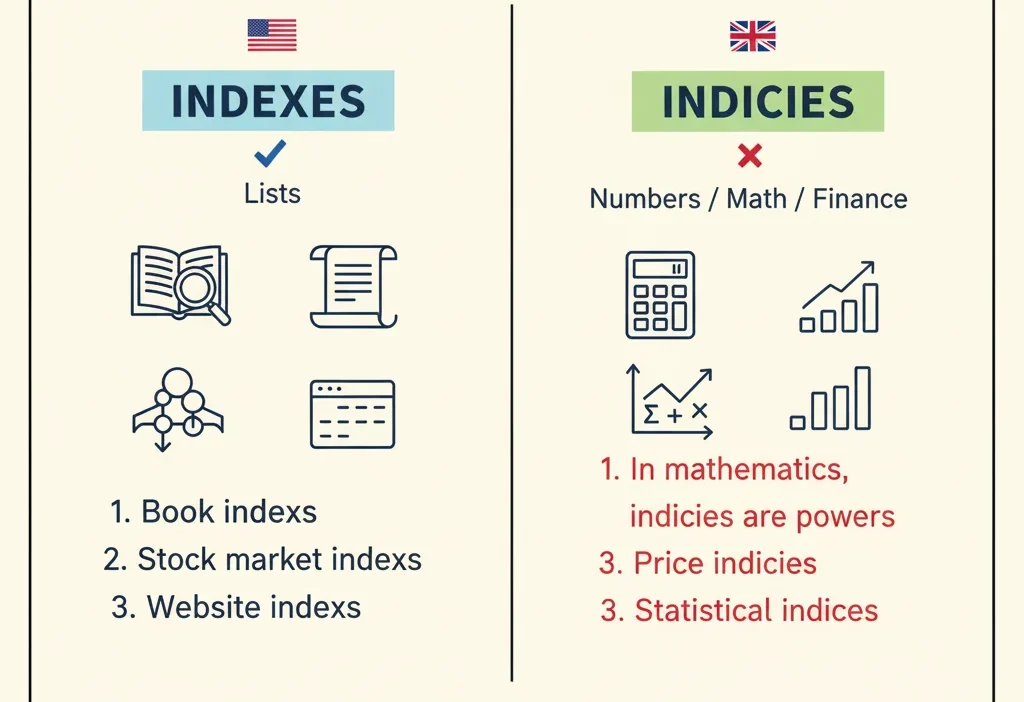
| Feature | Indexes | Indices |
|---|---|---|
| Used in | Books, databases, websites | Math, science, finance |
| Meaning | Lists of topics or data | Numerical indicators or exponents |
| Region | Mostly American English | Mostly British English / technical subjects |
| Example | “The website updated its indexes.” | “The stock market indices rose today.” |
✅ Quick Tip to Remember
Everyday life? → Use indexes
Math, science, finance? → Use indices
Common Mistakes & How to Avoid Them
| ❌ Wrong | ✅ Correct | Why? |
|---|---|---|
| The book has three indices. | The book has three indexes. | Books use lists, not math values. |
| In math class, we solved indexes. | In math class, we solved indices. | Math = indices |
✅ RULE:
If you can touch it or look it up → indexes
If it shows a number or value → indices
When to Use “Indexes” (with Examples)
Use indexes when talking about:
✅ Books
✅ Data lists
✅ Website databases
✅ Search engines
Examples:
- The book has two indexes to help readers.
- Google updates its search indexes daily.
- The program builds indexes to store information.
- Can you check the indexes for the topic “volcanoes”?
Memory Hack:
Indexes = Text + Lists
(Notice both words have an “x”)
When to Use “Indices” (with Examples)
Use indices when talking about:
✅ Mathematics
✅ Stock market values
✅ Science & research reports
Examples:
- In algebra, we studied indices like x² and y³.
- Global climate indices show temperature rise.
- The teacher asked us to simplify expressions using indices.
- The stock exchange publishes financial indices daily.
Memory Hack:
Indices sounds like “in-disi-sees”
Think: I see numbers.
✅ Quick Recap: Indexes vs Indices
| Shortcut Rule | Word |
|---|---|
| Lists, books, websites = INDEXES | ✅ indexes |
| Math, finance, science = INDICES | ✅ indices |
👉 If you’re unsure, indexes is always safe in general writing.
⭐ Advanced (Optional) — Extra Learning
- Origin:
- Indexes → Modern American English
- Indices → Classic Latin plural, used in academic fields
- In formal writing:
Use indices in math/ finance papers to look professional. - In everyday writing:
Use indexes so readers don’t get confused.
🧠 Mini Quiz (Test Yourself!)
Fill in the blanks with indexes or indices:
- The math book explains how to use __________.
- Google updates its search __________ every second.
- Stock market __________ went up today.
- The library added new __________ to the catalog.
- Scientists compare climate __________.
(Answers: indices, indexes, indices, indexes, indices)
❓ FAQs
1. Is “indexes” the plural of index?
Yes. For general usage (books, lists), indexes is correct.
2. Are indices only used in math?
Mostly in math, science, and finance.
3. Which one is used in American English?
Indexes.
4. Which one sounds more formal?
Indices.
5. Can both be correct?
Yes. It depends on context.
✅ Conclusion
You now understand the:
- Meaning of indexes
- Meaning of indices
- Exact difference between them
- Correct usage with examples
The word index has two plural forms, but they are not used the same way.
👉 Use indexes for everyday life (lists, books, search engines).
👉 Use indices for math, science, and finance.
The more you practice, the easier English becomes. Keep learning—you’re doing great!

Gwendoline Riley delivers clear, compelling insights into language and usage, helping readers understand meanings, nuances, and differences with confidence.