Have you ever seen both “ingrained” and “engrained” in writing and wondered which one is correct? 🤔 You’re not alone! These two words look almost identical and sound the same, which makes them super easy to confuse.
In this simple grammar guide, we’ll break down the meaning, difference, and correct usage of ingrained and engrained with easy examples, fun tips, and a short quiz at the end. By the time you finish, you’ll never mix them up again — promise! 🌟
🧠 What Does Each Word Mean?
Let’s start by understanding what each word means. Both ingrained and engrained come from the same root idea — something deeply fixed or embedded, like a habit or belief that’s hard to change.
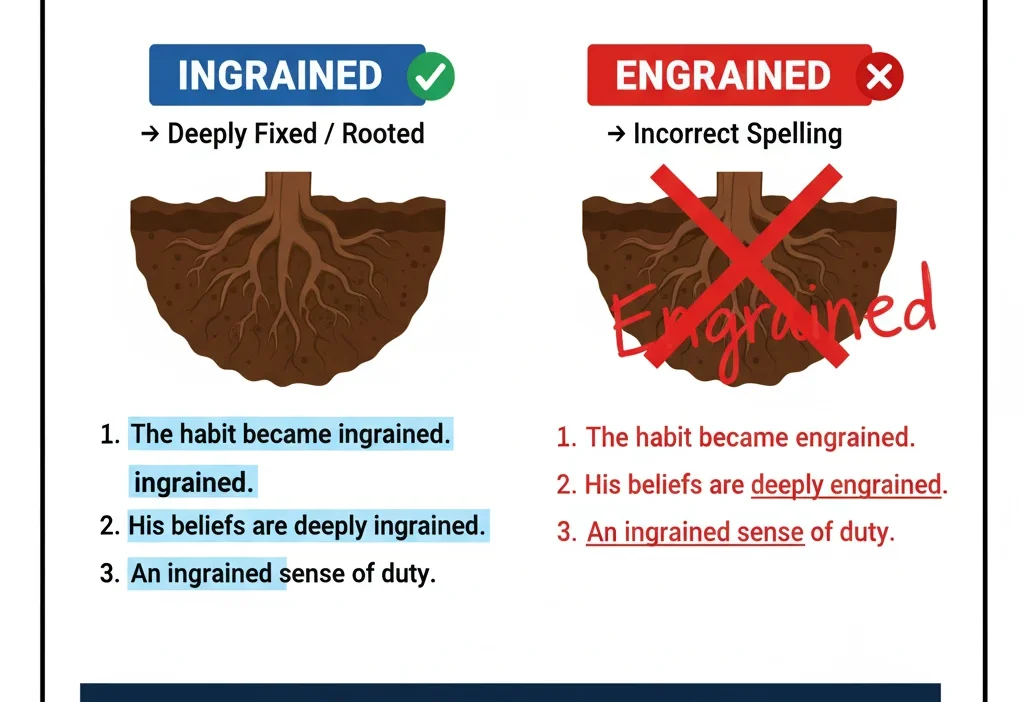
🔹 Ingrained (✅ Modern & Preferred)
Part of speech: Adjective
Meaning: Something that is deeply rooted, firmly fixed, or hard to remove.
Think of it as something “set in stone” — it’s a part of who or what it describes.
Examples:
- My love for reading is ingrained in me.
- Good manners were ingrained in her from childhood.
- The habit of helping others is ingrained in our family.
🔹 Engrained (⚙️ Older or Less Common)
Part of speech: Adjective
Meaning: The same as ingrained, but this spelling is considered archaic (old-fashioned).
It comes from the older form of “engrave,” which means to carve or etch deeply — so the idea is the same, but modern English prefers ingrained.
Examples:
- His engrained fear of failure held him back.
- Those traditions were engrained in their culture.
- The lessons were engrained in his memory.
📊 The Key Difference Between Ingrained and Engrained
Here’s a simple comparison table to help you remember the difference:
| Feature | Ingrained | Engrained |
|---|---|---|
| Meaning | Deeply rooted, firmly fixed | Same meaning but older form |
| Usage | Modern and widely accepted | Rare and old-fashioned |
| Part of Speech | Adjective | Adjective |
| Example | Her kindness is ingrained in her nature. | His engrained habits were hard to break. |
| Preferred Form (Modern English) | ✅ Yes | ❌ No |
💡 Quick Tip to Remember:
👉 “Ingrained” starts with “IN,” which means “inside” — something that’s deeply inside you or your behavior.
So, use ingrained when writing or speaking today.
❌ Common Mistakes and How to Avoid Them
Many people think “engrained” looks fancier or more correct because of the “en-” prefix — but that’s actually an old spelling. Here’s how to spot and fix the mix-up:
| ❌ Incorrect | ✅ Correct | 💬 Why |
|---|---|---|
| The values were engrained in him. | The values were ingrained in him. | Ingrained is the accepted modern spelling. |
| She has engrained habits. | She has ingrained habits. | “Ingrained” fits current English usage. |
| His engrained manners impressed everyone. | His ingrained manners impressed everyone. | Use ingrained to sound natural and modern. |
🔍 Fix-it Rule:
If you’re writing for school, essays, business, or online — always choose ingrained. It’s the version used in dictionaries like Merriam-Webster, Oxford, and Cambridge.
🪴 When to Use Ingrained (The Correct Word)
Use ingrained when describing something that’s deeply fixed, hard to change, or naturally part of someone or something.
✅ Examples:
- Her honesty is ingrained in her personality.
- The habit of saving money is ingrained in their culture.
- Respect for elders is ingrained in many families.
- Hard work became an ingrained habit after years of practice.
- That rule is ingrained in company policy.
👀 Memory Hack:
Think of ingrained like inside your brain — something stuck deep in your mind! 🧠
⚙️ When to Use Engrained (Rare or Historical)
You’ll rarely need engrained today, but you might still see it in:
- Old books
- Historical writings
- Poetry or formal literature
📚 Examples:
- Those beliefs were engrained in ancient traditions.
- The writer used engrained to create an old-fashioned tone.
- His engrained fears dated back to childhood (archaic usage).
💡 Quick Note:
If you’re ever unsure — just replace engrained with ingrained. You’ll always be correct in modern English.
🧩 Quick Recap: Ingrained vs Engrained
Here’s a super simple way to remember:
- ✅ Ingrained = Correct, modern spelling (use this one!)
- ❌ Engrained = Old spelling, rarely used
- Both mean “deeply fixed or rooted,” but ingrained is standard in English today.
Summary Points:
- Both words mean “firmly established.”
- “Ingrained” is what you should use in daily writing.
- Think of “in” = “inside,” easy memory trick.
🌍 Advanced Tips for Grammar Lovers
🏛️ Origin and History
Both words come from the 14th-century French word en grain, meaning “dyed in grain” — referring to fabrics dyed so deeply that the color became permanent. Over time, it evolved to mean “deeply fixed.”
By the 1600s, “ingrained” became the dominant spelling in English. Today, engrained is mostly found in old texts or literary writing.
✍️ Usage in Modern Writing
Use ingrained in:
- Essays and exams
- Professional writing
- Everyday communication
- Blogs or social media posts
Avoid engrained unless you’re quoting old literature or using it for stylistic effect.
📱 Fun Fact:
Many online tools (like Grammarly and MS Word) will automatically suggest changing engrained to ingrained — because that’s the accepted spelling today.
🧩 Mini Quiz: Test Your Understanding!
Fill in the blanks with either ingrained or engrained 👇
- The love of books was __________ in her from childhood.
- Those ancient customs were __________ in their traditions.
- The teacher tried to make kindness an __________ habit.
- His fear of heights is __________ after that bad experience.
- In old English texts, the word __________ is often found.
(Answers: 1. ingrained, 2. engrained, 3. ingrained, 4. ingrained, 5. engrained)
❓FAQs About Ingrained vs Engrained
1. Is “engrained” wrong?
No, it’s not wrong — just old-fashioned. “Ingrained” is the modern, correct version.
2. Which is used in American English?
“Ingrained” is used in both American and British English today.
3. Can I use “engrained” in creative writing?
Yes, if you want an old, poetic, or historical tone.
4. How can I remember the difference easily?
Think INgrained = INside your mind — deeply rooted!
5. Do both words have the same meaning?
Yes! They both mean “deeply fixed,” but only ingrained is preferred now.
🪶 Conclusion
Both ingrained and engrained mean something deeply rooted or firmly established, but ingrained is the correct and modern spelling. 🌱
Whenever you write essays, emails, or blog posts, use ingrained to sound natural and correct. The next time you see engrained, you’ll know it’s just an older form — kind of like vintage English!
Keep practicing little grammar details like this, and soon you’ll have an ingrained habit of perfect English! 💬✨

Eley Williams writes clear, engaging guides on confusing words and phrases, helping readers understand meanings, differences, and correct usage with ease.