Some English words sound the same but mean completely different things. These types of words are called homophones. One common confusion is between “insite” and “insight.”
Many people mistakenly think insite is the shorter or modern spelling of insight. But only one of these is an actual English word.
👉 In this detailed, beginner-friendly guide, you will learn:
- What insight means
- Why insite is not correct in standard English
- The difference between insite vs insight
- How to use insight correctly in sentences
- Simple grammar tricks to never confuse the two again
By the end, you will be able to:
- Understand the correct usage
- Avoid common spelling mistakes
- Explain the difference between insite and insight to others
Let’s make it so simple that even a 4th-grade student can understand it easily.
What Does Each Word Mean? (Simple Definitions)
✅ INSIGHT (Correct English Word)
- Part of speech: Noun
- Meaning: The ability to understand something clearly. A deep understanding.
- Think of it as: “seeing inside someone’s thoughts or a situation.”
✔ Examples of insight in sentences:
| Example Sentence | Meaning |
|---|---|
| She gave me helpful insight about life. | She shared useful understanding. |
| The teacher has great insight into how children think. | Teacher understands children very well. |
| Reading books gives you insight into different cultures. | Books help you understand cultures. |
🧠 Memory Trick: Insight = inside sight (seeing inside something).
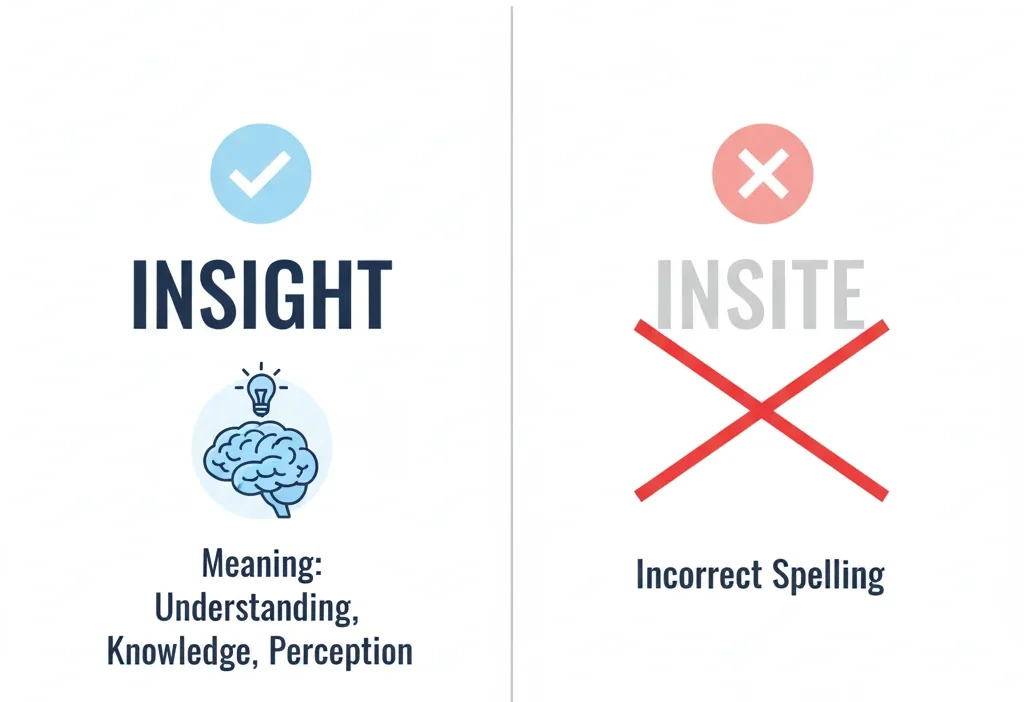
❌ INSITE (Not a real English word)
- Not a valid word in standard English dictionaries.
- Often used incorrectly when people mean insight.
🚫 Do NOT use “insite” in writing, school essays, or professional emails.
The correct word is always insight.
✅ “Insight” is correct.
❌ “Insite” is a spelling mistake.
⭐ The Key Difference: Insight vs Insite
| Feature | Insight (Correct) | Insite (Incorrect) |
|---|---|---|
| Word type | Noun | ❌ Not a real word |
| Meaning | Understanding / deep knowledge | No meaning in English |
| Usage | Formal writing, essays, speaking | Should never be used |
| Correct example | “She has great insight.” | “She has great insite.” (wrong) |
🔑 Quick Tip to Remember:
👉 Insight = IN + SIGHT → seeing inside (understanding something deeply).
🚫 Common Mistakes and How to Avoid Them
| ❌ Wrong Sentence | ✅ Correct Sentence |
|---|---|
| Thank you for the great insite. | Thank you for the great insight. |
| His insite helped us decide. | His insight helped us decide. |
| The book gives insite into success. | The book gives insight into success. |
Why the mistake happens:
People hear the word and write it based on sound (phonetic spelling). Because “in-site” sounds like a location or a website term, some assume it’s correct.
How to fix it:
Whenever you mean understanding, always choose insight.
✏ When to Use Insight (Correct Word)
Use insight when talking about:
- Understanding someone or something
- Learning from experience
- Gaining knowledge or wisdom
✅ Example sentences in real-life situations:
- My coach gave me great insight on improving my game.
- The psychologist has insight into human behavior.
- This article provides insight into English grammar.
- Children often have surprising insight.
- Your insight helped solve the problem.
💡 Memory Hack:
Think of insight as “seeing inside the situation.”
🚫 When to Use Insite?
📣 Never use “insite” in English writing.
The only place you might see “insite” is:
- As a brand name
- A company name
- A software/tool name
Example (only as a brand name):
InSite Construction Company
🔔 But in grammar and standard English writing, it is always incorrect.
🔁 Quick Recap: Insight vs Insite
- Insight = correct spelling
- Insite = not a word (don’t use it)
✔ Use insight when talking about understanding.
🌍 Advanced Tips (For Students, Bloggers & Professionals)
- Use insight when writing essays, emails, reports, presentations.
- It sounds professional and intelligent.
- Strong vocabulary boosts confidence and clarity.
Example for professional writing:
“Market insight helps companies make better decisions.”
📝 Mini Quiz (Test Yourself!)
Fill in the blank with insight:
- The teacher shared useful ______ about writing.
- Traveling gives us ______ into different cultures.
- I appreciate your ______ on this project.
Answers: insight, insight, insight
🧠 FAQs (For Featured Snippets)
1. Is “insite” a real English word?
No. The correct spelling is insight.
2. What does “insight” mean?
It means deep understanding or the ability to see the truth clearly.
3. Is it “insight” or “insite” in writing?
Always insight.
4. How can I remember the spelling?
Insight = in + sight → “seeing inside.”
5. Can “insite” be used in informal texting?
It’s still incorrect. Use insight.
✅ Conclusion
Words that sound the same can easily confuse learners.
But now you clearly understand the difference between:
- INSIGHT (correct word) – meaning deep understanding
- INSITE (incorrect spelling) – not a real English word
Use insight whenever you mean knowledge, wisdom, or understanding.
The more you practice using English correctly, the more confidence you gain. Keep learning — every new word gives you insight into the language

Eley Williams writes clear, engaging guides on confusing words and phrases, helping readers understand meanings, differences, and correct usage with ease.