
Interest is the correct spelling, while intrest is incorrect and considered a spelling mistake.
The confusion between interest and intrest is very common, especially among English learners and fast writers who accidentally drop the second “e.”
Although intrest may look acceptable at first glance, it is not recognized in standard English dictionaries and should never be used in formal or informal writing. This small spelling error can negatively affect clarity and make writing appear careless, particularly in exams, academic papers, professional documents, emails, and online content.
In this article, you will learn which spelling is correct, why this mistake happens so often, clear examples of correct usage, and simple tips to remember the correct form, so you can write accurate, confident, and polished English every time.
Interest
The correct spelling is “interest.” The spelling “intrest” is always incorrect in modern standard English.
“Interest” is a noun and a verb with several meanings:
- As a noun (Curiosity/Attention): She has a keen interest in ancient history.
- As a noun (Finance): The bank charges 5% interest on the loan.
- As a verb (To engage curiosity): This topic interests me greatly.
There is no context where “intrest” is acceptable. If you use it, spell-checkers will flag it, and it will be seen as a spelling error. Remember the phrase: “I am interested in the rest.” This can help you recall the correct order of the ‘e’s.

The Origin of Interest
The word “interest” has a long history that explains its spelling. It entered English in the late Middle Ages from the Anglo-French word “interest.” This, in turn, came from the Latin verb “interesse,” which means “to make a difference, to be important, or to lie between.”
The Latin word is a compound: “inter-” (meaning “between”) and “esse” (meaning “to be”). So, the core idea is “to be between” or “to concern.” This evolved into the financial sense (a concern or stake in money) and the general sense of concern or curiosity.
The common misspelling “intrest” arises from a linguistic process called elision. In fast, natural speech, the second “e” (the one after the “t”) is often not pronounced clearly. We say “IN-truhst” or “IN-ter-ist,” not “IN-ter-est.” Our ears hear “intrest,” so our hands sometimes type it. However, the standard written form has preserved the full spelling from its Latin and French roots.
British English vs American English Spelling
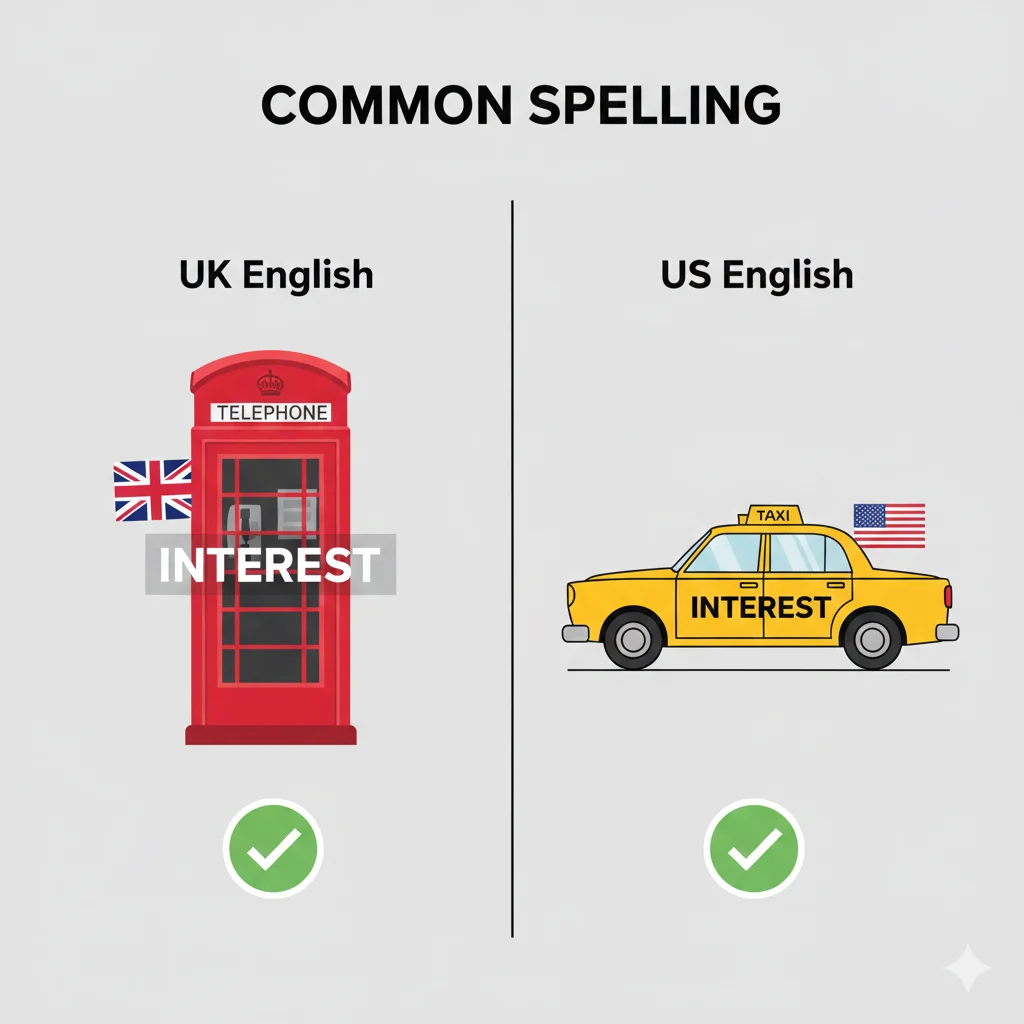
Here’s a key point: for the word interest, there is no difference between British and American spelling. Both varieties of English use “interest.”
The confusion with “intrest” is not a dialect difference; it’s a universal spelling error. However, understanding general US vs. UK spelling rules can prevent mistakes in other words:
- American English often simplifies spellings (e.g., color, center, traveled).
- British English tends to retain more traditional spellings (e.g., colour, centre, travelled).
Comparison Table: Spelling Conventions
| Feature | American English | British English |
|---|---|---|
| Our / Or | Color, Honor | Colour, Honour |
| Er / Re | Center, Meter | Centre, Metre |
| Single/Double L | Traveled, Counseling | Travelled, Counselling |
| Specific Word | Interest | Interest |
| Common Error | Intrest | Intrest |
As the table shows, “interest” is a consistent spelling across both major English standards. The Pinterest search bar on the popular platform also uses the correct spelling, reinforcing the standard globally.
Which Spelling Should You Use?
The rule is simple: Always use “interest.” Your specific audience just determines other stylistic choices, not this spelling.
- For American Audiences: Use “interest.” Also use American financial terms like “interest rate,” not “interest rate” (spelling is same, pronunciation may differ).
- For UK/Commonwealth Audiences: Use “interest.” You might be writing about your interest in something like cricket or discussing bank rates, but the spelling remains unchanged.
- For Global/Online Audiences : Use “interest.” This is crucial for search engine optimization . People searching for “new Pinterest app” or “Pinterest login help” will use the correct spelling. Google’s algorithm recognizes “intrest” as a misspelling and may rank your content lower for lacking authority.
Common Mistakes with Interest
The primary mistake is the simple misspelling: Intrest. Here’s how to correct it:
- Incorrect: The loan intrest is too high.
- Correct: The loan interest is too high.
Other common errors involve word choice and compound terms:
- Misusing “Interest” and “Intrigue”: While both relate to curiosity, “intrigue” suggests a more mysterious or fascinating interest.
- The plot interested me. (It was engaging)
- The plot intrigued me. (It was mysterious and captivating)
- Confusing “Interest” and “Rate”: Remember, the interest rate is the percentage. The interest is the actual monetary amount charged.
- The interest rate is 5%. My total interest payable will be $500.
Disingenuous / Disingenuine: The Truth Most People Get Wrong
Interest in Everyday Examples
Using “interest” correctly across contexts projects professionalism and literacy.
- In a Professional Email:
- “Dear Hiring Manager, I am writing to express my keen interest in the Marketing Manager position advertised on your website.”
- In Financial News:
- “The Central Bank announced a hike in the interest rate to combat inflation, affecting mortgage payments nationwide.”
- On Social Media (Pinterest & Beyond):
- “Find me on Pinterest searching for ‘minimalist home decor’! My interest in interior design is growing.” (For Pinterest search without login, you can browse but not save pins).
- In Formal/ Academic Writing:
- “The study’s findings are of significant interest to the field of renewable energy, offering new insights into storage solutions.”

Interest – Google Trends & Usage Data
According to Google Trends data, the search query “intrest” has a consistent, moderate volume globally, proving it is a persistent spelling doubt. Searches for “interest rate” dwarf both, showing the primary user intent is financial.
Geographically, searches for the misspelling “intrest” are common in countries where English is widely used as a second language, such as India, the Philippines, and Nigeria, as well as in the US and UK themselves. This highlights its status as a universal phonetic error rather than a regional one.
Searches related to “Pinterest login password” and “Pinterest sign up for free” show very high volume, indicating the brand name has firmly cemented the correct spelling in users’ minds for that context, yet the confusion for the standalone word persists. This data underscores the need for clear, authoritative content that addresses this specific query to satisfy user search intent.
FAQ:
1. What is the difference between intrest and interest?
“Intrest” is an incorrect spelling. “Interest” is the only correct spelling in modern English for the term relating to curiosity, attention, or finance.
2. What’s the difference between interest and interest rate?
Interest is the cost of borrowing money or the return on invested money (a sum). The interest rate is the percentage charged on the loan or earned on the investment over a period.
3. What is the difference between simple interest and compound interest?
Simple interest is calculated only on the principal amount. Compound interest is calculated on the principal plus any accumulated interest from previous periods, causing your balance to grow faster.
4. What is the full meaning of interest?
The meaning depends on context. Primarily: (1) A feeling of wanting to know or learn about something (curiosity). (2) Money paid regularly for the use of borrowed money or for delaying the repayment of debt. (3) A stake or involvement in an undertaking.
5. Do I need an account for Pinterest search?
You can use the Pinterest search bar and browse content without an account (Pinterest search without login). However, to save pins, create boards, or get personalized recommendations, you need to complete Pinterest sign up for free and log in.
6. How can I recover my Pinterest login?
If you need Pinterest login help, go to the login page and click “Forgot your password?” You will need to enter the email associated with your account to reset your Pinterest login password.
7. How do I show interest in something professionally?
You can say, “I have a professional/personal interest in [topic/field],” or “I am interested in pursuing opportunities in…” Be specific about what aspects engage you.
Conclusion
Navigating the correct spelling of “interest” is a small but significant step in mastering written English. The takeaway is absolute: “interest” is correct; “intrest” is not. This rule holds true whether you’re in the United States, the United Kingdom, or anywhere else in the English-speaking world.
The confusion stems naturally from pronunciation, not from regional differences. By using the correct spelling, you ensure clarity in all communications—from calculating an interest rate on a loan to describing your interest in something like a new hobby, or even when seeking Pinterest login help.

Gwendoline Riley delivers clear, compelling insights into language and usage, helping readers understand meanings, nuances, and differences with confidence.