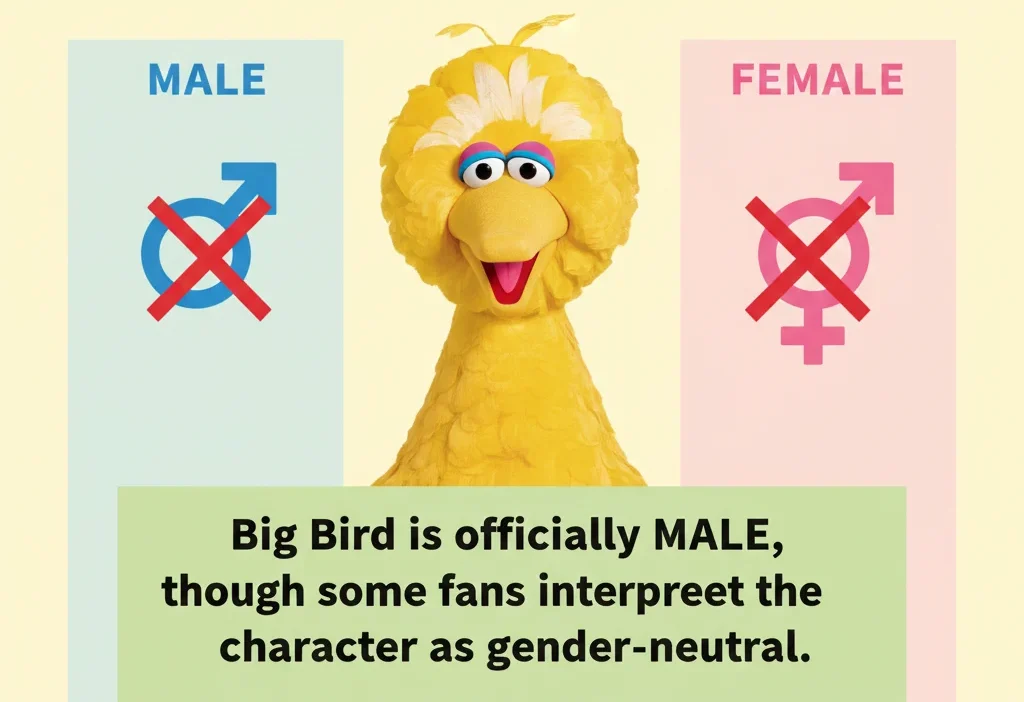
Big Bird is a boy. On Sesame Street, he is always referred to as he/him, has a male voice, and is portrayed as a young 6-year-old boy bird. But because he looks soft, bright, and gentle, many people still ask, “Is Big Bird a boy or girl?” — and that’s why this guide clears everything up in a simple, child-friendly way.
Many people—even adults—often wonder: Is Big Bird a boy or girl? The question is common because Big Bird is bright yellow, friendly, gentle, and has features that don’t immediately look “boy-like” or “girl-like.” This makes the character confusing, especially for children learning about characters, gender, and language.
In this easy guide, we will explain the meaning, difference, and correct usage when talking about Big Bird’s gender. You’ll learn:
- What Big Bird is
- Whether Big Bird is a boy or girl
- How to use the correct pronouns (they)
- Examples that even a class 4 student can understand
By the end, you’ll confidently answer anyone who asks, “Is Big Bird a boy or girl?” and you’ll know exactly how to use the correct words every time.
What Does Each Word Mean? (Boy vs. Girl Characters)
Before understanding is Big Bird a boy or girl, let’s clearly define the words boy and girl in the simplest way.
🟦 What Does “Boy” Mean?
A boy is a male child.
Boys usually use the pronouns he / him.
Simple Examples:
- The boy is playing football.
- He is doing his homework.
- That boy loves cartoons.
🟪 What Does “Girl” Mean?
A girl is a female child.
Girls usually use the pronouns she / her.
Simple Examples:
- The girl is drawing a picture.
- She is reading a book.
- That girl likes singing.
🐤 So, What Is Big Bird?
Big Bird is a boy.
On Sesame Street, everyone uses he / him when talking to Big Bird.
Examples:
- “He is learning today.”
- “Big Bird lost his teddy, can you help him?”
This proves that Big Bird is officially a male character.
The Key Difference: “Boy Big Bird” vs. “Girl Big Bird”
Here is a simple comparison table to help you see the difference clearly:
| Character Type | Meaning | Pronouns | Big Bird Status | Sentence Example |
|---|---|---|---|---|
| Boy Character | A male child | he / him | ✅ Yes, Big Bird is a boy | “Big Bird is tall. He is very friendly.” |
| Girl Character | A female child | she / her | ❌ Not Big Bird | “She is singing.” (Not used for Big Bird) |
⭐ Quick Tip to Remember
If you talk about Big Bird, always use he or him.
Big Bird = Boy character.
Common Mistakes and How to Avoid Them
❌ Mistake 1: Using “she” for Big Bird
Incorrect: “Big Bird is cute. She is so soft.”
Correct: “Big Bird is cute. He is so soft.”
Why it happens:
People assume the bird looks gentle or feminine. But the character is officially male.
❌ Mistake 2: Calling Big Bird “it”
Incorrect: “What is it doing?”
Correct: “What is he doing?”
Why it happens:
Some think animals or mascots don’t need gender terms.
But Big Bird is not an animal bird — he is a character, so he has a gender.
❌ Mistake 3: Confusing costume actors
Some kids think the person inside the Big Bird costume changes the character’s gender.
But the actor does not change the character.
Big Bird is always a boy, no matter who plays him.
When to Use “Boy” (for Big Bird)
Use boy when you talk about characters like Big Bird who are male.
Easy Examples:
- Big Bird is a boy on Sesame Street.
- He loves learning new things.
- The boy character is friendly.
- I saw Big Bird and he waved at me.
- Big Bird acts like a curious little boy.
Real-Life Situations
- In school: “My teacher asked, ‘Is Big Bird a boy or girl?’ I said he is a boy.”
- In writing: “The boy bird learns a lesson today.”
- In daily talk: “Big Bird is a tall boy.”
When to Use “Girl” (Not for Big Bird)
Use girl only for female characters—not for Big Bird.
Examples (NOT for Big Bird):
- The girl is singing.
- She is happy today.
- That girl loves drawing.
- I saw a girl character on TV.
- My sister likes girl superheroes.
Memory Hack
Big Bird has a deep male voice → Male voice = boy character.
Quick Recap: Is Big Bird a Boy or Girl?
- Big Bird = Boy
- Pronouns = He / Him
- Official character age = 6-year-old boy
- Voices and scripts always call him he
- Never use she, her, or it for Big Bird
Advanced Tips
🕰️ Origin Story
Big Bird first appeared in 1969 on Sesame Street.
The writers created him as a childlike boy character—curious, innocent, and always learning.
📝 In Formal Writing
Use:
- “Big Bird is a male character.”
- “He represents a young boy’s perspective.”
Avoid:
- “Big Bird is a female bird.” (Incorrect)
📱 In Texting & Online
Many kids type fast and use “she” by mistake.
This changes meaning and makes sentences incorrect.
Always check pronouns before posting.
Mini Quiz (Test Yourself!)
Fill in the blanks with they (Hint: Big Bird = boy).
- Big Bird is tall. ___ loves learning.
- I saw Big Bird today. ___ waved at me.
- The character lost ___ book.
- Big Bird said ___ is excited for school.
- The teacher asked me if Big Bird is a boy or girl. I said ___ is a boy.
- The costume actor helps Big Bird, but ___ does not change the character’s gender.
- Big Bird hugged Elmo. ___ looked happy.
(Answers: he, he, his, he, he, he, he)
FAQs
1. Is Big Bird a boy or a girl?
Big Bird is a boy. The show always uses “he” and “him.”
2. Why do people think Big Bird is a girl?
Because of the soft voice, bright color, and gentle personality, some assume he is female.
3. What pronouns does Big Bird use?
Big Bird uses he / him pronouns.
4. Does the actor inside the costume change Big Bird’s gender?
No. The actor does not change the character. Big Bird stays a boy.
5. How old is Big Bird supposed to be?
Big Bird is written as a 6-year-old boy on Sesame Street.
Conclusion
Now you know the clear and simple answer to the common question, “Is Big Bird a boy or girl?” Big Bird is officially a boy, and the correct pronouns for him are he and him. Understanding this helps children, parents, and learners use the right words in conversations, writing, and schoolwork.
Whenever you talk about Big Bird, remember he is a friendly, curious, 6-year-old boy character who loves learning. Keep practicing using correct pronouns, and soon it will feel natural and easy. Learning small language details like this builds your confidence in English every day.

Gwendoline Riley delivers clear, compelling insights into language and usage, helping readers understand meanings, nuances, and differences with confidence.