If you are asking “is it better to plead guilty or no contest?” the short answer is this:
👉 Pleading guilty admits the crime, while 👉 pleading no contest avoids admitting guilt but still accepts punishment.
Which one is better depends on your situation, future risks, and legal advice. This guide will help you understand the difference in the simplest way possible.
Many people feel confused when they hear the legal question: is it better to plead guilty or no contest? These two choices sound very similar, but they are not the same. One small decision can affect your future, your record, and even civil lawsuits later.
People mix them up because both options can lead to the same punishment, like fines, probation, or jail time. But what you say in court matters a lot.
In this easy-to-understand guide, you will learn:
- The meaning of guilty and no contest
- The difference between pleading guilty and no contest
- When to use each plea
- Simple examples anyone can understand
- Common mistakes and how to avoid them
Everything is explained in plain English, using real-life examples, so even a 4th-grade student can understand.
What Does Each Plea Mean?
Let’s break both pleas down in the simplest way possible.
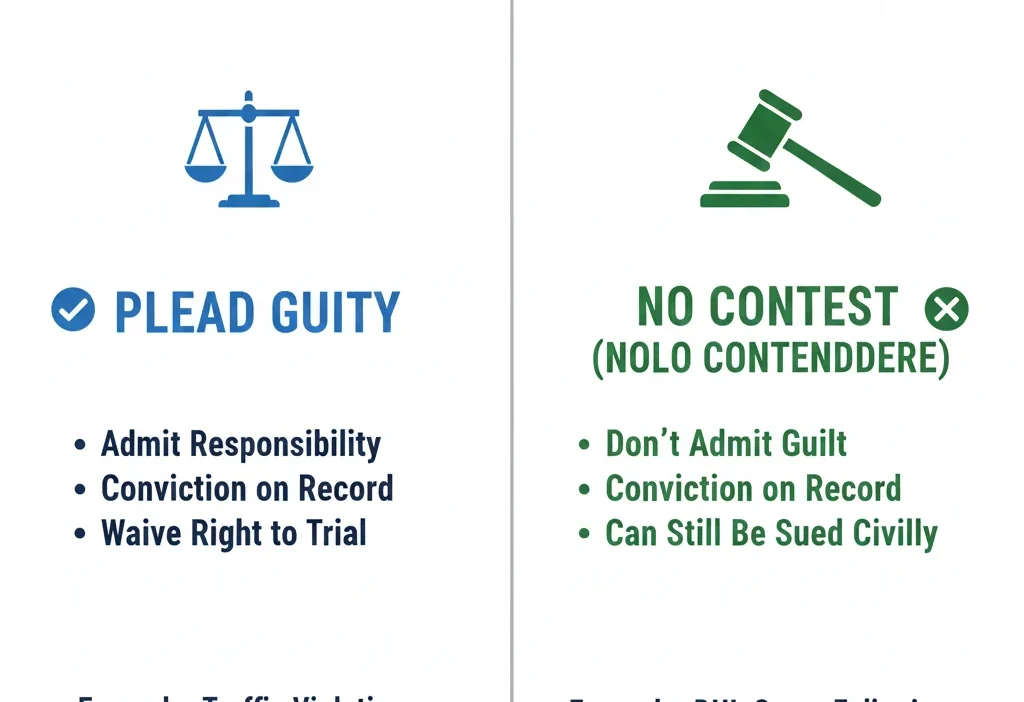
What Does “Plead Guilty” Mean?
Plead guilty means:
👉 You are admitting that you committed the crime.
Part of speech: Verb phrase (legal action)
When you plead guilty, you are saying:
“Yes, I did it.”
Easy Examples:
- Sarah pleads guilty to speeding because she knows she was driving too fast.
- Ali pleads guilty to shoplifting after admitting he took the item.
- The man pleads guilty and accepts the fine from the judge.
Simple story:
Imagine breaking a classroom rule and telling the teacher, “Yes, I broke it.” That is like pleading guilty.
What Does “No Contest” Mean?
No contest (also called nolo contendere) means:
👉 You do not admit guilt, but you accept the punishment.
Part of speech: Legal plea (phrase)
When you plead no contest, you are saying:
“I won’t fight this case, but I’m not saying I did it.”
Easy Examples:
- John pleads no contest to avoid arguing in court.
- Maria pleads no contest to a traffic ticket.
- The driver pleads no contest and pays the fine.
Simple story:
It’s like saying, “I don’t want to argue. I’ll accept the punishment.”
The Key Difference Between Pleading Guilty and No Contest
The biggest difference is admitting guilt.
📊 Comparison Table: Guilty vs No Contest
| Feature | Plead Guilty | Plead No Contest |
|---|---|---|
| Admit the crime? | ✅ Yes | ❌ No |
| Accept punishment? | ✅ Yes | ✅ Yes |
| Used as admission in other cases? | ✅ Yes | ❌ Usually no |
| Common in plea deals | ✅ Yes | ✅ Yes |
| Sounds like saying “I did it” | Yes | No |
⭐ Quick Tip to Remember
- Guilty = Admit
- No Contest = No arguing
Are Corn or Flour Tortillas Healthier? The Hidden Difference
Common Mistakes and How to Avoid Them
Many people choose the wrong plea because they don’t understand the difference.
❌ Mistake 1: Thinking Both Are Exactly the Same
✔️ Fix: Guilty admits fault. No contest does not.
❌ Mistake 2: Pleading Guilty Without Knowing the Future Impact
✔️ Fix: Guilty pleas can be used against you later in civil cases.
❌ Mistake 3: Thinking No Contest Means “Not Guilty”
✔️ Fix: No contest still leads to punishment.
Wrong: “No contest means I’m free.”
Correct: “No contest means I accept punishment.”
When to Plead Guilty
You may consider pleading guilty when:
- You clearly committed the crime
- You want to show responsibility
- The deal offers a lighter sentence
- There is no risk of civil lawsuits
Real-Life Examples:
- A student admits cheating and accepts punishment.
- A driver admits speeding to reduce court time.
- Someone pleads guilty to receive a lower fine.
- A person wants to finish the case quickly.
- Evidence against them is very strong.
Simple idea:
If you did it and want to move on, pleading guilty may help.
When to Plead No Contest
You may consider pleading no contest when:
- You don’t want to admit guilt
- A civil lawsuit may follow
- You want to avoid a long trial
- Your lawyer suggests it
Easy Examples:
- A driver pleads no contest to avoid insurance problems.
- A business owner pleads no contest to protect reputation.
- Someone accepts punishment without admitting fault.
- A person wants the case over quietly.
- The plea avoids future legal trouble.
🧠 Memory Hack:
👉 No Contest = No Confession
Quick Recap: Plead Guilty vs No Contest
- Plead Guilty
- Admit the crime
- Accept punishment
- Can affect future cases
- Plead No Contest
- Do not admit guilt
- Accept punishment
- Usually safer for civil cases
Simple rule:
If admitting guilt could hurt you later, no contest may be better.
Advanced Tips
History
- No contest comes from Latin: nolo contendere
- It means “I do not wish to fight”
Formal Use
- Courts use both pleas in criminal cases
- Lawyers often suggest the safer option
Texting & Online Writing
- Using “no contest” incorrectly can confuse meaning
- Always understand legal terms before using them
Mini Quiz: Test Your Understanding ✅
Fill in the blanks:
- Pleading ______ means admitting the crime.
- Pleading ______ avoids saying you did it.
- No contest still accepts ______.
- Guilty pleas can affect ______ cases later.
- No contest is often safer when a ______ lawsuit is possible.
(Answers: guilty, no contest, punishment, civil, civil)
FAQs
1. Is it better to plead guilty or no contest?
It depends on your situation. No contest is often safer if civil lawsuits are possible.
2. Does no contest mean not guilty?
No. It means you accept punishment without admitting guilt.
3. Will no contest remove charges?
No. The court still gives punishment.
4. Is pleading guilty faster?
Yes, guilty pleas often finish cases quicker.
5. Should I talk to a lawyer before choosing?
Yes. Always get legal advice before pleading.
Conclusion
So, is it better to plead guilty or no contest? Now you know the real answer. Pleading guilty means admitting the crime. Pleading no contest means staying quiet but accepting punishment. Both lead to legal consequences, but they affect your future differently.
Understanding the difference can protect your rights and help you make smarter choices. Always think carefully, learn the meaning, and ask for professional advice when needed.

Gwendoline Riley delivers clear, compelling insights into language and usage, helping readers understand meanings, nuances, and differences with confidence.