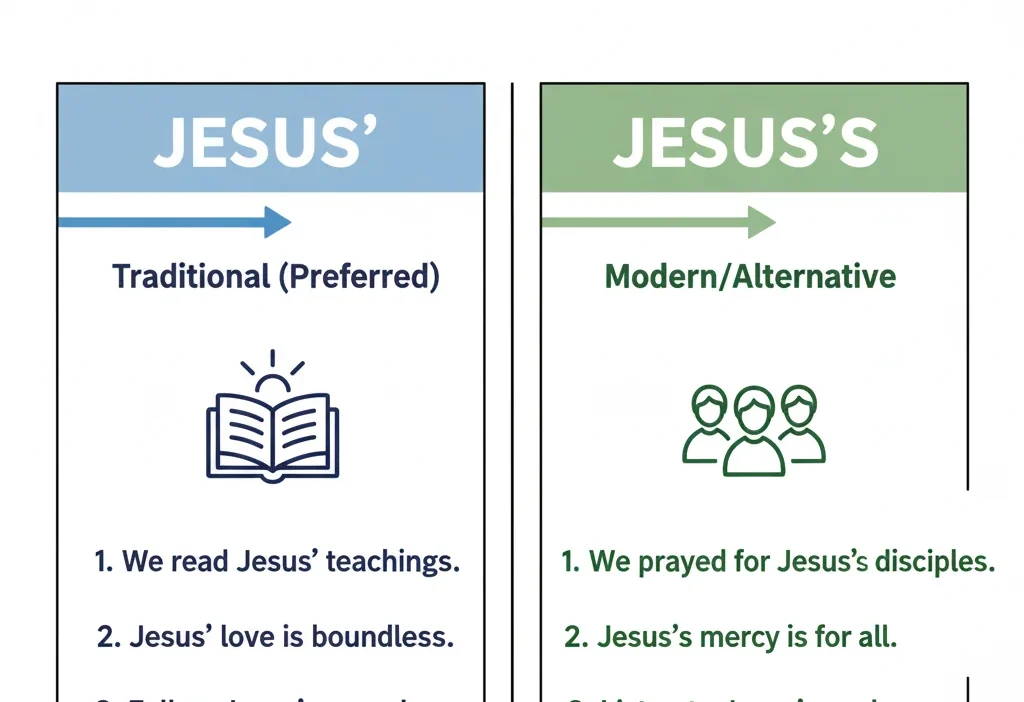
“Use ‘Jesus’s’ to show singular possession, though some style guides allow ‘Jesus’’; both are correct depending on context, style, and consistency.”
Confused about whether to write Jesus’ or Jesus’s? You’re not alone. These are possessive forms of the name Jesus, and the correct form depends on grammar rules, style guides, and context. Using the wrong form can make writing look inconsistent or unpolished, especially in religious, academic, or formal texts.
- “Jesus’s” is the standard singular possessive, following modern grammar rules by adding ‘s’ to singular nouns:
“Jesus’s teachings inspire millions around the world.” - “Jesus’” is an alternative form, often used in traditional or religious writing:
“Jesus’ disciples followed him faithfully.”
⚠️ Tip: Both forms are generally accepted, but the key is consistency throughout your writing. Most modern style guides (Chicago, APA) prefer Jesus’s, while older texts or certain religious publications use Jesus’.
Using the correct form ensures your writing is clear, professional, and grammatically accurate.
In this article, you’ll also find:
- Common mistakes people make with Jesus possessives
- Tips to remember which form to use
- Practical examples in religious, academic, and casual contexts
By the end, you’ll confidently know how to use Jesus’ and Jesus’s correctly, making your writing polished, consistent, and mistake-free.
What Does Each Form Mean?
Let’s start by understanding what both Jesus’ and Jesus’s mean.
Both are possessive forms of the name Jesus, showing that something belongs to Him. The only difference is how they’re written and pronounced.
1. Jesus’
This form adds only an apostrophe (’) after the s.
It is often used in traditional or religious writing to show respect and avoid awkward pronunciation.
Examples:
- We follow Jesus’ teachings every Sunday.
- The church celebrates Jesus’ resurrection in April.
- They sang songs in Jesus’ name.
2. Jesus’s
This form adds apostrophe + s (’s) after the name.
It follows the modern English grammar rule for possessives — add ’s to most singular nouns, even if they end in s.
Examples:
- Jesus’s disciples were twelve in number.
- The story of Jesus’s miracles inspires millions.
- We pray in Jesus’s love and mercy.
👉 Both mean the same thing — something belonging to Jesus — but their usage depends on writing style or tradition.
The Key Difference Between Jesus’ and Jesus’s
Here’s a simple comparison table to make it clear:
| Feature | Jesus’ | Jesus’s |
|---|---|---|
| Grammar Style | Traditional or Biblical | Modern or Standard |
| Rule | Add only an apostrophe (’) | Add apostrophe + s (’s) |
| Pronunciation | “Jee-zus” | “Jee-zus-iz” |
| Common In | Religious writing, older texts | Modern writing, schools, media |
| Example | Jesus’ followers | Jesus’s followers |
Quick Tip to Remember:
If you’re writing something religious or biblical, use Jesus’.
If you’re writing in modern English or essays, use Jesus’s.
210+ People’s vs Peoples’ Difference in English Grammar 📚 2025
Common Mistakes and How to Avoid Them
Let’s look at some common errors people make:
❌ Incorrect: Jesus teachings were about love.
✅ Correct: Jesus’ teachings were about love.
❌ Incorrect: The story about Jesus miracles inspired them.
✅ Correct: The story about Jesus’s miracles inspired them.
Why the mistake happens:
People often forget the apostrophe because they think names ending in s don’t need it. But even for names like James, Thomas, or Jesus, the possessive form must include the apostrophe — either ’ or ’s.
How to fix it:
👉 Always check if the name owns something.
If it does, add ’ or ’s depending on your style.
When to Use Jesus’
Use Jesus’ when you’re writing in a formal, religious, or biblical context.
It’s common in church literature, prayers, or classic translations of the Bible.
Examples:
- Jesus’ parables teach kindness and forgiveness.
- The cross is a symbol of Jesus’ sacrifice.
- Jesus’ compassion touched many hearts.
- They gathered to celebrate Jesus’ birth.
- The painting shows Jesus’ last supper.
🕊 Memory Hack:
If your writing feels holy or traditional, choose Jesus’ — it’s shorter and used by most churches.
When to Use Jesus’s
Use Jesus’s in modern English writing, like essays, newspapers, or school work.
Most grammar experts and modern style guides, including The Chicago Manual of Style and APA, prefer ’s even for names ending with s.
Examples:
- Jesus’s message focuses on love and peace.
- I read a story about Jesus’s miracles.
- Jesus’s words give us strength in hard times.
- The painting shows Jesus’s crown of thorns.
- We learned about Jesus’s journey in history class.
💡 Memory Hack:
If you want your writing to sound modern and academic, use Jesus’s.
Quick Recap: Jesus’ vs Jesus’s
Let’s summarize everything simply:
- Both mean “belonging to Jesus.”
- Jesus’ → traditional, often used in church or religious writing.
- Jesus’s → modern, used in everyday English and school essays.
- Both are correct! Choose based on your writing style or audience.
- Always remember: no matter which you choose, stay consistent throughout your text.
✅ Quick Example:
- Traditional: We celebrate Jesus’ birth every year.
- Modern: We celebrate Jesus’s birth every year.
210+ Parents’ vs Parent’s Grammar Difference 📚 2025 English Help
Advanced Tips: Grammar, History, and Style
📜 Origin and Grammar Rule
In ancient English, writers avoided double “s” sounds at the end of words, so they dropped the extra “s.” That’s why older versions of the Bible used Jesus’.
Modern grammar rules later standardized possessives as apostrophe + s, giving us Jesus’s.
🏛 Style Guides Today
- Chicago Manual of Style: prefers Jesus’s
- Associated Press (AP): prefers Jesus’
- Oxford/APA: allow both — just be consistent.
💬 Real-Life Writing
- In religious books, you’ll often see Jesus’ teachings.
- In school essays or modern books, you might find Jesus’s love.
💻 Online Writing Tip
Search engines and readers accept both, but Jesus’s fits modern SEO and grammar standards better.
Mini Quiz: Test Your Understanding!
Fill in the blanks with Jesus’ or Jesus’s.
- We read about _____ miracles in Sunday school.
- The story of _____ birth is in the Bible.
- _____ disciples followed Him everywhere.
- The painting shows _____ crucifixion.
- People pray in _____ name for strength.
✅ Answers:
- Jesus’s (modern)
- Jesus’ (traditional)
- Jesus’s
- Jesus’
- Jesus’s
FAQs About Jesus’ vs Jesus’s
1. Is Jesus’ correct grammar?
Yes! It’s the traditional possessive form of Jesus, commonly used in religious writing.
2. Is Jesus’s also correct?
Yes. Modern grammar accepts Jesus’s as correct, especially in academic or general English writing.
3. Which should I use in essays?
Most schools prefer Jesus’s, following modern style guides.
4. Why do some people avoid writing Jesus’s?
Because it sounds like an extra “iz” at the end, and older grammar avoided that sound.
5. Can I use both in the same text?
No. Choose one and stay consistent for a polished, professional look.
Conclusion
Now you know the difference between Jesus’ and Jesus’s, when to use each, and how to avoid common mistakes.
Both are grammatically correct — your choice depends on whether you prefer a traditional or modern style.
Keep practicing, read examples, and soon these possessives will feel natural to you. Remember — mastering small grammar rules like this helps you write clearly and confidently every day.

Gwendoline Riley delivers clear, compelling insights into language and usage, helping readers understand meanings, nuances, and differences with confidence.